Author: Fitfortunes yogaways

  • Brahmacharya in Daily Life: Meaning, Practice & Self-Discipline

    Brahmacharya in Daily Life: Meaning, Practice & Self-Discipline

    Brahmacharya in Daily Life: A Yogic Path of Energy Wisdom

    I didn’t grow up hearing the word Brahmacharya. It wasn’t taught in school, and I never heard it on the street. The first time I came across it was in an old yoga book, tucked between other Sanskrit terms that I struggled to pronounce. It sounded serious, almost too strict for my playful personality. I closed the book and moved on.

    But like many things in yoga, Brahmacharya found me again, years later.

    My First Real Encounter with Brahmacharya

    It was a hot summer morning in Rishikesh. I was staying at an ashram, doing my first proper stay in a yogic community. There were no phones allowed, meals were silent, and the day began at 4:30 AM with chants. One of the teachers was giving a talk on the yamas the ethical roots of yoga and when he reached Brahmacharya, he paused.

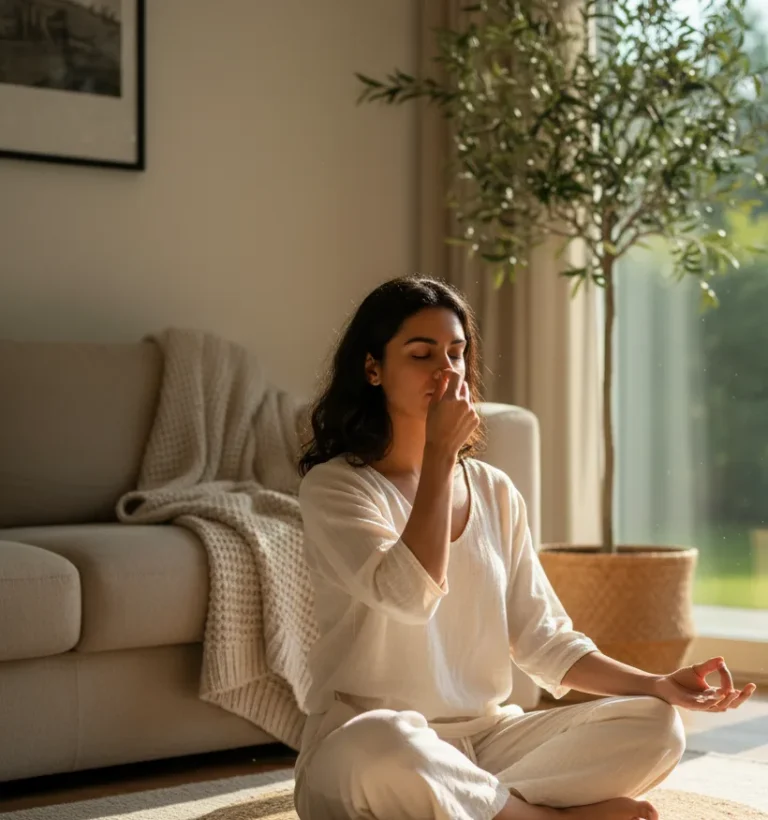
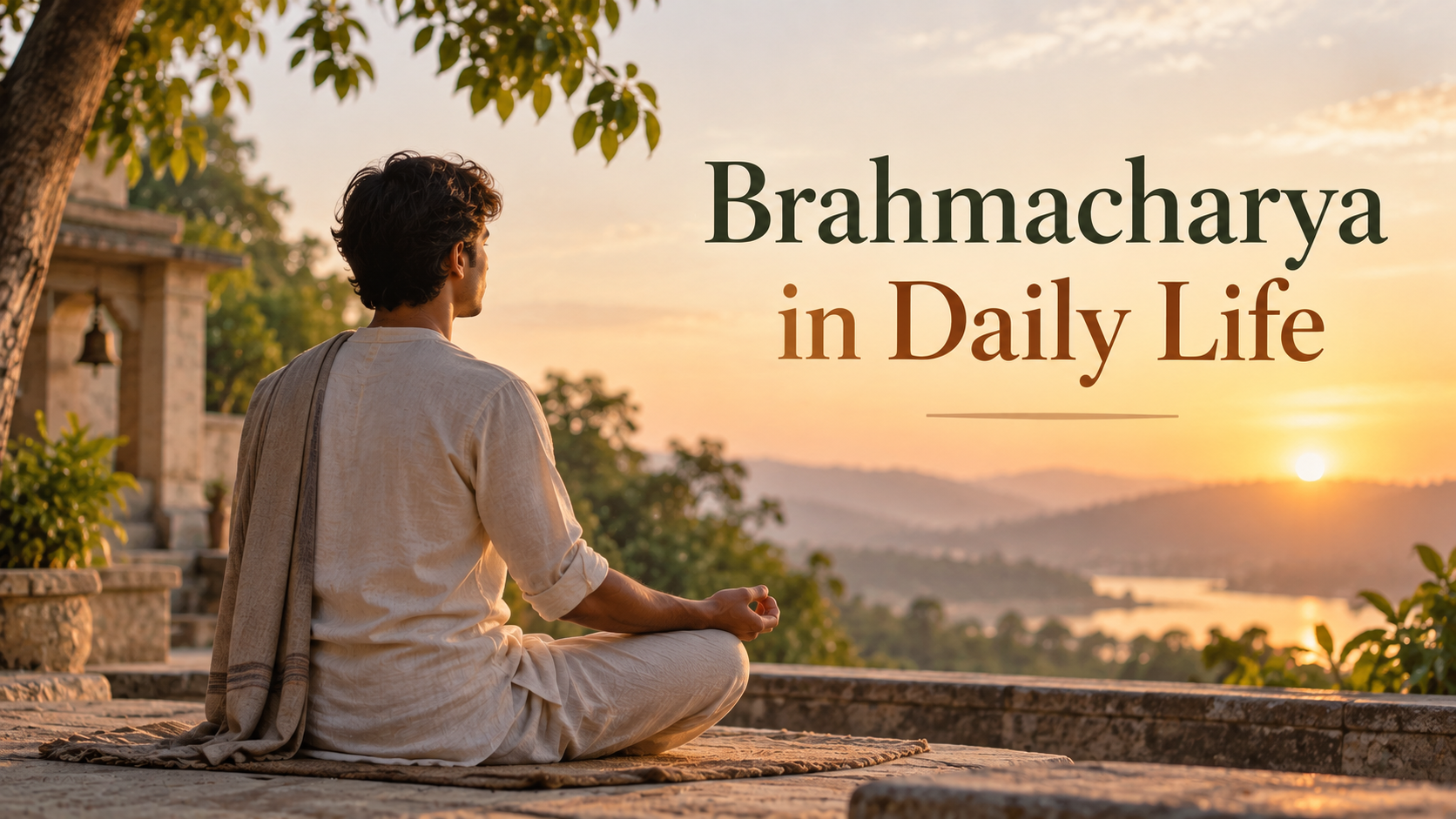
    A yogi practicing Brahmacharya in daily life by meditating outdoors
    Most people, he said, mistake Brahmacharya for just celibacy. But it’s about energy where it goes, what drains it, and how to hold it wisely. He spoke so gently, but it hit me like a quiet slap.

    What Is Meaning of Brahmacharya in Yoga?

    It took me a while to understand. Brahmacharya isn’t about denying yourself joy. It’s about noticing what steals your stillness. It’s not about never enjoying a sweet or touch or thrill it’s about knowing when enough is enough.

    In my life, Brahmacharya started showing up in the small choices. Choosing not to binge-watch something late into the night. Eating one spoon less of dessert when I’m already full. Saying no to conversations that leave me feeling drained.

    Brahmacharya isn’t a one-time vow. It’s a way of walking through the world. Step by step. Moment by moment.

    Brahmacharya in the Yogic Texts Yoga Philosophy

    In yogic texts like the

    Manusmriti and the Upanishads Brahmacharya in Ancient Scriptures

    Brahmacharya is seen as the first stage of life (Brahmacharya Ashrama) a time of study, discipline, and restraint. It is said that conserving sexual energy leads to increased Ojas (vital life force), which supports mental clarity and spiritual power.

    Brahmacharya and Self-Mastery in the Bhagavad Gita

    The Bhagavad Gita does not mention Brahmacharya by name, but its spirit runs through Krishna’s teachings. When Arjuna breaks down in battle, Krishna urges him to act with awareness and steady mind. He speaks of self-control, discipline, and inner focus. These are core aspects of Brahmacharya. Krishna teaches that desire clouds the mind. Stillness brings clarity. He says, “Yoga is skill in action” a reminder that wise, focused living is true strength. Brahmacharya, in this light, is not about withdrawal. It’s about choosing where your energy goes moment by moment.

    Swami Sivananda on Brahmacharya and Vital Energy (Ojas)

    “Swami Sivananda called Brahmacharya the root of true strength. Not just strength in body, but in spirit too. He believed our sexual energy is sacred. When wasted, it weakens. When preserved, it becomes Ojas the inner fire.
    Ojas gives us clarity, willpower, and calm. It makes deep meditation possible. It supports peace of mind. Swami Sivananda often said, “Without Brahmacharya, no spiritual growth is possible.” In simple terms, he showed that Brahmacharya builds power not by force, but by wise living.”

    Practicing Brahmacharya in Daily Life

    At first, I only thought of it in terms of sex. That’s how most people frame it. But over time, I noticed it also meant being mindful of where my attention was going. Was I scrolling endlessly, avoiding feelings? Was I eating for energy, or out of boredom? Was I gossiping just to feel important? These were harder questions than I expected. And when I began to answer them honestly, I saw how much energy I was leaking every day.

    Energy as Sacred Fuel

    Yoga taught me something simple but powerful energy is precious. We only have so much of it each day. And most of us spend it all without even realizing it.

    When I started to practice Brahmacharya gently not as a rule but as a friend I found I had more focus. I was less reactive. I didn’t snap at the traffic or sigh at the dishes. I started to enjoy the quiet again.

    That was the biggest shift. Learning to enjoy stillness.

    Practical Brahmacharya: Small Choices, Big Shifts

    In the modern world, Brahmacharya is not about isolation. It’s about presence. I started to make simple changes:

    • Turning off notifications after 8 PM

    • Taking quiet walks without headphones

    • Eating slowly, without screens

    • Saying no to gossip

    • Choosing conscious speech

    • Taking regular tech breaks

    These things sound simple, but they help me feel whole.

    Brahmacharya and Yogic Food Habits

    What we eat also impacts our pranic energy. Heavy, spicy, oily foods can overstimulate the senses. I moved toward sattvic food fresh, light, seasonal meals. Eating with awareness became a form of Brahmacharya.

    Fewer cravings. More calm.

    Speak Less, Speak Mindfully

    Every time I speak unnecessarily, I lose energy. I began to practice mindful silence. Observing my words before they left my mouth. Replacing chatter with presence.

    This helped me listen more. Connect deeper. And speak with intention.

    Conscious Relationships Through Brahmacharya

    You don’t need to live in isolation to follow Brahmacharya.
    Even within relationships, it’s about awareness staying present, not possessive. It means honoring boundaries, listening with attention, and not seeking validation from chaos. Love grows deeper when your energy isn’t scattered. Presence is the real intimacy.

    In close relationships, we often lose energy trying to control, fix, or chase. But when you come from a place of stillness, you relate differently.
    You start to notice your triggers instead of reacting blindly.
    You offer your presence instead of your exhaustion. Brahmacharya reminds us to share love, not drain it.
    To speak when needed, not to fill the silence. To hold space, even when emotions rise. It’s not about withholding affection. It’s about letting your energy support the bond, not blur it. That’s when connection becomes sacred, not scattered.

    Vital Energy and Modern Life

    Yes, Brahmacharya includes celibacy for some. But for most of us, it’s about mastery not suppression. It’s about understanding the power of sexual energy and choosing when and how to express it. I learned that it’s okay to have desire. It’s human. But when I’m not run by it, I feel stronger inside.

    A Real Moment That Changed Me

    One night during a retreat I was teaching, a student came to me in tears. She said she felt guilty about her choices, her past, her patterns. She had read about Brahmacharya and felt she could never live up to it.

    I told her what my teacher told me: “It’s not about becoming perfect. It’s about learning where you give your power away.”

    We sat in silence for a while. Then she said, “I think I’m ready to stop running.”

    That’s when I knew Brahmacharya had truly entered my life not as a rulebook, but as a rhythm.

    What I’ve Learned from my Celebic Practice

    After four years of practicing yoga and writing about it, I’ve seen how misunderstood Brahmacharya is. It’s not about denial. It’s about direction.

    When your energy is scattered, you feel tired no matter how much you sleep. When it’s steady, you feel strong, even when life gets tough.

    My Personal Benefits of Brahmacharya:

    • Deeper, more restful sleep

    • Sharper mental focus and clarity

    • Calmer nervous system and reduced anxiety

    • Improved self-awareness and emotional stability

    • More creative flow, without mental fatigue

    • Stronger body-mind connection during yoga practice

    • Freedom from impulsive cravings and emotional eating

    • Healthier relationship with sexuality and intimacy

    • Less reactivity, more conscious response to life

    • Greater joy in simple, everyday moments

    • Speech becomes more meaningful and intentional

    • Energy feels centered instead of scattered

    • Inner confidence and quiet self-respect

    • Better digestion and bodily awareness

    • More consistent spiritual practice without burnout

    And above all, it’s taught me to slow down.

    Final Thoughts: Where I Stand Now

    Walking with Brahmacharya has been slow and sometimes messy. But it has taught me how to pause, how to notice when I’m reaching outside myself for comfort, and how to gently turn inward instead.

    It’s not about being perfect it’s about being honest with where your energy is going.

    Each day, I try to make choices that leave me feeling steady, quiet inside, and a little closer to the person I want to be. And that, I suppose, is what Brahmacharya has quietly given me a kind of steadiness that doesn’t shake so easily anymore.

    Common Questions About Brahmacharya

    Is Brahmacharya only about celibacy?
    No. While celibacy is one aspect, Brahmacharya is more about conserving energy and living with focus.

    Can you follow Brahmacharya without being a monk?
    Absolutely. It’s for everyone. It means making mindful choices in everyday life.

    How do I practice Brahmacharya in daily life?
    Start small limit distractions, observe cravings, and notice what drains you emotionally and mentally.

    What are some signs I’m practicing Brahmacharya well?
    You’ll feel more focused, less reactive, and more at peace. It’s subtle but powerful.

    Does Brahmacharya mean I should avoid all pleasure?
    No. It’s about balance. Enjoy life, but stay aware of when pleasure turns into compulsion.

    Can I still have a family and follow Brahmacharya?
    Yes. It’s not about cutting off love or connection. It’s about living consciously.

    Is Brahmacharya relevant in the modern world?
    More than ever. In a noisy, fast world, learning to hold your energy is a quiet strength.


    If you’re reading this, thank you for walking a little of this path with me. We may not be perfect practitioners, but we’re sincere ones. And that, to me, is enough.

    Join our Yoga Teacher Training program in India and explore the deeper roots of yoga like Brahmacharya, Ayurveda, and Yogic Food habits.
    Find your inner stillness. One breath at a time.
  • Best Yoga Teacher Training in the World: How to Choose

    Best Yoga Teacher Training in the World: How to Choose

    I didn’t set out looking for the best yoga training in the world.

    All I wanted was to go deeper. Not into handstands or perfect posture. Just deeper. Into myself. Into the roots of what yoga really is.

    I had been practicing for years, mostly alone, sometimes in small group classes. But something kept tugging at me. As if I was only touching the surface. I wanted more than poses. I needed the why behind them. I wanted to understand what this ancient thing really meant.

    So I packed my bags and went searching.

    The First Clue

    A friend once said, “If you’re serious, go to India.” So I did. Not because it was trendy. Just because it felt right. I chose Rishikesh, not after reading reviews, but because I saw a picture of the Ganga river at sunrise. And it moved me. That was enough.

    When I arrived, it wasn’t glamorous. The guesthouse was simple. My bed creaked. The food was bland some days. But each morning, as the sun lit the hills, I felt I was exactly where I needed to be.

    A Room Full of Strangers in TTC

    The training started with silence. Not instructions. Just silence. Many of us, sitting cross-legged in a hall, not knowing what would come next. That was the beginning.

    Our teacher, a wiry man with a soft voice and stern gaze, welcomed us. He said yoga was a mirror. That whatever we ran from would eventually show up on the mat. I didn’t fully get it. But I wrote it down.

    We began every day at 5:30 a.m. with kriyas breathwork I had never done before. Neti pots, kapalabhati, and deep breathing that made my whole body hum. At first, I felt awkward. But over time, I felt awake in a new way.

    Not Just Asanas

    We did asana practice, yes. Hatha in the morning. Vinyasa in the evening. But the postures were only part of it.

    Mid-mornings were for anatomy taught by a cheerful guy from Kerala who could name every bone like it was a poem. Afternoons were for philosophy long sessions sitting on thin mats, reading the Yoga Sutras in Sanskrit, then slowly breaking down their meaning.

    Some of it went over my head. But slowly, lines started sticking. Ideas about non-violence. About discipline. About contentment not the Instagram kind, the quiet kind.

    The Hard Days

    It wasn’t all bliss. Some mornings, my body ached. My back cramped. My mind raced. There were days I wanted to skip class. Days I questioned everything. “Why am I here?” “Who am I to teach anyone?”

    But those were also the days something shifted. In savasana, tears would come without warning. Not from pain. Just from release. Grief I didn’t know I carried. Relief I didn’t know I needed.

    A teacher told me, “You’re not here to become someone new. You’re here to meet who you already are.” I held onto that.

    Meals and Moments

    Lunches were simple dal, rice, sabzi. Eaten in silence. I used to rush meals. Now I chewed slowly. Tasted everything.

    Evenings we had satsang not sermons, but storytelling. Our teachers told us of their gurus, their doubts, their lives before yoga.

    We laughed. We cried. We passed around ginger tea and spoke about fear like it was an old friend.

    What Made It “The Best”

    It’s funny. No one in that training called it the best. There were no five-star ratings or promises.

    But it was the best yoga training in the world for me because it was honest. Because it didn’t try to sell me anything. Because the people there believed in yoga as a way of living, not just something to perform.

    We learned mantra chanting. We sat in fire ceremonies. We got mosquito bites during meditation. But every moment felt full. Real. Whole.

    And slowly, I changed. Not into a better version of myself. Just into a quieter, more observant one.

    After the Certificate

    When I got my 200-hour certificate, it didn’t feel like an ending. More like a beginning. I didn’t rush to open a studio or start a brand. I just went home and began teaching small classes.

    Sometimes in parks. Sometimes online. Sometimes just for one person who needed it.

    I spoke not from authority, but from experience. I taught breathing before bending. Listening before leading. Being before doing.

    Things No One Told Me

    Yoga training isn’t about mastering the body. It’s about noticing. How you sit. How you speak. How you avoid. How you hold tension.

    The best training gives you tools, yes but more than that, it gives you pause.

    It makes you look. Not outside. But in.

    Final Thoughts From My Mat

    It’s been years since that training, and still, each day I return to the mat, I learn something new.

    The world is full of yoga schools now. Fancy ones. Affordable ones. Online and offline. And while that’s a beautiful thing, I’ll say this:

    The best yoga training in the world is the one that makes you feel less like a student and more like a seeker.

    One that humbles you.

    One that reminds you that yoga isn’t about perfection but presence.

    And if you find a place like that, don’t worry if the bed is hard or the food is bland.

    Stay.

    You’ll be fed in ways you didn’t know you were hungry.

    FAQs – Honest Answers About Yoga Training

    Is a 200-hour training enough to teach?
    Yes if you continue learning. It gives a solid base, but the real teaching comes from your own daily practice.

    What if I’m not flexible?
    Doesn’t matter. Yoga is about the mind and breath, not touching your toes.

    Should I go to India for training?
    If you’re drawn to it, yes. Not because it’s better but because it connects you to the roots.

    Can I do it online?
    You can learn online, sure. But the depth, community, and subtle teachings are often stronger in-person.

    Will it change me?
    Probably. But not overnight. It’s a slow shift. You may just find yourself noticing things you once ignored.

    What kind of yoga is best to study?
    Start with Hatha or traditional styles. They’re slower, steadier, and give you the foundation.

    Is it okay to feel lost during training?
    Completely. Feeling lost often means you’re growing. Ask questions. Be kind to yourself.

    If you’re thinking about taking a yoga training, just begin. Not to become a teacher. Not to chase anything. Just to remember who you are.

    Upcoming Traditional Multi-Style 200 Hour Yoga Teacher Training

    Upcoming Traditional Multi-Style 200 Hour Yoga Teacher Training

    Date Shared Room Book Private Room Book
  • How a Yoga Course for Good Health is Important

    How a Yoga Course for Good Health is Important

    I never planned to take a yoga course for good health. Like most people, I thought yoga was just about stretching. Something you do when you want to look calm on Instagram. But life, in its funny way, had other plans.

    The Day My Body Said ‘Enough’

    It started with back pain. Nagging, low, and always there. I’d sit at my desk all day, hunched over a laptop, sipping endless cups of tea. Every evening, I’d tell myself I’d stretch. Every morning, I’d forget. One day, while tying my shoe, my lower back seized up. That moment changed everything.

    A friend gently suggested I try a yoga class. Not for flexibility. Not for Instagram. Just for health. Simple, daily health.

    Beginning My First Yoga Course

    I remember my first day. The yoga mat smelled new, the room was quiet, and I was nervous. But the teacher smiled in that way yoga teachers do — not forced, not fake. Just present.

    She introduced us to Hatha Yoga, one of the slower styles. Perfect for beginners, she said. We learned basic poses Tadasana, Balasana, and gentle spinal twists. Nothing fancy. But by the end of that one hour, my body felt.. lighter. Not healed, but hopeful.

    That hope kept me coming back.

    Yoga for Physical and Mental Health

    Within weeks, something subtle shifted. My back pain didn’t vanish, but it dulled. More surprising was how my breathing changed. I didn’t even realize I’d been breathing shallowly for years.

    Through Pranayama the breathing techniques I began to notice moments of stillness. My heart raced less. I felt less irritated in traffic. My digestion improved. Sleep came easier.

    These weren’t miracles. They were side effects of showing up every day. Of moving with intention and breathing with awareness.

    Why a Yoga Course is Different from a YouTube Video

    Before the course, I tried random videos online. Some helped. Most overwhelmed me. What made the course special was structure. We had a routine. A daily yoga practice schedule.

    It was also the presence of the teacher. She noticed how I held tension in my jaw. She offered props when I couldn’t touch my toes. She didn’t push. She observed.

    We learned about yogic anatomy, mind-body connection, and even a bit of Ayurveda. Our teacher reminded us often: “Yoga isn’t a workout. It’s a way to be kind to your body.”

    Small Wins That Matter

    I remember the day I held Vrikshasana (Tree Pose) for ten full breaths without wobbling. Or when I sat in Sukhasana for an entire meditation without my legs falling asleep.

    These moments felt small, but they mattered. Each one told my body, “I hear you. I respect you.”

    The course also included a Sattvic meal discussion. We weren’t forced into diets, but encouraged to eat light, seasonal, and with gratitude. Eating mindfully changed my energy levels more than any supplement ever did.

    Meeting People on the Same Path

    One unexpected joy was the people I met. A retired teacher, a young college student, a mother of three all attending the same course. Each of us came for our own reasons: chronic pain, stress, or simply curiosity.

    In sharing our stories, we built something rare a community. We weren’t competing. We were learning to listen. To ourselves and each other.

    Ancient Wisdom, Modern Life

    Our teacher often quoted from Patanjali’s Yoga Sutras. Not in a preachy way, but like a grandparent sharing wisdom over morning tea.

    One line stayed with me:“Yogas chitta vritti nirodhah” Yoga is the stilling of the mind.

    Over time, this made sense. Not just intellectually. But viscerally. I understood it on days when I’d sit in meditation, thoughts swirling, then suddenly quiet.

    Why Yoga is More Than Just Poses

    Sure, we practiced Asanas. But we also explored Dhyana (meditation), Yamas and Niyamas (ethical guidelines), and how to integrate yoga into daily life. It wasn’t about being perfect. It was about being present.

    We learned how simple habits waking early, drinking warm water, walking barefoot on grass could be yogic practices.

    Can a Yoga Course Really Improve Health?

    Yes. But maybe not in the way you expect.

    Yoga didn’t “cure” my pain overnight. It taught me how to listen to my pain. It didn’t erase stress, but it gave me tools to meet stress with clarity.

    Over time, I became more flexible physically and mentally. My immunity improved. I got sick less. My posture got better. My inner voice got kinder.

    And all of this started with one yoga course for good health.

    Who Can Join a Yoga Course?

    Anyone. Truly.

    You don’t need to be fit, flexible, or spiritual. You just need to be curious. Whether you’re a beginner, a senior, a busy professional, or someone simply tired of feeling tired there’s a style for you: Yin Yoga, Chair Yoga, even online yoga classes if you can’t travel.

    Pick a teacher who feels genuine. One who meets you where you are.

    Final Reflections

    If you’re reading this, maybe your body is whispering something too. Maybe you’re carrying stress in your shoulders or tension in your gut.

    A yoga course won’t fix everything. But it might help you see clearly. Breathe easier. Stand taller.

    And that’s a pretty good place to begin.

    FAQ – Yoga Course for Good Health

    1. Do I need to be flexible to start a yoga course?
      Not at all. Yoga meets you where you are. Flexibility comes with time.
    2. How often should I practice for real benefits?
      Even 20 minutes a day can create change. Consistency matters more than intensity.
    3. What if I have an injury or health condition?
      Tell your teacher. They can modify poses or suggest therapeutic yoga options.
    4. Is yoga just stretching?
      No. It includes breathing, mindfulness, ethical living, and much more.
    5. Can yoga help with stress and anxiety?
      Yes. Breathing techniques and gentle movement are deeply calming for the nervous system.
    6. What kind of yoga is best for health and wellness?
      Hatha Yoga, Restorative Yoga, and gentle Vinyasa are great for overall well-being.
    7. Can I learn yoga online?
      Yes, but choose structured courses or live classes for guidance and support.

    Thanks for spending this time with me. If this touched something in you, maybe it’s time to roll out a mat. Gently. Honestly. With heart.

    A Good Yoga Course Should Leave You With a Routine

    Course featureWhy it matters
    Clear progressionHelps beginners build consistency
    Teacher feedbackSupports safer practice choices
    Simple home planMakes practice easier after the course ends

    Next Steps

    Compare weekly yoga frequency, daily posture practice, and beginner poses.

    Build a Routine You Can Continue

    Choose a course that leaves you with a realistic home practice rather than a routine that only works inside the classroom.

    Track Progress by Consistency

    Notice whether you are practising more regularly, moving with less unnecessary effort, and understanding your own limits better.

  • Face Yoga Exercises: Do They Work? Benefits, Limits and a Beginner Routine

    Face Yoga Exercises: Do They Work? Benefits, Limits and a Beginner Routine

    Face yoga exercises are gentle movements and awareness practices for the muscles of the face, jaw, and neck. They may help you notice tension and use facial muscles more deliberately, but the evidence for anti-ageing claims is still limited. One small study found modest changes in cheek fullness after a long exercise program, while newer reviews say the research is too small and mixed to promise reliable facial rejuvenation. Face yoga cannot be expected to burn face fat, remove a double chin, erase wrinkles, or replace dental, dermatology, or medical care. The most useful way to approach it is as mindful movement with realistic expectations.

    In this guide

    What is face yoga?

    “Face yoga” is a modern name used for facial exercises, controlled expressions, gentle massage, posture work, and awareness of tension around the jaw, eyes, forehead, cheeks, and neck. Different teachers use very different routines. Some focus on appearance, while others use the practice mainly to notice habitual clenching or effort.

    It is important not to rewrite yoga history to make the trend sound older than it is. Classical yoga texts do not describe the modern face-yoga routines commonly shown online today. Traditional Indian practices do include subtle movement, breath, concentration, and awareness of small parts of the body, so there can be a useful similarity in attitude. That does not mean every modern facial exercise should be presented as an ancient yogic technique.

    For a yoga practitioner, the sensible connection is awareness. We often notice tight shoulders but ignore a hard jaw, raised eyebrows, pressed lips, or a tongue held with unnecessary tension. A few minutes of gentle facial movement can become a way to observe these habits without turning the mirror into a place for judging your appearance.

    Face yoga exercises for beginners
    Face yoga is best approached as gentle facial movement and awareness, not as a promise of instant cosmetic change.

    Does face yoga really work?

    The short answer is: possibly for some limited changes, but the evidence is not strong enough for big promises. A widely discussed 2018 JAMA Dermatology pilot study taught 32 facial exercises to middle-aged women. Sixteen participants completed the 20-week program. Blinded raters found improved upper and lower cheek fullness and a lower estimated age at the end of the study.

    Those results are interesting, but the study had major limits. It was very small, included only middle-aged women, had many dropouts, and had no control group. That means we cannot confidently say the exercises alone caused the changes or that the same results would happen for men, younger people, older adults, or people following a different routine.

    A more recent systematic review of conservative facial rejuvenation methods looked at facial exercises, myofunctional methods, and massage. Some studies reported improvements in specific areas, but the review found that the evidence remained unclear because the studies were small and used different methods and outcome measures. An earlier systematic review reached a similar conclusion: there was not enough high-quality evidence to know whether facial exercises reliably rejuvenate the face.

    Realistic benefits and limits

    Face yoga is easier to use well when you separate what is plausible from what is marketing. Moving a muscle can improve your awareness and control of that muscle. A calm routine may also help you notice when you are clenching the jaw or holding tension around the eyes. Those are reasonable practice goals. Cosmetic outcomes are much harder to predict because facial appearance depends on many things beyond muscle activity.

    What face yoga may help with

    • Becoming more aware of jaw, forehead, cheek, and eye-area tension.
    • Practising gentle control of facial muscles without force.
    • Building a short pause away from screens and habitual expressions.
    • Noticing the connection between posture, breathing, and unnecessary facial effort.
    • Possibly changing muscle fullness in some areas over time, although research is still limited.

    What face yoga cannot reliably promise

    • Spot-reducing fat from the face or under the chin.
    • Permanently sculpting a sharp jawline.
    • Erasing wrinkles or reversing skin ageing.
    • Lifting loose skin in a predictable way.
    • Treating TMJ disorders, migraines, nerve pain, or other medical conditions.
    • Producing the same “before and after” result for every face.

    Facial ageing is affected by skin quality, sun exposure, genetics, changes in fat and bone, hormones, lifestyle, and time. Facial exercises act on only part of that picture. A responsible teacher should say this clearly instead of presenting a dramatic before-and-after photo as proof.

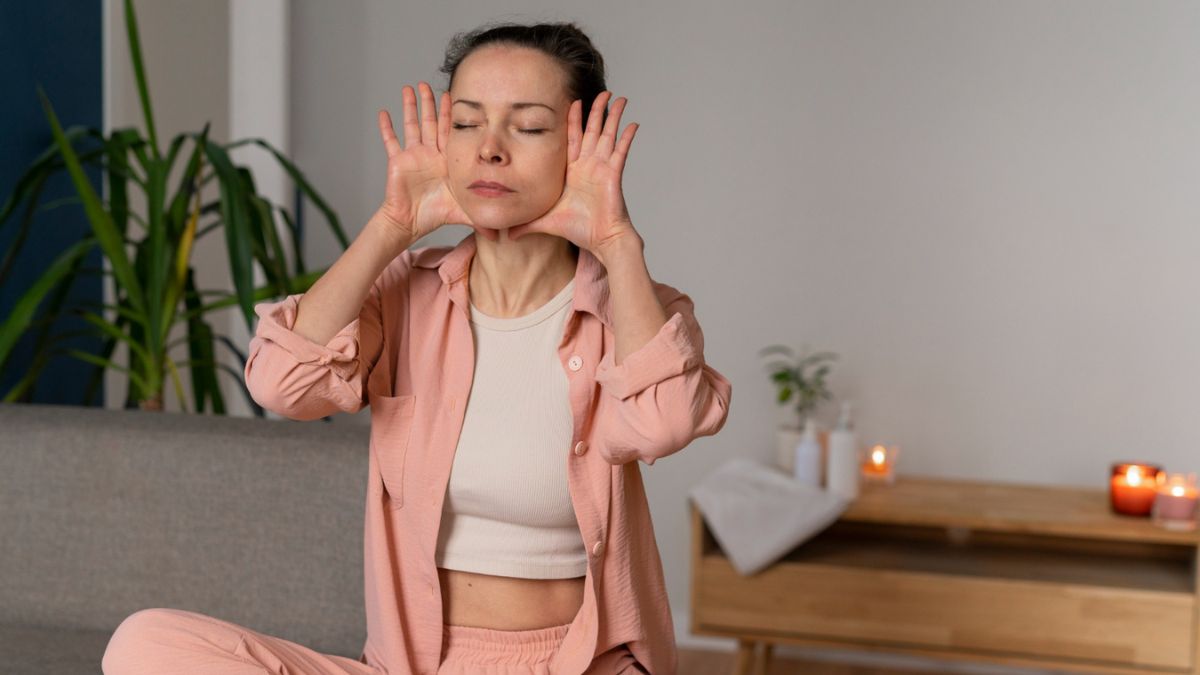
    Relaxed yoga practitioner with a soft face and neutral posture
    Keep the face soft between movements. More effort is not automatically better in face yoga.

    A simple face yoga routine for beginners

    You do not need tools, oils, or a long routine to begin. Start with clean hands and a comfortable seated or standing posture. Use a mirror only if it helps you check that you are not straining. The movements should feel controlled and easy. If an exercise causes pain, clicking, dizziness, headache, numbness, or skin irritation, stop.

    1. Settle the posture

    Let the shoulders drop and bring the head over the ribs instead of pushing the chin forward. Take two or three normal breaths. Notice whether the teeth are pressed together and whether the tongue is tense. Do not force a “perfect” posture. The aim is simply to remove obvious extra effort.

    2. Forehead release

    Place the fingertips lightly on the forehead. Without dragging the skin, notice whether you are lifting the eyebrows. Let the brow soften for several breaths. Then slowly raise and lower the eyebrows a few times with a small range of movement. Finish by relaxing completely.

    3. Eye-area relaxation

    Soften your gaze, blink naturally, then close the eyes without squeezing them shut. Notice the tiny muscles around the eyes. Hold for a few breaths and reopen the eyes gently. Avoid pulling the skin around the eyes or forcing exaggerated expressions.

    4. Gentle cheek activation

    Make a small, comfortable smile and feel the cheeks lift. Hold for two or three seconds, then release fully. Repeat a few times. Keep the jaw loose and avoid clenching the teeth to make the movement stronger.

    5. Jaw release

    Let the lips part slightly and allow a small space between the upper and lower teeth. Slowly open and close the mouth within a comfortable range. The movement should be smooth and quiet. If your jaw clicks, locks, or hurts, do not push through it.

    6. Chin and neck awareness

    Keep the gaze level and make a very small chin nod, as if lengthening the back of the neck. Return to neutral. Repeat gently. This is not a strong neck stretch and it is not a “double-chin remover.” It is simply a way to notice forward-head posture and unnecessary neck effort.

    7. Finish with stillness

    Relax the whole face for about thirty seconds. Notice the forehead, eyes, cheeks, lips, tongue, jaw, and throat. This quiet finish matters because the purpose is not to keep the facial muscles working all day. It is to learn when to use them and when to let them rest.

    If you enjoy this kind of body awareness, it can sit beside a simple meditation practice. Our beginner yoga and meditation guide gives a broader starting point that does not depend on appearance goals.

    Can face yoga define the jawline or reduce a double chin?

    This is one of the most searched questions around face yoga, and it needs a clear answer. There is not good evidence that facial exercises can selectively burn fat under the chin. The body does not normally choose one small area for fat loss just because the nearby muscles are exercised. A double chin can also be influenced by genetics, skin laxity, anatomy, body-fat distribution, and posture.

    Some exercises may make you more aware of head and neck position, and changes in muscle use can alter how the face looks in certain expressions. That is different from proving that face yoga removes submental fat or permanently sharpens the jawline. Be cautious with videos that use lighting, camera angle, facial expression, or short-term swelling changes as “proof” of fat loss.

    Can face yoga reduce wrinkles?

    There is not enough high-quality evidence to say that face yoga reliably removes wrinkles. The small studies on facial exercise mainly look at facial fullness or selected appearance measures, not a guaranteed reduction of every type of line. Wrinkles are affected by repeated expression, skin structure, sun exposure, age, genetics, and loss of volume, so one exercise routine cannot control all of these factors.

    More movement is also not automatically better. Very forceful, repetitive expressions or pulling on delicate skin do not become more effective simply because they feel intense. Keep the range small, avoid aggressive tugging, and treat any cosmetic change as uncertain rather than promised.

    How often should you practise face yoga?

    There is no proven ideal dose. The 2018 pilot study used a demanding 30-minute routine every day for eight weeks and then every other day, but that study was too small to establish a universal prescription. You do not need to copy its schedule to practise responsibly.

    For a beginner, five to ten gentle minutes three to five days a week is a reasonable way to learn the movements and observe how your face and jaw respond. If you feel sore, tense, or irritated afterward, reduce the effort or frequency. Consistency is more useful than making the routine harder.

    Yoga practitioner using calm breathing before a gentle face yoga routine
    A relaxed breath and easy posture are useful preparation. Face yoga should not require forceful breathing.

    Safety and common mistakes

    Face yoga is low-risk for many healthy people when movements are gentle, but the face and jaw are sensitive areas. People with jaw pain or a diagnosed TMJ disorder, recent dental work, facial surgery, facial nerve problems, active skin irritation, or recent injectable cosmetic treatment should get advice from the relevant clinician before starting or changing a routine.

    Do not press through pain or copy extreme movements simply because they are popular online. If an exercise causes a new headache, jaw locking, facial numbness, sharp pain, or persistent discomfort, stop. A wellness practice should not ask you to ignore warning signs.

    Common mistakes to avoid

    • Pulling or stretching the skin aggressively.
    • Clenching the teeth while trying to “work” the jaw.
    • Holding the breath during facial movements.
    • Doing a long routine on the first day because faster results are promised.
    • Treating soreness as proof that the exercise is working.
    • Using filtered or differently lit before-and-after photos as evidence.
    • Turning every look in the mirror into a search for flaws.

    If stress is the main reason you hold tension in the jaw or forehead, a whole-body practice may be more useful than adding more facial exercises. Our guide to yoga styles for stress relief explains several gentler options.

    Face yoga should be about awareness, not fear of ageing

    Face yoga exercises can be a simple way to explore facial movement and tension, but they should come with honest limits. Research gives us a small signal that certain exercise programs may change cheek fullness or other local features, yet it does not support the large promises often made online. If you enjoy the routine, keep it gentle, consistent, and free from pressure. A practice that makes you more aware and comfortable in your face is useful even when it does not produce a dramatic before-and-after photo.

    Frequently asked questions

    Does face yoga really work?

    There is limited evidence that some structured facial exercise programs may change cheek fullness or selected appearance measures. The studies are small and inconsistent, so face yoga cannot be promised as a proven anti-ageing treatment.

    Can face yoga get rid of a double chin?

    There is no good evidence that it can selectively burn fat under the chin. Posture and muscle use may affect appearance, but that is different from proven local fat loss.

    Can face yoga sharpen the jawline?

    It may change muscle awareness or the way you hold the head and jaw, but a permanently sharper jawline is not a reliable or guaranteed result. Bone structure, fat distribution, skin, and genetics also affect the jawline.

    Can face yoga remove wrinkles?

    Current evidence does not show that facial exercises reliably erase wrinkles. Keep expectations modest and avoid forceful pulling or exaggerated repetitive movements.

    How long does face yoga take to show results?

    There is no established timeline because the research is limited and different routines use different methods. Be cautious with anyone who guarantees a visible result in a fixed number of days.

    Can I do face yoga every day?

    A gentle short routine may be comfortable for some people, but daily practice is not required. Start with a few days each week and reduce the frequency if you notice soreness, jaw tension, or skin irritation.

    Do I need a gua sha, roller, or face cream?

    No. Face yoga can be practised without tools. Tools and massage are separate practices with their own techniques and precautions. Clean hands and gentle movement are enough for a basic routine.

    Is face yoga safe if I have TMJ pain?

    Do not assume a general face-yoga routine will treat TMJ pain. Jaw disorders can have different causes, and some exercises may aggravate symptoms. Get advice from a dentist, physiotherapist, or other qualified clinician who understands your condition before doing repetitive jaw exercises.

  • 500 Hour Yoga Teacher Training

    500 Hour Yoga Teacher Training

    If you’ve ever wondered what lies beyond the initial steps of teaching yoga, you’re not alone. The 500 hour yoga teacher training is often seen as the next big step for those who have completed the 200-hour course and want to deepen their knowledge and practice. I remember my own journey vividly it was like peeling back layers of understanding that I hadn’t even known were there.

    The first time I stepped into an advanced yoga teacher training program, I felt a mix of excitement and humility. This wasn’t just about learning more poses or fancy sequencing. It was about immersing myself in yoga philosophy, anatomy, breathwork, and the subtle energies that flow through the practice. This training reshaped my teaching and my life, and I want to share with you why it might be the right path for you too.

    What Exactly Is 500 Hour Yoga Teacher Training?

    Simply put, a 500 hour yoga teacher training is a comprehensive program for teachers and advanced practitioners. It builds on the foundation of the 200-hour certification, adding deeper study in areas like yoga philosophy, anatomy, pranayama, meditation, and teaching techniques.

    Unlike the initial course, which often focuses on the basics of asanas (poses) and teaching fundamentals, the 500-hour program expands into:

    • Advanced asana practice and adjustments
    • Detailed anatomy and injury prevention
    • Deeper philosophical texts like the Yoga Sutras and Bhagavad Gita
    • Breathwork (pranayama) and meditation techniques
    • Holistic approaches including Ayurveda and yoga therapy

    This journey challenges your body, mind, and spirit in new ways. It’s less about rushing through material and more about learning each lesson with patience.

    Why Choose Advanced Yoga Certification?

    When I first considered this training, I was a little unsure. I had been teaching for a few years but felt a gap between my own practice and what I wanted to offer students. What I learned is that the 500 hour Yoga teacher course is as much about growing internally as it is about external skills.

    Some teachers pursue it to deepen their understanding of yoga philosophy, which often gets overlooked in shorter courses. Others want to explore styles like Hatha, Vinyasa, or Kundalini yoga on a much more advanced level.

    Personally, what stood out was the focus on teaching methodology. How to safely guide students through complex poses, how to create thoughtful sequences, and how to address injuries and limitations. That knowledge gave me confidence I didn’t realize I was missing.

    What to Expect in the Training?

    You’ll find that 500-hour training programs vary widely. Some happen in quiet retreat centers in India, others online, and some combine both. The format might include:

    • Daily asana practice (often longer and more intense than in 200-hour courses)
    • Workshops on anatomy and physiology tailored for yoga teachers
    • Deep dives into breath control and meditation practices
    • Group discussions on yoga ethics and philosophy
    • Teaching practicums where you practice instructing your peers

    I remember a day during my course when we studied the chakras and energy flow. The teacher spoke gently about how understanding these subtle bodies changed her own teaching. Sitting there, I realized yoga was more than physical postures; it was a path inward.

    My Personal Journey Through 500 Hour Yoga TTC

    I want to share a small story. During my advanced training, there was a moment when a particularly difficult posture humbled me. I was so focused on achieving the perfect shape, I forgot to listen to my body. My teacher gently reminded me: “Yoga is not about the pose, it’s about the process.”

    That simple reminder shifted my whole perspective. From then on, I approached my practice with kindness and curiosity rather than judgment. It was a lesson I carry into every class I teach.

    How Does This Training Shape Your Teaching Style?

    One of the beautiful things about 500 hour yoga teacher training is that it helps you find your voice. You’re encouraged to explore different styles like Ashtanga, Iyengar, or Yin yoga, and incorporate what resonates with you.

    It’s also where many teachers learn to integrate yoga therapy and holistic healing into their classes. This deeper knowledge can help students with injuries or chronic pain, making your teaching more accessible and compassionate.

    Common Questions About 500 Hour Yoga Teacher Training

    Do I need to complete a 200-hour course first?

    Yes, the 500-hour training builds on the basics you learned in the 200-hour certification.

    Can I do this training online?

    Many schools now offer online or hybrid programs. However, in-person training provides hands-on adjustments and immersive experience.

    How long does the training last?

    It varies some programs run for several months part-time, others are intensive retreats lasting a few weeks.

    Will this help me become a better teacher?

    Absolutely. It deepens your knowledge, refines your teaching skills, and boosts your confidence.

    Is the 500-hour certification recognized?

    Yes, it is recognized by Yoga Alliance and other international bodies.

    Final Thoughts on the 500 Hour Yoga Teacher Training Journey

    If you feel called to deepen your understanding of yoga, both on and off the mat, the 500 hour yoga teacher training can be a profound experience. It’s a path that challenges and nurtures you, inviting you to grow beyond just the physical postures.

    Remember, this training isn’t about perfection. It’s about showing up, listening, learning, and sharing. Every teacher’s journey is unique and that’s the beauty of it.

    I hope this glimpse into the world of advanced yoga certification helps you as you consider your next step. Keep your heart open, your breath steady, and your practice grounded in presence.

    Namaste.

    Upcoming Traditional Multi-Style 200 Hour Yoga Teacher Training

    Upcoming Traditional Multi-Style 200 Hour Yoga Teacher Training

    Date Shared Room Book Private Room Book

    500-Hour Yoga Teacher Training: What to Verify

    • Confirm whether the program is a continuous 500-hour route or a 200+300 pathway.
    • Check prerequisites before paying a deposit.
    • Read the practicum and teaching-assessment requirements.
    • Ask how much live teacher contact is included.
    • Verify what credential or registration pathway the course actually supports.

    Compare this with our 300-hour YTT guide, YTT syllabus guide, and Yoga Alliance certification guide.

    Does 500 hours automatically make someone an expert?

    No. Hours matter, but teaching skill also depends on practicum quality, feedback, continued study and experience.

    500-Hour YTT: 200+300 vs Continuous Program

    FormatWhat to verify
    200 + 300 pathwayWhether the 300-hour school accepts your earlier 200-hour training
    Continuous 500-hour courseHow practicum, anatomy, philosophy and teaching hours are distributed
    Modular studyWhether modules count toward one recognised training pathway

    Before You Enrol

    Ask for the written curriculum, practicum requirements, prerequisites, attendance rules and the exact certification or registration pathway.

    500-Hour Training: Depth Matters More Than the Number

    A higher hour count is useful only when the course includes meaningful study, supervised practice and feedback.

    Compare Schools by Curriculum

    Look at practicum, anatomy, philosophy, methodology and teacher access instead of choosing by hours alone.

  • Brahmacharya for Householders: Relationships, Desire & Restraint

    Brahmacharya for Householders: Relationships, Desire & Restraint

    I still remember the first time I heard the word Brahmacharya. It was during a yoga philosophy class in Rishikesh, many years ago. The teacher spoke about it with such reverence, yet I found myself puzzled. Was it just about celibacy? Was it relevant to someone like me, leading a household life? These questions lingered, nudging me to delve deeper into its essence.

    Understanding Brahmacharya Beyond Celibacy

    In the traditional sense, Brahmacharya is often equated with celibacy. Ancient texts like the Yoga Sutras of Patanjali list it as one of the five Yamas, ethical guidelines for yogic living. Patanjali states, “Brahmacharya-pratisthayam virya-labhah,” meaning that upon establishing oneself in Brahmacharya, one gains vitality . However, over time, I realized that Brahmacharya encompasses much more than abstaining from sexual activity.

    The term itself is derived from “Brahma,” meaning the divine or ultimate reality, and “charya,” meaning conduct. Thus, Brahmacharya implies conducting oneself in alignment with the divine. It’s about channeling our energies towards spiritual growth, exercising self-restraint, and living a life of moderation.

    My Personal Struggles and Insights

    Embracing Brahmacharya wasn’t easy. In the early days, I grappled with understanding its practical application. Was I supposed to renounce all pleasures? How could I balance my worldly responsibilities with this principle?

    Over time, I learned that Brahmacharya isn’t about suppression but about mindful engagement. It’s about recognizing the distractions that pull us away from our spiritual path and choosing to redirect our focus . For instance, instead of indulging in excessive screen time, I began dedicating those hours to meditation and self-study.

    Childlight Education Company

    This shift wasn’t abrupt. There were days of relapse, moments of doubt, and feelings of inadequacy. But with each stumble, I reminded myself of the purpose: to live in harmony with my higher self.

    Practical Applications in Daily Life

    Incorporating Brahmacharya into daily life doesn’t require drastic changes. It’s about making conscious choices:

    Mindful Consumption: Eating when hungry, choosing nourishing foods, and avoiding overeating.

    Speech and Thought: Speaking truthfully, avoiding gossip, and cultivating positive thoughts.

    Relationships: Engaging in relationships with respect, understanding, and boundaries.

    By practicing moderation and self-discipline, I found a sense of inner peace and clarity. My energy levels improved, and I became more attuned to my spiritual practices.

    The Deeper Spiritual Significance

    Brahmacharya, at its core, is about preserving and directing our vital energies towards spiritual realization. It’s a commitment to living with integrity, aligning our actions with our higher purpose. By doing so, we cultivate inner strength, clarity, and a deeper connection with the divine.

    This principle isn’t confined to monastics or ascetics. Even as householders, we can embody Brahmacharya by practicing moderation, self-awareness, and intentional living.

    Reflections on the Journey

    Looking back, embracing Brahmacharya has been transformative. It’s taught me the value of self-restraint, the importance of intentional living, and the joy of aligning with my higher self. While the journey continues, each step brings deeper understanding and fulfillment.

    Frequently Asked Questions about Brahmacharya

    Q1: Is Brahmacharya only about celibacy?

    No, while celibacy is a component, Brahmacharya encompasses broader aspects of self-restraint, moderation, and aligning one’s actions with spiritual goals.

    Q2: Can householders practice Brahmacharya?

    Absolutely. Householders can embody Brahmacharya by practicing moderation in all aspects of life, including speech, consumption, and relationships.

    Q3: How does Brahmacharya benefit daily life?

    Practicing Brahmacharya can lead to increased energy, mental clarity, emotional balance, and a deeper sense of inner peace.

    Q4: Is Brahmacharya relevant in modern times?

    Yes, perhaps more than ever. In a world filled with distractions, Brahmacharya offers a path to intentional living and spiritual growth.

    Q5: How can one start practicing Brahmacharya?

    Begin with small steps: be mindful of your consumption, practice self-awareness, and make choices that align with your higher self.

    Living with brahmacharya isn’t about being perfect. It’s about paying attention. Some days, I slip. Some days, I feel steady. But each day, I try to choose a little more peace, a little less noise. That’s the practice. Not a rulebook — just a path that keeps teaching me where I’m really at.

  • How to Train as a Yoga Teacher

    How to Train as a Yoga Teacher

    So, you’re thinking about becoming a yoga teacher? Maybe it started as a small spark — a quiet feeling after class that you could guide others through what helped you. Or maybe someone told you, “You’ve got the vibe of a yoga teacher.” Either way, the thought has grown, and now you’re looking for the path.

    Let me tell you this straight: training as a yoga teacher is not about picture-perfect poses. It’s about understanding, patience, and staying grounded. It’s not glamorous — it’s real. It’s sweat, stillness, mistakes, and breakthroughs. Let’s talk about how you really train as a yoga teacher, from the inside out.

    The First Step: Self-Practice Comes First

    Before you even start looking for a course, take a moment. Ask yourself: Why do I want to teach yoga? If the answer is about helping others feel better in their body and mind, you’re on the right track.

    Good yoga teachers are lifelong students. Your personal practice should be steady and sincere. This doesn’t mean practicing every day for hours. It means showing up. Rolling out the mat even when it’s hard. Learning from your own body, your own breath.

    Choosing the Right Yoga Teacher Training (YTT) Course

    Now let’s get into it. The yoga world is full of teacher training programs. Some are beautiful. Others are just businesses. How do you know which one to trust?

    Look for a Yoga Alliance-certified 200-Hour Yoga Teacher Training. That’s the most common and recognized starting point. But don’t just go by the stamp. Research the teachers. Read reviews from past students. Check their teaching experience — not just in hours, but real time spent teaching.

    Some questions to ask:

    • Is the training residential or online?
    • Who are the lead teachers, and what style do they teach?
    • Is there daily practice, teaching methodology, philosophy, and anatomy included?

    YTT isn’t just about learning asanas. It’s about learning to teach — that includes language, energy, ethics, and presence.

    The Daily Life of a Trainee

    Let’s be honest: it’s not a holiday. Training is intense. Your body might ache. You’ll probably cry once or twice. You’ll question if you’re ready. That’s all part of it.

    Mornings usually begin early, sometimes at 6 AM. You’ll start with meditation, pranayama, and asana. Then you’ll study yoga philosophy — the deeper stuff that doesn’t show up on Instagram. You’ll also learn about the human body, how it moves, and how to keep your future students safe.

    Afternoons might be filled with teaching practice. Yes, even if you’re nervous. You’ll speak out loud. You’ll cue someone into Warrior II. You’ll mess up and try again. That’s how confidence is built.

    Learning to Teach — Not Just Do

    Being able to do a pose is one thing. Teaching it is another. As a yoga teacher, your job is to hold space for others — and that means speaking clearly, observing bodies, and adapting.

    In training, you’ll learn:

    • How to build a safe class
    • How to cue movements in plain English
    • How to offer hands-on adjustments (if applicable)
    • How to modify for different needs

    One of the biggest things you’ll learn is voice. Not just volume — but tone, clarity, calmness. You’ll learn how to guide, not perform.

    The Role of Yoga Philosophy

    Too many trainings skip this part, but it’s vital. Yoga is not just fitness — it’s a way of living. You’ll read the Yoga Sutras, discuss the Bhagavad Gita, and explore the eight limbs of yoga.

    You’ll understand:

    • What “Ahimsa” (non-violence) means on and off the mat
    • Why “Satya” (truthfulness) matters in your teaching
    • How “Dhyana” (meditation) supports your life

    This is what roots your teaching in tradition and makes it meaningful.

    Building Confidence Through Teaching Practice

    Most people are shy at first. Speaking in front of others, leading a group — it’s new. But you grow each day. Through teaching your fellow trainees, giving and receiving feedback, and learning to handle the awkward silences.

    By the end of the training, you’ll teach a full class. And you’ll do it with your own words, your own way. That moment? It’s unforgettable.

    What Happens After You Graduate

    So, now you have your certificate. What next?

    You’re still a beginner teacher. And that’s okay. The best way to grow is to teach. Start small. Offer free classes to friends. Volunteer. Assist a senior teacher. Get feedback.

    Keep studying. Attend workshops. Practice different styles. Learn about trauma-informed yoga, yoga for seniors, yoga nidra. Keep your curiosity alive.

    Also, start building your presence — online and offline. Share real things. Be honest. That’s what draws students to you.

    Is It Worth It?

    If you want to deepen your understanding of yoga, absolutely. If you want to teach others from a place of honesty and care, even more so. But if you’re looking for a career shortcut, it’s not the right path.

    Yoga teaching is fulfilling, but it takes patience. There might not be a huge paycheck in the beginning. But the reward is deep — helping someone breathe better, feel calmer, move with more ease.

    And that? That’s worth everything.

    FAQs – Real Questions from Real People

    Q: Do I need to be flexible to become a yoga teacher?

    A: Not at all. Flexibility comes with time. What matters is consistency and willingness to learn.

    Q: How long does it take to become a certified yoga teacher?

    A: A 200-hour course typically takes 3 to 4 weeks (intensive) or 3 to 6 months (part-time).

    Q: Can I teach yoga without certification?

    A: Technically yes, but most studios and insurance providers require at least a 200-hour certification.

    Q: What’s the best yoga style to train in?

    A: It depends on you. Hatha is foundational. Vinyasa is dynamic. Choose what resonates with your body and heart.

    Q: Can I make a living teaching yoga?

    A: Yes, but it takes time. Many teachers start part-time and build slowly. Some offer retreats, private sessions, or online classes.

    Q: Is online YTT as good as in-person?

    A: In-person offers a deeper experience, but online can be great if it’s interactive and guided by experienced teachers.

    Final Words

    Training as a yoga teacher is a journey — not just of learning poses, but of discovering yourself. It’s not about perfection. It’s about presence.

    Start where you are. Trust your practice. Choose your teachers wisely. And remember, yoga is not about touching your toes — it’s about what you learn on the way down.

    That’s how you train as a yoga teacher.

    How to Train as a Yoga Teacher: Practical Sequence

    1. Build a consistent personal practice.
    2. Choose a course with named teachers and a written curriculum.
    3. Study anatomy, philosophy, teaching methodology and ethics.
    4. Complete supervised practice teaching.
    5. Understand the certification or registration pathway.
    6. Keep learning after graduation rather than treating the certificate as the end.

    Use our YTT selection checklist, syllabus guide, and YTT for beginners guide.

    Yoga Teacher Training: Skills You Need Beyond Asana

    SkillWhy it matters
    ObservationHelps you notice when a student needs a different option
    Clear cueingMakes instructions easier to follow
    SequencingCreates logical progression and recovery
    Professional boundariesSupports safer and more ethical teaching
    Practice teachingBuilds confidence through feedback

    After Graduation

    Keep observing experienced teachers, practise teaching regularly, collect feedback and continue studying.

    Teacher Development Does Not End at Certification

    New teachers improve through repetition, feedback, observation and continued study. A certificate confirms completed training; it does not replace experience.

    Build Experience Gradually

    Start with small classes, keep lesson notes, review what worked and seek feedback from experienced teachers.

  • A Real-World Guide to Ashtanga Yoga Teacher Training

    A Real-World Guide to Ashtanga Yoga Teacher Training

    Ashtanga Yoga Teacher Training isn’t a casual journey. It’s a path rooted in discipline, sweat, and deep tradition. If you’re thinking about diving in, this guide is written for you. Not by a content robot, but by someone who’s walked the mat, carried sore legs up stairs, and taught real students in dusty studios.

    What is Ashtanga Yoga Teacher Training?

    Ashtanga yoga teacher training is a structured course focused on traditional Mysore-style yoga. The format follows a set sequence of poses. These poses are practiced daily, under the watchful eye of experienced teachers. It’s not freestyle yoga. It’s a practice of repetition, progress, and patience.

    You’ll learn more than just poses. The course will dig into yoga philosophy, breathing techniques (pranayama), teaching methodology, and the Yoga Sutras. If you’re searching for a loose, slow-flow weekend certification, this isn’t it.

    Why People Choose Ashtanga?

    Most choose Ashtanga for its discipline. Others are pulled in by the lineage that traces back to Sri K. Pattabhi Jois. Some come because they want to feel strong. Others want a clear routine.

    You don’t get bored in Ashtanga. Every session is familiar, but never easy. The daily practice is physically intense and mentally cleansing. You’ll sweat. You’ll struggle. And you’ll grow.

    What Happens in a 200-Hour Ashtanga Training?

    The most common entry point is the 200-hour Ashtanga yoga teacher training. It’s recognized by Yoga Alliance. It’s also the standard for teaching worldwide.

    Here’s what’s typically covered:

    • Primary Series (Yoga Chikitsa)
    • Mysore Practice (Self-led practice with guidance)
    • Anatomy & Alignment
    • Bandhas, Drishti, and Breath
    • Teaching Techniques
    • Yoga Philosophy and Ethics
    • Meditation and Chanting

    You’ll practice 5-6 days a week. Some courses start at sunrise. You’ll repeat the same poses daily, slowly mastering each one.

    Is Ashtanga Yoga Teacher Training Hard?

    Yes. Let’s not sugarcoat it. Ashtanga yoga teacher training is physically demanding and mentally humbling. It’s not about nailing advanced poses quickly. It’s about showing up even when you’re tired.

    Most students hit a wall by the second week. That’s normal. That’s where real growth happens. You’ll find yourself doing things you thought you couldn’t.

    The structure of Ashtanga can feel strict. But the discipline brings focus. And the repetition becomes meditation.

    What You Should Know Before Joining

    Here are a few real-life tips:

    • Get familiar with the Primary Series before the course starts.
    • Expect Mysore-style practice. Don’t rely on led classes only.
    • Take rest seriously. You’ll need it.
    • Bring patience. Flexibility and strength come with time.
    • Choose a school wisely. Look for Yoga Alliance certified schools in India or Mysore lineage instructors.

    Top Locations for Authentic Training

    Many students head to India for their ashtanga yoga TTC. It’s where the roots are. Some of the most respected places include:

    • Mysore, Karnataka – Home of the Jois family and the original school
    • Rishikesh, India – Known for peaceful surroundings and ashtanga-focused schools
    • Kerala and Goa – Ideal for tropical training spots with qualified teachers

    If India isn’t an option, look for local studios led by teachers trained in the Jois tradition.

    What Makes a Good Ashtanga Teacher?

    It’s not about having a perfect handstand. A good teacher shows up, listens, and practices what they teach. They don’t push; they guide.

    A teacher who’s walked the hard road earns trust. One who respects the lineage keeps it alive. If you want to be that teacher, focus less on Instagram and more on your mat.

    Daily Routine During Training

    Here’s a sample routine from a traditional ashtanga training course:

    • 5:30 AM – Wake-up bell
    • 6:00 AM – Mysore-style practice
    • 8:30 AM – Light breakfast
    • 9:30 AM – Anatomy and alignment
    • 11:30 AM – Break or chanting
    • 1:00 PM – Lunch
    • 3:00 PM – Teaching techniques / Philosophy
    • 6:00 PM – Meditation or group discussion
    • 8:00 PM – Lights out

    The routine is strict but creates clarity and focus.

    How Much Does It Cost?

    Costs vary. In India, you might spend $1200–$2500 for a full course. This often includes food and shared lodging. Western countries might charge more — sometimes up to $5000.

    Check what’s included: meals, materials, accommodation, weekend breaks, and certification.

    What Will You Gain?

    You gain strength, knowledge, and clarity. You’ll feel more connected to your body and breath. You’ll learn to guide others without ego.

    You may also experience frustration, tiredness, and doubt. That’s all part of the learning curve.

    Common Misconceptions

    You need to be super flexible. Nope. You need to be consistent.

    It’s too strict. Structure doesn’t mean rigidity. It offers a frame to grow.

    You can’t teach unless you finish the full series. Not true. Most teachers begin with the Primary Series.

    Conclusion

    Ashtanga Yoga Teacher Training is not just a certification. It’s a process that builds you from the inside out. If you crave routine, structure, and lineage, this path is worth walking.

    But go in ready to sweat, to fall, to get back up — and to do it all over again.

    Upcoming Traditional Multi-Style 200 Hour Yoga Teacher Training

    Upcoming Traditional Multi-Style 200 Hour Yoga Teacher Training

    Date Shared Room Book Private Room Book

    FAQs on Ashtanga Yoga Teacher Training

    1. Do I need to know the entire Primary Series before joining?
      Not fully, but some familiarity helps. Learn the first half if you can.
    2. Can beginners join an Ashtanga TTC?
      Yes, but be ready for a challenge. Consistency matters more than skill level.
    3. How long is the course?
      Most last around 3–4 weeks for 200-hour certification.
    4. Will I be able to teach after the course?
      Yes, if you complete the training and feel confident guiding others.
    5. Is Ashtanga yoga safe for all ages?
      Yes, but modifications are essential. Talk to your teacher before starting.
    6. What’s the difference between led and Mysore-style classes?
      Led classes follow a teacher’s pace. Mysore classes let you move at your own rhythm with teacher help.
    7. Does Yoga Alliance recognize Ashtanga TTC?
      Yes, if the school is registered with Yoga Alliance.
    8. Is it better to train in India?
      India offers deeper cultural immersion and lineage-based teachings, but good schools exist globally.

    Final Thought: If you’re searching for depth, structure, and inner strength, then Ashtanga yoga teacher training will give you more than you expect — just be willing to show up every single day.

    Ashtanga Training: Two Meanings to Separate

    TermMeaning
    Ashtanga YogaPatanjali’s eight-limbed framework
    Ashtanga Vinyasa YogaA modern physical practice with fixed series and vinyasa transitions

    Questions to Ask Before Training

    • Is the course about Patanjali’s eight limbs, Ashtanga Vinyasa, or both?
    • Does it include Mysore-style practice or led classes?
    • Who are the teachers and what is their background?
    • How much supervised teaching practice is included?

    Related reading: what Ashtanga Yoga means, Ashtanga Vinyasa training, and the eight limbs.

  • Eastern Yoga: My Journey Back to the Mat

    Eastern Yoga: My Journey Back to the Mat

    There’s something about the quiet in the early morning that makes the body listen. Not just hear but really listen. That’s how I found myself, once again, on the mat at 5:30 a.m., in the middle of winter. The heater had barely warmed the floor, and my breath looked like fog in the soft yellow light. But there I was. Practicing what I’ve come to love and need: Eastern Yoga.

    How Eastern Yoga Began

    I wasn’t born into a yogic family. I didn’t chant mantras as a child. My first memory of yoga wasn’t in an ashram or a peaceful hall. It was in a living room, hunched over a borrowed book, trying to twist myself into something like Trikonasana. It hurt. I felt silly. But it lit a spark.

    Eastern Yoga the kind rooted in old texts, passed from teacher to student didn’t find me all at once. It came slowly, like breath in pranayama. Inhale. Pause. Exhale. Wait. Then repeat.

    What Eastern Yoga Taught Me

    The first thing I learned was that it’s not a workout. It’s a practice. A way of being.

    It’s waking up early when your body begs to stay in bed. It’s sitting in silence even when your mind is loud. It’s choosing a home-cooked kitchadi over processed snacks. It’s breath. Discipline. Stillness. And yes, sometimes, sweat.

    This form of yoga Hatha, Raja, Ashtanga isn’t about speed. It’s not a race. It’s about showing up. The yogic lifestyle, in its realest sense, asks for presence. For stillness in movement. For honesty in stillness.

    Asanas That Changed My Life

    Some days, it was just Tadasana. Standing tall. Grounded. On others, it was long-held Virabhadrasana or the deep release of Balasana. Each asana taught me something new.

    • Trikonasana taught me alignment. Of bones and of purpose.
    • Padmasana taught me patience. Stillness doesn’t come easy.
    • Savasana, oddly enough, taught me surrender. Real, deep surrender. Not the hashtag kind.

    Yoga practice isn’t perfect poses. It’s not the Instagram-ready shots. It’s you, on your mat, with your breath, doing the work no one sees.

    Pranayama and the Power of Breath

    Breathing used to be automatic. Now it’s intentional.

    With pranayama, I learned that breath is the bridge. Between chaos and calm. Between reaction and response. I started with Anulom Vilom. Then Nadi Shodhana. Some mornings I just sit, eyes closed, and let my lungs guide me.

    It’s medicine. Real, accessible, ancient medicine.

    The Philosophy Behind It All

    You can do asanas all day and still miss the point. I did. Until I read the Yoga Sutras of Patanjali. That little book so small you could carry it in a pocket changed how I saw the world.

    Yama. Niyama. Asana. Pranayama. Pratyahara. Dharana. Dhyana. Samadhi.

    Not steps. But layers. Like peeling an onion. And sometimes it makes you cry.

    This is where Eastern Yoga goes deeper. It’s not just a series of poses. It’s an inner excavation. A dive into the soul.

    Eastern Yoga in Daily Life

    You don’t need a mountaintop or an incense-filled room. I’ve practiced in airports, in bathrooms, even in parking lots.

    • Waiting in line? Mindfulness.
    • Brushing your teeth? One-pointed focus.
    • Making lunch? Seva service through care.

    Every action, done with awareness, becomes yogic. That’s what my teacher told me. And slowly, I began to believe it.

    When Yoga Becomes a Mirror

    Some days I hate what I see on the mat. My impatience. My ego. My doubt.

    But Eastern Yoga doesn’t turn away from that. It sits with it. It says, “Yes, look at that. Breathe with it.”

    And over time, you soften. Not into weakness but into awareness.

    The Role of Food, Sleep, and Silence

    Ayurveda taught me about balance and yoga reinforced it. I stopped skipping meals. I honoured my hunger. I stopped numbing with sugar and caffeine.

    Sleep became sacred.

    And silence? Golden. Not the ‘quiet’ kind. But the inner kind. The kind where you can finally hear your own truth.

    Teaching Others What I Know

    When I started teaching, I didn’t feel ready. But someone told me, “Just share what you know. That’s enough.”

    So I did. Not with a script. Not with choreography. But with honesty.

    • I tell them about the early mornings.
    • I show them how I wobble in tree pose.
    • I remind them to breathe.

    Eastern Yoga isn’t about perfection. It’s about returning. Again and again.

    Final Thoughts: Why I Keep Practicing

    Because it makes me better. Not in a flashy way. But in the quiet moments — when I choose kindness over anger, or patience over panic.

    Because it reminds me who I am beneath the noise.

    Because every time I step onto my mat, I remember — I’m home.

    This is Eastern Yoga. And it’s not something I do. It’s who I’m becoming

    FAQs: Eastern Yoga

    1. What is Eastern Yoga?
      Eastern Yoga refers to traditional forms of yoga rooted in Indian philosophy, including Hatha, Raja, and Ashtanga yoga.
    2. Is Eastern Yoga different from Western Yoga?
      Yes. Western Yoga often focuses on physical exercise, while Eastern Yoga emphasizes philosophy, breath, and inner awareness.
    3. Can beginners practice Eastern Yoga?
      Absolutely. Start with simple asanas, basic pranayama, and consistent practice.
    4. Do I need a teacher to learn Eastern Yoga?
      Having a teacher helps, but you can start with trusted books and self-discipline.
    5. Is Eastern Yoga religious?
      No. It’s spiritual, not religious. It focuses on self-awareness and inner growth.
    6. What are the benefits of Eastern Yoga?
      Physical flexibility, mental clarity, emotional balance, and spiritual insight.
    7. How often should I practice Eastern Yoga?
      Daily if possible. But even three times a week can bring deep shifts.

    And now, dear reader if you’ve made it this far roll out your mat. Sit tall. Close your eyes. Breathe.

    Your journey begins now.

    Eastern Yoga Beyond the Physical Class

    • Asana can be part of yoga without being the whole system.
    • Breathing and meditation may support attention and steadiness.
    • Philosophy provides context for discipline, ethics and self-study.
    • Daily practice matters more than adopting an “Eastern” aesthetic.

    Related Reading

    Continue with the roots of yoga, the eight limbs, and being a yogi beyond poses.

  • Kriya Yoga Rishikesh: A Simple Path to Deep Inner Peace

    Kriya Yoga Rishikesh: A Simple Path to Deep Inner Peace

    If you’ve been looking for a way to calm your mind and bring some peace into your life, Kriya Yoga in Rishikesh might just be what you need. Rishikesh isn’t just any place—it’s the heart of yoga, a town where the practice lives and breathes through its people. And Kriya Yoga? Well, that’s the heart of it all.

    What is Kriya Yoga?

    Now, Kriya Yoga isn’t about mastering complicated poses or having the perfect yoga body. It’s about your breath. It’s about learning how to control it, slow it down, and let it guide you. Think of it as a technique to bring your mind and energy into balance. It’s simple, but that’s what makes it so powerful.

    When I first came across Kriya Yoga in Rishikesh, I had no idea what I was getting myself into. I thought yoga was just about stretching. But Kriya opened up a whole new world to me. It’s about going within. It’s a practice that connects you to yourself, in a way that words can’t fully explain.

    Why Rishikesh for Kriya Yoga?

    Rishikesh is one of those places that calls to you if you’re looking for something deeper. The energy in this town is unlike anything I’ve felt anywhere else. The Ganga River, the temples, and the ashrams all come together to create an environment where true spiritual growth can happen. It’s the perfect place for Kriya Yoga.

    You don’t just practice Kriya here—you live it. And after spending some time in Rishikesh, I can tell you that there’s something about this place that makes it so much easier to connect with your practice.

    The Benefits of Kriya Yoga

    When I first started with Kriya Yoga, I wasn’t expecting much. But the results were real. My mind quieted down. I slept better. I could focus more. And that’s just the beginning. Over time, Kriya Yoga became more than a practice—it became part of my life. The benefits are subtle but powerful:

    • You’ll think more clearly.
    • You’ll feel less anxious.
    • You’ll sleep more peacefully.
    • You’ll find strength in your daily routine.

    It’s not about huge shifts overnight. It’s about small, steady changes. And over time, those changes add up.

    How Kriya Yoga Works

    The basic idea behind Kriya Yoga is simple: control your breath, control your mind. It sounds easier than it is, but once you start, you’ll see how deeply connected the two really are. There’s something powerful about focusing on your breath—it brings you back to the present moment.

    You don’t need to be a master yogi to practice Kriya. In fact, anyone can start. It’s about working with what you’ve got—your breath, your energy, and your focus. You’ll start slow and gradually go deeper into the practice. The more you do it, the more you’ll feel the benefits.

    Kriya Yoga Retreats in Rishikesh

    If you’re serious about learning Kriya Yoga, Rishikesh is the place to be. There are plenty of retreats and ashrams that offer training in this practice. Some of the best schools in town focus specifically on Kriya Yoga. They’ll teach you not just the techniques but the philosophy behind them. It’s a full experience—body, mind, and spirit.

    When you’re looking for a retreat, it’s important to find a place that fits your style. Some retreats are more traditional, others are a little more modern. The key is to find a place where you feel comfortable and supported in your practice.

    Who Can Practice Kriya Yoga?

    Here’s the best part—anyone can practice Kriya Yoga. You don’t need to be fit, young, or spiritual. All you need is a willingness to slow down and pay attention to your breath. Whether you’re a beginner or have been practicing yoga for years, Kriya Yoga can fit into your life. It’s about getting back to the basics.

    My Experience with Kriya Yoga

    I remember when I first stepped into a Kriya Yoga class in Rishikesh. I wasn’t sure what to expect. But once we started with the breathing exercises, I could feel something shift inside me. The pace of my mind slowed down. It was like I could breathe again.

    Kriya Yoga in Rishikesh isn’t about getting it right every time—it’s about showing up and being present. Over time, I realized that this practice doesn’t just affect how I breathe, it affects how I live. It’s not a magic trick, but it’s pretty close.

    Kriya Yoga Myths

    There are a few things I’ve heard people say about Kriya Yoga that I’d like to clear up:

    1. You need to be advanced in yoga to do it. Not true. Kriya Yoga is accessible to anyone. All you need is the willingness to start.
    2. Kriya Yoga is all about complex breathing techniques. While breath is the foundation, it’s also about meditation and awareness.
    3. You need a guru to learn Kriya Yoga. While having a teacher is helpful, many schools in Rishikesh offer a structured, step-by-step approach for beginners.

    FAQs About Kriya Yoga Rishikesh

    Q: Is Kriya Yoga suitable for beginners?

    Yes, Kriya Yoga can be practiced by anyone. You don’t need any prior yoga experience.

    Q: How is Kriya Yoga different from other forms of yoga?

    While most yoga practices focus on physical postures, Kriya Yoga focuses more on breath control and meditation.

    Q: Can I learn Kriya Yoga without a teacher?

    It’s highly recommended to learn from a qualified teacher, especially if you’re new to Kriya Yoga.

    Q: How long does it take to feel the benefits?

    With regular practice, you may start feeling more calm and centered within a few weeks.

    Final Thoughts: The Power of Kriya Yoga in Rishikesh

    If you’re ready for a practice that goes beyond just physical fitness, Kriya Yoga is worth exploring. It’s simple, real, and it can make a difference in your life. You don’t need to go anywhere special to practice—but if you’re looking for a place where the energy is right, Rishikesh is waiting for you.

    Whether you’re a seasoned yogi or a complete beginner, Kriya Yoga in Rishikesh offers a deep and meaningful way to connect with yourself. So, take a step towards peace, slow down, and let the breath guide you.

    Choosing Kriya Yoga Guidance in Rishikesh

    • Ask which Kriya tradition or method is being taught.
    • Check the teacher’s training background.
    • Be cautious with promises of rapid awakening or guaranteed spiritual results.
    • Strong breath retention should be introduced gradually.
    • Choose a setting where questions and modifications are allowed.

    For related reading, see how to practise Kriya Yoga at home, Kriya Yoga benefits and limits, and Kriya Yoga teachers.