
200 Hour Hatha Yoga
Daily study includes asana, pranayama, meditation, yoga philosophy, anatomy, alignment, and teaching methodology. Suitable for beginners and dedicated practitioners who want structured practice and practical teaching experience.
Both room options include accommodation and vegetarian meals.
Understand your practice. Learn how to teach it.
Teaching Hatha Yoga takes more than knowing the postures. At FitFortunes, you learn to explain each practice, demonstrate clearly and structure a class. You put these skills into use through supervised teaching, observation and discussion. Feedback helps you notice what needs work and connect your own practice with the responsibilities of guiding others.
Learn the Practice. Understand the Method. Then Learn to Teach It.
Traditional Hatha training is not only about following a sequence of postures. You learn how the practices are performed, why they are used and how different parts of yoga work together.
Philosophy is studied alongside practice so it remains connected to what you actually do on the mat. Read how philosophy fits into Hatha training.
Build Your Own Foundation
Work with classical Hatha postures through preparation, breathing, stability and individual ability. Understanding your own practice comes first.
See Yoga as One System
Asana is studied with pranayama, meditation, mudra, bandha and philosophy rather than as a group of unrelated techniques.
Know Why You Are Teaching
Anatomy, alignment, sequencing and teaching principles help you understand the reasons behind an instruction instead of simply memorising cues.
Put Knowledge Into Practice
Observe classes, prepare lessons, practise teaching under supervision and receive feedback as your teaching skills begin to develop.
Is This Hatha Training the Right Fit for You?
This course suits students who want to study Hatha in depth, rather than divide their attention between several yoga styles.
This course may suit you if…
You would rather understand Hatha carefully than rush through several styles.
You want to study breathing, movement, positioning and individual differences.
You are ready to practise, study and gradually develop the skills needed to guide others.
Consider another option if…
In that case, our Multi-Style training is the more suitable course.
A yoga retreat may suit you better than a teacher-training programme.
If you already have foundational teacher training, a higher-level course may be more useful.
Want Hatha together with Vinyasa? Compare the 200-hour Multi-Style training.
How a Traditional Hatha Yoga Practice Is
Hatha practice is not a random collection of postures. The methods are introduced in an order that prepares the body, steadies the breath and gradually turns attention inward.
Why this order matters: Each stage prepares the student for the next rather than treating every Hatha technique as a separate exercise.

Prepare the Body
Begin with simple preparation and movement so the body is ready for more stable asana practice.
Work Through Asana
Classical postures develop steadiness, awareness and a clearer relationship between position and breath.
Refine the Breath
Pranayama practices train attention through controlled and observed breathing.
Introduce Mudra and Bandha
These traditional practices are studied with explanation and preparation rather than added as isolated techniques.
Move Toward Nadanusandhana
Attention becomes quieter through Nada-based listening and meditation practices.
How You Learn Inside the Classroom
Teacher training works best when students can see a method, understand the reason behind it, ask questions and receive correction. Classes therefore combine demonstration, explanation and guided observation instead of relying only on lectures or imitation.
Small-Group Learning
Why small groups matter
A smaller class gives teachers more opportunity to observe students, answer questions and notice where additional explanation is needed.
See · Teachers Demonstrate Before Expecting
Watch the method demonstrated clearly.
New techniques are introduced through demonstration and explanation so students can first see what they are being asked to practise.
Review · Details Are Broken Down
Revisit details instead of rushing ahead.
Position, movement, breathing and common difficulties are examined separately when needed instead of being hidden inside a fast class.
Observe · Observation Is Part of Learning
Learn to notice differences between bodies.
Students learn to notice how the same instruction may look different in different bodies. This becomes important when studying teaching later in the course.
Ask · Questions and Corrections Stay Practical
Question what you do not understand.
Classroom discussion connects directly with what students are practising, making theory easier to understand and remember.
Choose a Room That Helps You Rest and Study
Accommodation is part of the residential course package. Private and shared rooms follow the same training schedule. The difference is mainly how much privacy and personal space you prefer outside class.
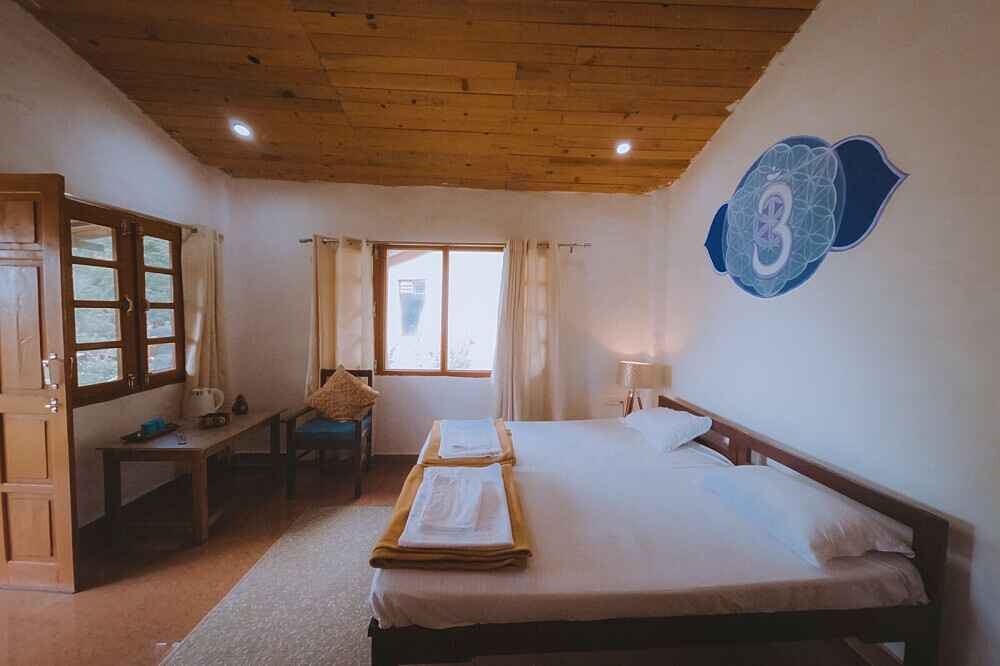
Room Facilities
- Bed, linen and seasonal blanket
- Attached bathroom
- Storage for belongings
- Ceiling fan and power socket
- Wi-Fi access
- Balcony or terrace access in many rooms
More Personal Space
Your own room gives you more privacy for sleep and personal study.
Best for: light sleepers and students who prefer quiet time.
Share the Residential Experience
Share your room with another student attending the same training.
Best for: students comfortable sharing personal space.
Not sure which room suits you? Compare private and shared rooms.
Room position varies. Depending on availability, views may face Ganga-side surroundings, nearby mountains, garden areas or an inner courtyard.

Yogic Food for Hatha Yoga Practitioners
आयुः सत्त्वबलारोग्यसुखप्रीतिविवर्धनाः ।
रस्याः स्निग्धाः स्थिरा हृद्या आहाराः सात्त्विकप्रियाः ॥८॥
— Bhagavad Gita (Shraddhatraya Vibhaga Yoga, Verse 8)
At FitFortunes Yoga School, our sattvic meals are thoughtfully prepared to nourish body, mind, and soul. Light, fresh, and wholesome, these meals support your Hatha Yoga practice, enhance energy, balance, and overall well-being, making your 200-Hour Yoga Teacher Training in Rishikesh a holistic experience.
What You’ll Eat During Your Stay
Three vegetarian meals are served each day during the residential course. Food is simple, freshly prepared and based mainly on familiar Indian home-style dishes rather than restaurant-style menus.
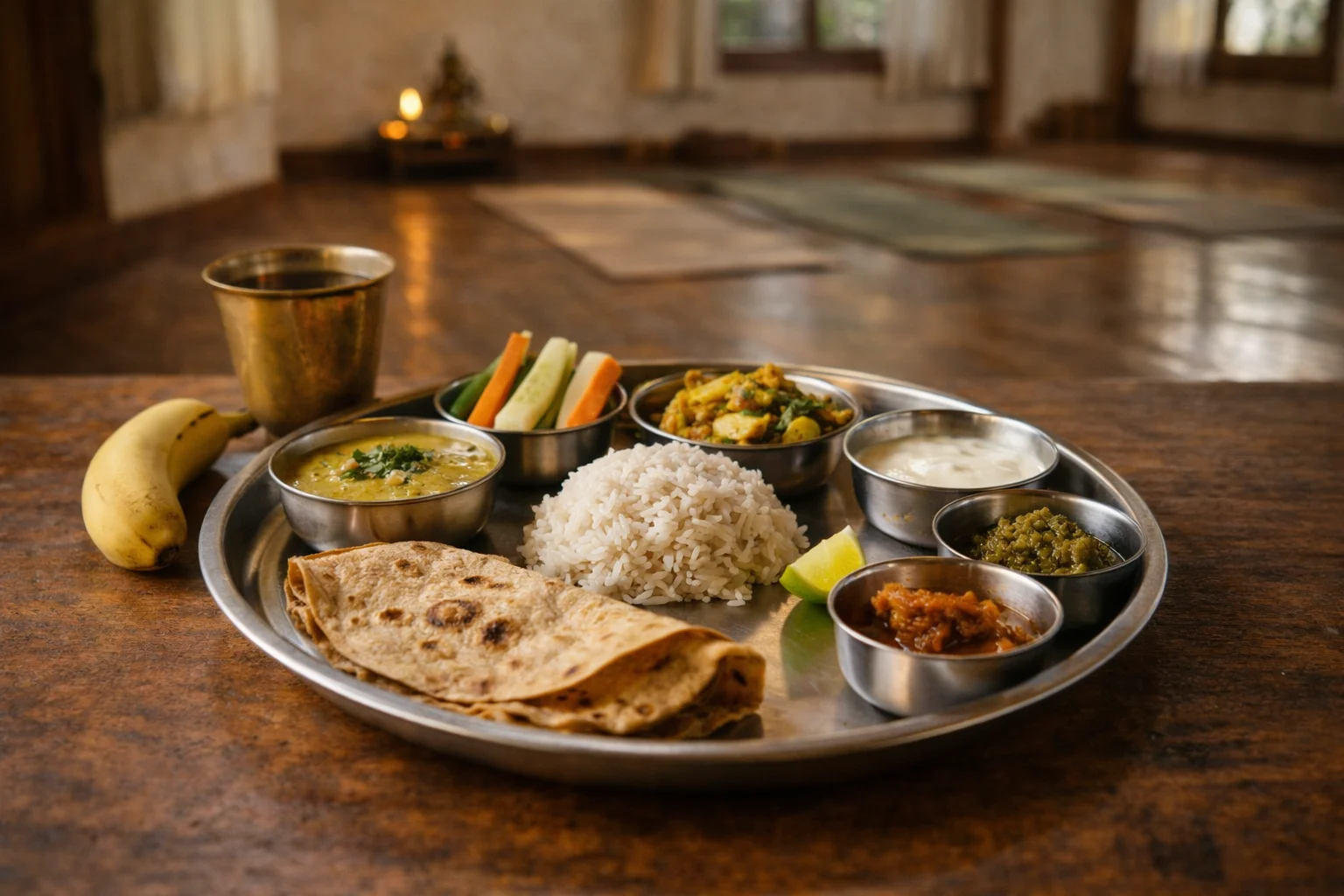
Simple Vegetarian Meals
What is usually served?
Meals commonly include vegetables, pulses, grains, rice, chapati and other simple dishes prepared as part of the daily school routine.
What style of food is it?
The menu follows a simple vegetarian approach influenced by sattvic and Indian food traditions. Dishes vary according to the day and available ingredients. Meals change during the training while remaining simple and vegetarian.
Vegan or gluten-free?
Vegan and gluten-free options can be discussed when requested in advance. Tell the school about important dietary restrictions before arrival.
Before You Arrive
Tell us about allergies, intolerances or strict dietary requirements in advance so the kitchen can explain what can reasonably be provided.
Interested in the food philosophy behind this style of eating? Read our Ayurvedic meal-preparation guide.
What You Study in the 200-Hour Hatha Training
The course is organised around five areas of study. Practical Hatha training is supported by anatomy, yoga humanities, professional teaching skills and supervised practicum.
Techniques, Training & Practice · 75 Hours
The practical foundation of the Hatha course.
Study: Classical Hatha asana, pranayama, meditation, mudra, bandha, kriya and practice refinement.
Breakdown: Asana 35h · Pranayama 15h · Meditation 15h · Mudra, Bandha & Kriya 10h
Anatomy & Physiology · 30 Hours
Understanding the body behind the practice.
Study: Functional anatomy, movement, joint actions, breathing, physiology, movement limitations and injury awareness.
Breakdown: Anatomy 15h · Physiology 10h · Injury Awareness 5h
Yoga Humanities · 30 Hours
The philosophical and historical context of practice.
Study: Patanjali Yoga Sutras, eight limbs of yoga, yoga history, yogic lifestyle, ethics and philosophy in teaching.
Breakdown: Yoga Sutras 20h · History 5h · Lifestyle & Ethics 5h
Professional Essentials · 20 Hours
Turning personal understanding into responsible instruction.
Study: Teaching methodology, class organisation, communication, observation, inclusive teaching and professional responsibilities.
Breakdown: Methodology 10h · Teaching Skills 5h · Inclusivity 5h
Practicum · 45 Hours
Learning to teach through supervised experience.
Practice includes: teaching observation, lesson preparation, supervised teaching, peer observation, teacher feedback and teaching evaluation.
Looking for a shorter training? View the 100-Hour Hatha Yoga Teacher Training .
Teaching Develops Through Practice
Practicum begins with observation rather than expecting you to teach a complete class immediately.
As the course progresses, you prepare lessons, practise giving instructions and gradually take more responsibility under teacher supervision.
Feedback helps you recognise what is clear, what needs improvement and whether you understand the practice you are teaching.
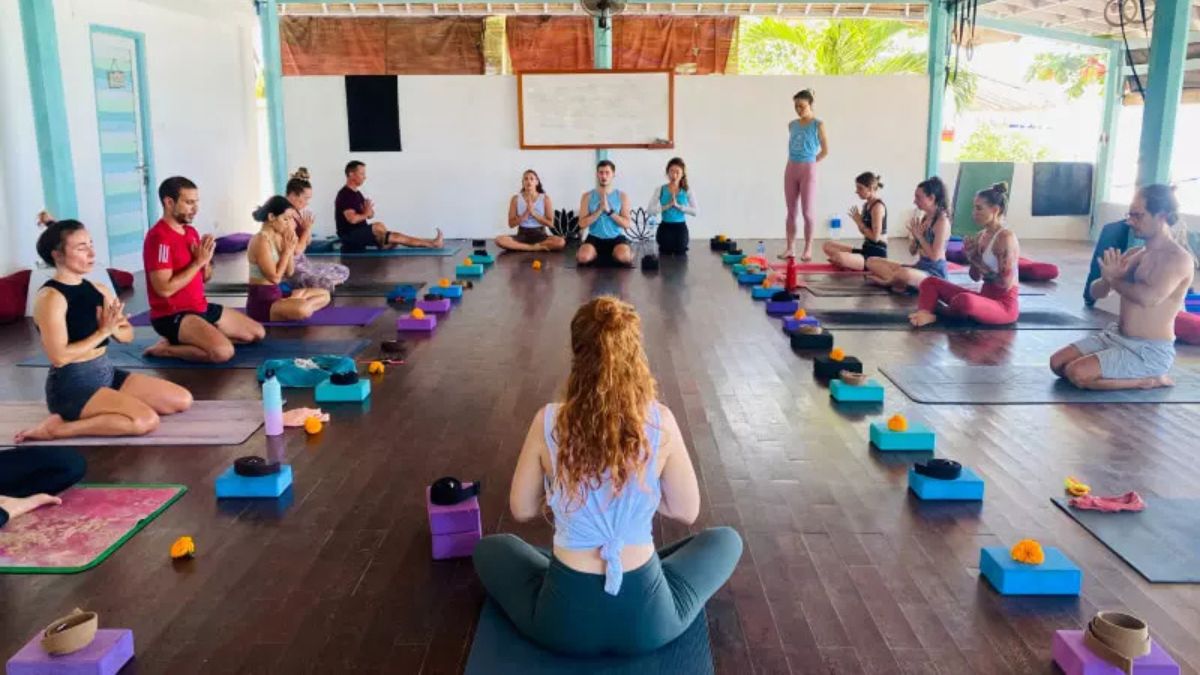
How the Practicum Progresses
Observe
Watch class organisation, instruction and student response.
Prepare
Build lesson plans with a clear purpose and realistic timing.
Teach
Guide short sessions and longer teaching assignments under supervision.
Review
Receive teacher feedback and complete the practical evaluation.
The goal is a strong foundation. Teaching skill continues to improve through practice, study and experience after the 200-hour course.
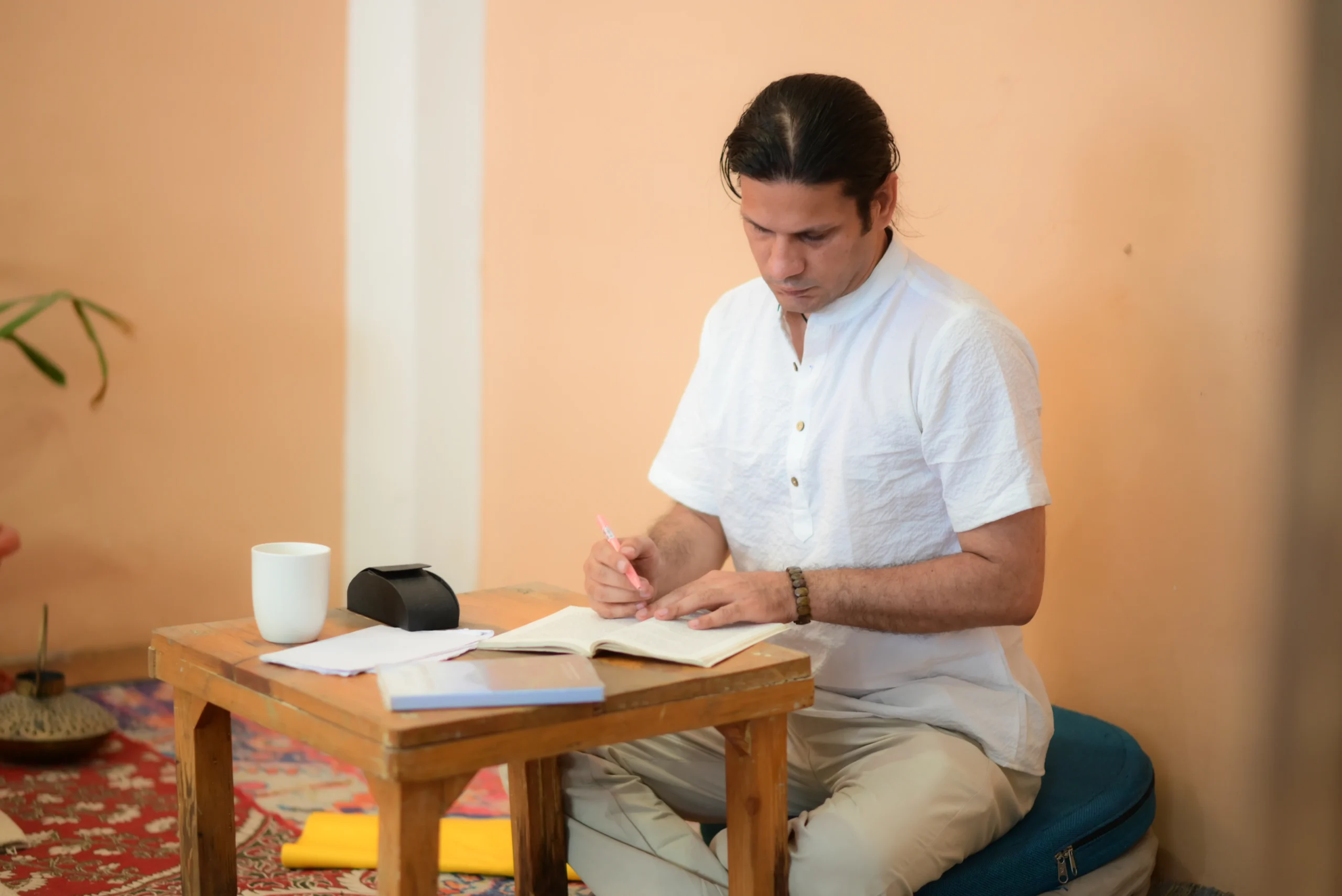
Pravesh Narwal
E-RYT 500 · AYUSH Level-3 Wellness Teacher
Founder & Lead Teacher
Learn Hatha Yoga with Pravesh Narwal
Pravesh leads the teacher-training programme at FitFortunes. His classes connect traditional Hatha practice with clear explanation, observation and practical teaching skills. The emphasis is on understanding the practice and learning how to work with the person in front of you.
His Role in This Training
Pravesh teaches Traditional Hatha Yoga, alignment and movement observation, pranayama, yoga philosophy, teaching methodology and supervised teaching practice. His teaching connects personal practice with the skills needed to observe, explain and guide another student.
Daily Schedule During the Hatha TTC
Each training day combines Hatha practice, academic study, teaching skills and supervised practicum, with regular breaks for meals and rest.
Morning
Practice & Study
Morning Yoga Practice · Asana, pranayama and meditation
Breakfast & Break
Yoga Philosophy & Theory · Yoga principles and their relationship with practice
Anatomy & Physiology · Body, movement and practice-related anatomy
Lunch & Break
Afternoon & Evening
Teaching & Practice
Teaching Methodology · Instruction, class organisation and teaching techniques
Practice Teaching · Guided teaching practice
Practicum · Observation and feedback
Evening Practice · Restorative yoga, meditation or workshop
Dinner
Evening Satsang · Discussion, chanting or guest lecture
Schedule note: This is the typical daily structure. Individual classes may move when a workshop, assessment or course activity requires it.
Please keep in mind that this schedule of Hatha Yoga Rishikesh is provided as an example and may vary depending on the specific curriculum, duration of the Hatha Yoga Rishikesh, and the preferences of the training institution. It is recommended to refer to the specific program details provided by the institution offering the Hatha Yoga Rishikesh for an accurate and detailed daily schedule.
Your 200-Hour Certificate and RYT-200 Eligibility
After successfully completing the required training, practice, practicum and assessments, you receive your 200-hour Hatha Yoga Teacher Training course-completion certificate from FitFortunes.
Course-Completion Certificate
The certificate confirms successful completion of the 200-hour programme, including Hatha practice, anatomy, yoga philosophy, teaching methodology and supervised practicum.
RYT-200 Registration
RYT-200 is not issued automatically by the school. After completing an eligible 200-hour programme, you can separately apply for your own registration through Yoga Alliance under its current requirements.
Your Certificate and Your Registration
FitFortunes is the registered yoga school and issues your course-completion certificate. Your personal RYT registration is a separate application if you choose to make one.
Study Hatha Yoga in Rishikesh
Your 21-day training takes place in Rishikesh, at the foothills of the Himalayas beside the Ganga. The city has a long connection with yoga, meditation, ashram life and traditional study.

Near Laxman Jhula and Swargashram
FitFortunes is based in the Laxman Jhula and Swargashram area of Rishikesh. During free time, students can walk through the surrounding neighbourhood, spend time near the Ganga and experience the town outside the classroom.
Rishikesh also gives context to the subjects studied during the course. Yoga schools, ashrams, temples, the river and everyday Indian life are part of the surroundings in which the residential training takes place.
Outside class: The course itself remains focused on training. Time outside class is for rest, personal study and experiencing the local area at your own pace.
Choose Your Room for Rishikesh
Choose the room that suits your stay. A 20% advance reserves your place in the 21-day Hatha Yoga Teacher Training.
Shared Room
Stay in shared accommodation during your training.
Reserve your place with the advance payment.
Private Room
Choose a private room during your training.
Reserve your place with the advance payment.
In the application: Select Hatha Yoga TTC, your training date and your preferred room. You can contact the school before payment if you need help choosing between a shared or private room.
Before You Reserve Your Place
Your Booking Amount
The 20% advance used to reserve your place is non-refundable, so please book when you are reasonably sure you can attend.
Cancellation Before Training
Any course payment made above the 20% booking amount can be refunded up to one day before the course start date.
If Your Plans Change
The booking amount cannot be transferred to another person. You may use it for a later FitFortunes course within one year, subject to availability.
Please read the full booking terms before making your advance payment.
Ready to Study Hatha Yoga With Us in Rishikesh?
Start your application for the 200-hour Hatha Yoga Teacher Training when you are ready. If you have a question before applying, you can speak with the school first.
Read our Hatha Yoga TTC FAQ
We accept payments by PayPal, Western Union, bank transfer or cash. Amount due is to be paid on arrival in cash. You can use your debit card (Visa/Electron/Master), credit card, travel cash card, to withdraw cash from nearby ATM’s in Indian Rupees.
To become a successful yoga teacher, first, you need to have a love for yoga. Then you must successfully complete a yoga training course. You have to showcase your ability as a yoga trainer. You need to know the minimum requirements for the training and enroll yourself in it. Check all the available sessions and choose one at your convenience.
Can house from 15-20 students in each session of YTT.
We recommend modest dressing. White color is the highly recommended color. You can choose some light-colored clothes too. But you must not wear black colored dresses to the class.
No, you do not need to bring your own yoga mat. We will provide you with course materials and a yoga mat.
No, we highly recommend you not enroll in the course. The course pattern is very intense, and it is not curated for pregnant women
If it is an emergency, you can skip the class. But you must inform your teacher before skipping the class.
No. we only allow those students who had enrolled for the course.
Yes, if international travel rules and regulations require you to have a visa for the travel into India. There are some nations which do not require a visa for entry. A tourist visa should supply you with sufficient time to complete your Yoga Teacher Training program but please ensure that the period of your visa is not less than the course period.
Since the duration of the FFYS Yoga Teacher Training program is a quite short time, so each class lesson is very important. The Knowledge that is not fully developed never gets noticed.t
We will provides you with all the necessary study materials for our Yoga Teacher Training program. Our study material is well designedby experts in an easy comprehensive manner which is easy to learn and simple to adopt.
English is the medium for the Yoga Teacher Training program so it is good to be knowledgeable in English. There are no restrictions though. People who are not proficient at English can also enroll for the program because yoga is for all.
No experience or qualification is necessary to join the Yoga Teacher Training program but you should be eager to learn about yoga.
Here are our tuition rates for each program:
200 hour: $1499 USD
The tuition covers the following: over the 21-day residential course, our students participate in intense and immersive days of classes starting at 6:30AM and ending at 8:00PM, familiarizing themselves with the fundamental aspects of yoga.
However Sundays are fun Days, we will go out for local sight seeing and other activities.
The Fees Includes Stay, 3 vegetarian meals and snacks per day for the duration of the course, and all other basic amenities for the comfort.
The only experience needed for students is that they have an open mind and an progressive nature.
Yes. It is totally safe for womens. Thousands of female travel Rishikesh every year, both from ( India & Out side India). You need to take care of few things – Be sensitive near holy places, Never Carry alcohol or Non Veg food. Wear acceptable clothes according to the Indian Yogic Culture.
The deposit of 20% of course fee is non-refundable once accepted. Rest of the remaining amount will be refunded up until 1 day before the course starts.
The student registers for the Yoga Teacher Training Certificate program , other short term courses and retreats by paying the deposit of atleast 20% from the total course fee. This 20% is non refundable.
We understand the importance of your time and resources, so we advise you to please book after extra consideration. The booking fee will not be refunded to you or transferred to any other student if you wish to cancel. But you are eligible to join our next course with in 1 year of Booking.
Generally we recommend you to apply for a tourist visa as it is a quick and easy process. You may reference your purpose of visit as Yoga retreat or Ayurvedic retreat. If required, students may use our school`s address and contact number as their Indian reference on the visa form. It generally takes 2-3 weeks for your Indian visa to be processed, accepted and sent back to you
As the fees are being paid only by those who are attending the course, extra people are not allowed to stay with you. Also, living with someone who is not attending the course can be a distraction and disrupt your learning.
Students are expected to follow the dress code regularly. You are required to dress in modesty while on the school premises. Female students, please ensure that your shoulders, knees and belly area is covered as well as avoid tops with straps and low-cut tops, and no skin tight clothes.
Classes run from Monday to Saturday and the full daily training schedule is approximately 9 hours, including practice, theory, methodology, breaks, and supervised study periods.
Unfortunately we do not allow the use of any electronics/gadgets in our classes in order to maintain silence during the class. Please switch them off or keep them in silent mode for the duration of class and meals.
We highly recommend you bring pen and notebook to make your own notes. As no recording will be allowed during the class.
The Directors have an open door policy and will make every effort to be available to listen to concerns and do what is best for all involved. In the event that a student feels his or her rights have been violated, s/he should meet with the person against whom they have the complaint outside of class, and attempt to resolve the conflict. If the grievance is with an instructor, the student must first attempt to resolve the matter with the instructor.
If this fails to rectify the problem, the student should file a formal complaint in writing to the Program Director within 3 days of the incident. The Program Director will respond in writing within 3 days of receipt of the complaint.
Questions About Your Hatha Training
A few practical answers to help you choose your course, room and next step.
How long is the Hatha Yoga Teacher Training?
The 200-hour Hatha Yoga Teacher Training is a 21-day residential course in Rishikesh. The daily structure combines practice, academic study, teaching methodology and supervised practicum, with breaks for meals and rest.
When does the course start?
Monthly batches start on the 2nd. Choose your preferred training date in the application and confirm availability with the school before making travel plans.
Can a beginner join?
The course welcomes beginners and experienced practitioners. You should be ready for regular practice, study and participation throughout the residential training; speak with the school if you are unsure whether the course suits your experience.
What are the shared and private room fees?
The shared-room course fee is $1,199 and the private-room fee is $1,499. Residential accommodation and meals are included in the course offering. Choose the room that suits your stay in the application.
How much advance payment reserves my place?
A 20% advance reserves your place: $239.80 for a shared room or $299.80 for a private room. The booking amount is non-refundable; read the full booking terms before paying.
Will I receive RYT-200 registration automatically?
After successfully completing the required training, practice, practicum and assessments, FitFortunes issues your course-completion certificate. Personal RYT-200 registration is a separate application through Yoga Alliance under its current requirements; it is not issued automatically by the school.
Can I discuss dietary requirements?
Meals follow a simple vegetarian approach, with dishes varying according to the day and available ingredients. Vegan and gluten-free options can be discussed when requested in advance. Tell the school about important dietary restrictions before arrival.
How do I apply for this Hatha course?
Open the application form and select Hatha Yoga TTC, your preferred training date and room. If you have a question before applying or paying, contact FitFortunes first so the school can help you decide.
Still have a question? Speak with FitFortunes before you apply.