
Hatha yoga teacher training philosophy gives students the context behind the physical practice. Without philosophy, teacher training can become a collection of poses, breathing methods and teaching cues. Students may know what to do but not understand why these practices developed.
A good Hatha yoga teacher training therefore includes history, classical texts, ethics and discussion alongside physical practice. The purpose is not to force students to adopt a belief system. It is to help future teachers understand the tradition they are teaching.
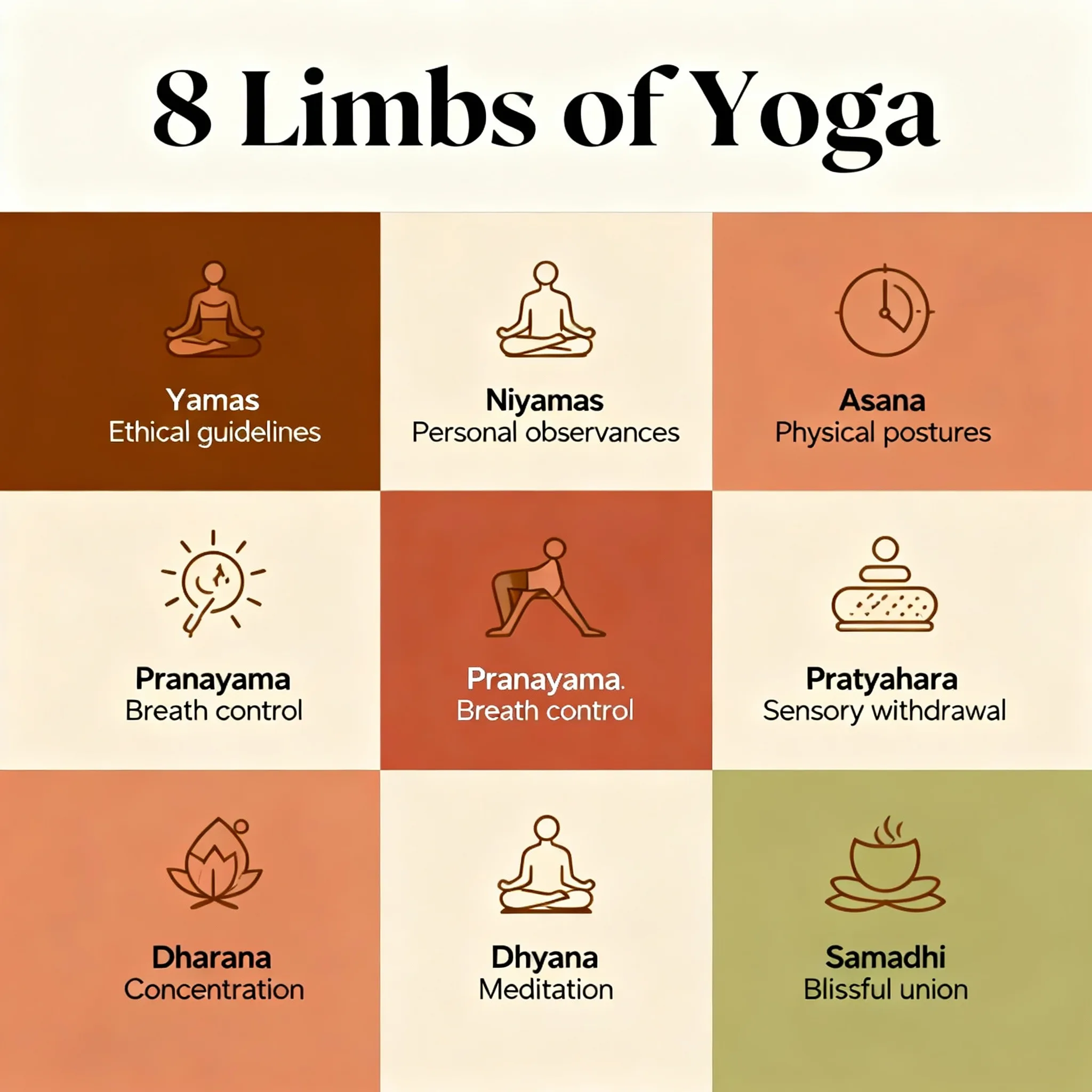
Table of contents
- Why philosophy belongs in Hatha yoga teacher training
- Main texts students may study
- Yoga Sutras and the eight limbs
- Bhagavad Gita
- Hatha Yoga texts
- Ethics for future yoga teachers
- Why history matters
- Philosophy in the FitFortunes curriculum
- Frequently asked questions
Why philosophy belongs in Hatha yoga teacher training
Yoga existed long before the modern studio class. Asana is important, but it represents only one part of the wider yoga tradition. Students studying Hatha Yoga should understand how posture, pranayama, concentration, meditation, discipline and ethical conduct relate to one another.
Yoga Alliance’s current RYS 200 curriculum includes 30 hours of Yoga Humanities covering history, philosophy and ethics. It also lists familiarity with major yogic texts such as the Yoga Sutras, Bhagavad Gita, Upanishads and Hatha Yoga Pradipika.
This means philosophy is not simply decorative content added after physical practice. It is part of teacher education.
Which texts are studied in Hatha yoga teacher training?
The exact texts depend on the school and teaching tradition. A 200-hour course cannot cover every classical yoga source in depth, so responsible training usually focuses on a smaller group of important ideas and texts.
- Patanjali’s Yoga Sutras
- Bhagavad Gita
- Hatha Yoga Pradipika
- Selected Upanishadic ideas
- Other Hatha texts according to the school’s lineage
Students do not need to become Sanskrit scholars. The goal is to understand important concepts well enough to discuss them clearly and connect them with practice.
Patanjali’s Yoga Sutras and the eight limbs
The Yoga Sutras are important because they present a systematic framework for yoga. Students often begin with definitions of yoga and then study the eight-limbed structure.
- Yama
- Niyama
- Asana
- Pranayama
- Pratyahara
- Dharana
- Dhyana
- Samadhi
This immediately changes how a student sees yoga. Asana becomes one part of a wider discipline rather than the whole subject.
The Yoga Sutras also introduce ideas such as practice, non-attachment, mental patterns, concentration and ethical conduct. These concepts give future teachers a vocabulary for discussing yoga without reducing every lesson to physical benefits.
Yama and niyama in teacher training
Yama and niyama are especially useful for future teachers because they ask students to think about conduct, habits and responsibility.
Common yamas include non-harming, truthfulness, non-stealing, appropriate use of energy and non-grasping. Common niyamas include cleanliness, contentment, disciplined effort, self-study and orientation toward something larger than personal ego.
The value comes from reflection rather than moral superiority. For example, non-harming can lead to practical teaching questions. Should a teacher push a student deeper into a pose? Should every person receive the same instruction? Should a teacher make health promises that exceed professional scope?
What students learn from the Bhagavad Gita
The Bhagavad Gita presents yoga through action, knowledge, devotion and disciplined living. Teacher trainees often find it useful because it discusses practice within ordinary responsibilities rather than only in isolation.
Ideas such as karma yoga, steadiness, moderation and disciplined action help students understand how practice relates to daily life. The text also makes clear that yoga has never been limited to physical posture.
Why the Hatha Yoga Pradipika matters
The Hatha Yoga Pradipika is directly relevant to Hatha yoga teacher training philosophy. It discusses asana, pranayama, mudra, bandha, cleansing practices and other methods associated with Hatha Yoga.
Students quickly see that classical Hatha Yoga contains much more than slow postures. Our article on what traditional Hatha yoga teacher training means explains this distinction in more detail.
Historical texts also need careful teaching. A description found in a classical source should not automatically become a modern medical claim. Teachers need to separate historical context, yogic concepts and evidence-based health information.
Is Hatha Yoga the same as Patanjali’s Ashtanga Yoga?
No. Hatha Yoga and Patanjali’s eight-limbed framework are connected within modern yoga education, but they are not identical systems.
This distinction matters because the word Ashtanga can cause confusion. In philosophy, Ashtanga means the eight limbs described in the Yoga Sutras. It does not automatically mean the modern Ashtanga Vinyasa Primary Series.
A responsible teacher should know the difference and explain it clearly.
Why yoga history matters
Hatha yoga teacher training philosophy should include historical context. Students need a basic understanding of how yoga developed through different periods and texts.
They should know that modern posture practice did not appear in exactly the same form thousands of years ago. Yoga changed over time, and different traditions placed different emphasis on meditation, philosophy, ritual, physical methods and renunciation.
Understanding this history helps teachers avoid unsupported claims such as saying a modern pose has been practised in exactly the same way for thousands of years.
Philosophy should not become religious pressure
Yoga developed within Indian religious and philosophical cultures. That history should not be hidden. At the same time, teacher training should not force a student’s personal belief.
People may come from Hindu, Christian, Buddhist, Muslim, secular or other backgrounds. A teacher can explain a text respectfully without demanding agreement.
This approach allows honest study while keeping yoga connected to its cultural roots.
Ethics for future yoga teachers
Teacher ethics is one of the most practical parts of Hatha yoga teacher training philosophy. A new teacher may know how to demonstrate a pose but still need guidance on professional boundaries.
- Respecting student consent
- Avoiding exaggerated health promises
- Staying within professional scope
- Handling physical adjustments responsibly
- Protecting student privacy
- Avoiding manipulation
- Giving credit to sources and teachers
- Treating students fairly
- Knowing when to refer someone to another professional
These subjects are part of teaching competence. They should not be treated as secondary material.
How philosophy changes the way you teach asana
Philosophy becomes useful when it changes teaching behaviour. A teacher who understands non-harming may become more careful with pressure. A teacher who understands non-attachment may avoid making difficult poses the main measure of progress.
A teacher who studies self-observation may encourage students to notice their own experience rather than copy a perfect shape. A teacher who understands moderation may avoid turning every class into maximum effort.
Philosophy therefore affects the physical class. It changes priorities.
Philosophy and pranayama belong together
Hatha texts often connect physical methods with breathing and mental training. Without context, pranayama can become a list of breathing exercises. With context, students begin to understand why breathing, concentration and asana were studied together.
Our companion guide to pranayama in Hatha yoga teacher training explains the practical side of this relationship.
Do students need to memorise Sanskrit?
No. Sanskrit terminology can improve accuracy, but memorisation should not replace understanding. A student who can recite several Sanskrit terms but cannot explain them simply is not necessarily prepared to teach.
Teacher training should help students understand meaning first. Pronunciation and terminology can then improve with continued study.
How philosophy helps international students
International students sometimes arrive in India knowing yoga mainly through studio classes. Philosophy gives historical and cultural context.
It also corrects common assumptions. Hatha Yoga is not simply slow yoga. The eight limbs are not a modern fitness sequence. Meditation is not separate from the wider yoga tradition.
Students comparing locations can also read our guide on where to learn Hatha Yoga in India.
Philosophy is not about sounding spiritual
New teachers sometimes feel pressure to use complicated spiritual language. That is unnecessary. Clear language usually shows better understanding.
If the subject is ahimsa, explain non-harming clearly. If the subject is svadhyaya, explain self-study and reflection. If the subject is pranayama, distinguish traditional ideas from respiratory anatomy.
Complicated language can hide confusion. Good teaching makes difficult ideas understandable without stripping away their meaning.
How philosophy fits the FitFortunes curriculum
At FitFortunes, the 200-hour curriculum includes dedicated Yoga Humanities study covering Yoga Sutra study, history, lifestyle and ethics. These subjects sit beside asana, pranayama, meditation, anatomy, teaching methodology and practicum.
The 200-hour Hatha yoga teacher training in Rishikesh runs for 21 days. Students who want a shorter foundation can review the 100-hour Hatha yoga teacher training.
If you want to compare Hatha with a broader format, read Hatha vs multi-style yoga teacher training in India.
How to prepare for philosophy classes
You do not need to finish several classical texts before training. Reading too much without guidance can create more confusion than clarity.
A better approach is to read a short introduction, keep notes and write down questions. Notice terms that appear repeatedly and bring those questions into class.
The Hatha yoga teacher training preparation checklist explains how to add short study periods before travelling to India.
Questions to ask a school about philosophy
- Which texts are included?
- Who teaches philosophy?
- How many hours are given to the subject?
- Is philosophy connected with teaching practice?
- Are history and ethics included?
- Can students ask questions and discuss different interpretations?
- Are Sanskrit terms explained in simple English?
Clear answers usually tell you more than a claim that a course teaches “authentic philosophy.”
Frequently asked questions
What philosophy is taught in Hatha yoga teacher training?
Courses commonly cover yoga history, the Yoga Sutras, ethical principles, Hatha Yoga texts and selected ideas from the Bhagavad Gita.
Do I need to be Hindu to study yoga philosophy?
No. Students can study yoga’s historical and philosophical sources without being required to adopt a religion.
Is the Bhagavad Gita a Hatha Yoga manual?
No. It is an important yoga text that helps students understand wider ideas about action, knowledge, devotion and disciplined living.
Is Hatha Yoga philosophy only about chakras and energy?
No. It also includes history, ethics, classical texts, practice theory, meditation and relationships between different yoga methods.
Why should a physical yoga teacher study philosophy?
Because teachers represent more than exercises. Philosophy helps them understand terminology, tradition, ethics and the purpose behind different practices.
Can I teach yoga without knowing Sanskrit?
Yes. Sanskrit knowledge can help, but clear understanding and responsible teaching matter more than memorising terminology.
Final thoughts
Hatha yoga teacher training philosophy gives physical practice its wider context. It helps students understand where yoga methods came from, how different practices relate and what responsibilities come with teaching.
A strong teacher does not need to become an academic philosopher. But a teacher should understand enough history, ethics and classical thought to represent yoga accurately.
Reference: Yoga Alliance RYS 200 standards.