A yoga teacher training curriculum should make it clear what students will study, practise, teach, and be assessed on before they book. At FitFortunes Holistic Wellness Yoga School in Rishikesh, the curriculum connects physical practice with breathing, meditation, philosophy, anatomy, teaching skills, sequencing, ethics, and supervised practicum. The aim is not to fill a timetable with as many subject names as possible. Each subject should help the student understand yoga more clearly and communicate it more responsibly. This guide explains what the main curriculum areas mean and how they fit together.
FitFortunes currently offers a 10-day 100-hour foundation course and a 21-day 200-hour residential teacher-training program. The practical asana focus is Hatha Yoga and Vinyasa Krama, supported by pranayama, meditation, philosophy, anatomy, alignment, teaching methodology, and practice teaching. The exact timetable can change as a course develops, so the live course page remains the final source for current dates and daily scheduling. The curriculum below explains the learning structure rather than promising that every topic receives the same number of hours.
Yoga teacher training curriculum at a glance
A useful curriculum has a clear relationship between personal practice and teaching practice. Students first need to understand what they are doing in their own body and breath before they can guide someone else. They also need enough philosophy and ethics to understand yoga beyond exercise, enough anatomy to observe movement safely, and enough teaching practice to communicate clearly. These areas should support each other instead of appearing as separate subjects that never connect. In a well-planned course, what happens in the morning practice should make more sense after the anatomy, philosophy, or methodology class later in the day.
- Hatha Yoga and Vinyasa Krama asana practice.
- Pranayama, meditation, and selected subtle-body practices.
- Yoga philosophy, ethics, and classical context.
- Anatomy, movement, alignment, and basic safety.
- Teaching methodology, cueing, observation, and class management.
- Sequencing and lesson planning.
- Practicum, feedback, and teaching assessment.
- Professional responsibility and scope of practice.
Asana practice: Hatha Yoga and Vinyasa Krama
Asana is the most visible part of a yoga teacher training course, but the curriculum should go beyond copying shapes. Students learn how to enter and leave a posture, coordinate movement with breath, notice stability and unnecessary effort, and understand what a posture is trying to develop. They also learn that different students may need different ranges of motion or simpler variations. A good class therefore combines personal practice with observation and explanation. The goal is to build a practical understanding that can later support safe and clear teaching.
How the Hatha-focused curriculum differs
Students who choose the 200-hour Hatha Yoga Teacher Training in Rishikesh follow a more Hatha-centred practical path. Its traditional practice framework gives specific attention to Asana, Pranayama, Mudra and Bandha, and Nadanusandhana (Nada Yoga), while still including philosophy, anatomy, alignment, teaching methodology, observation, and practicum. This is different from the Multi-Style program, where Hatha Yoga is paired with Vinyasa Krama. Keeping those two paths clear helps students choose by learning focus instead of seeing the courses as duplicate versions of the same program. The separate guide on what makes Hatha teacher training traditional explains the classical sources and practices behind that label.
At FitFortunes, Hatha Yoga provides a steady foundation while Vinyasa Krama develops the idea of progressing through movement in a logical order. Students study how one movement can prepare for another, how transitions affect the body, and how pace changes the experience of a class. This is different from collecting difficult postures for display. It teaches students to think about purpose, preparation, breath, and the needs of the group. The same thinking later becomes important when students begin planning their own classes.
Pranayama, meditation, and subtle practice
Pranayama training should begin with breathing awareness, posture, and control of unnecessary tension. Students learn selected breathing methods step by step and are encouraged to understand preparation, pace, comfort, and purpose rather than simply memorising names. They also study when a technique should be simplified or avoided. This creates a more responsible approach than treating stronger breathing practices as a performance. The aim is to help students understand how breath practice fits into a wider yoga class and personal routine.
Meditation develops attention, observation, and the ability to stay with a practice without constant external stimulation. Depending on the course format, students may also meet selected mudra, bandha, mantra, yoga nidra, or cleansing practices. These subjects should be introduced with enough context for students to understand why they are used. They should not be added only to make the curriculum look longer. When taught well, they help students see how asana, breathing, concentration, and meditation relate to one another.
Yoga philosophy, ethics, and classical context
Yoga philosophy gives students a framework for understanding yoga beyond physical exercise. A foundational curriculum may introduce ideas from Patanjali’s Yoga Sutras, the Bhagavad Gita, and selected Hatha Yoga texts, together with self-study, discipline, meditation, and ethical conduct. The purpose is not to turn a student into a Sanskrit scholar in a few weeks. It is to give enough context to understand key ideas and avoid repeating unsupported claims. Philosophy becomes useful when students can connect it with practice, teaching, and everyday decisions.
Clear terminology is part of that responsibility. Patanjali’s Ashtanga Yoga refers to an eight-limbed framework and should not automatically be treated as the same thing as the modern Ashtanga Vinyasa Primary Series. A teacher should know when the same word is being used in different historical or teaching contexts. Ethics also includes professional boundaries, consent, honesty about qualifications, and knowing when a student needs support outside a yoga teacher’s scope. These subjects protect both the teacher and the people they teach.
Anatomy, alignment, and movement observation
Anatomy is most useful when it changes how a trainee observes movement. Students study basic joints, muscles, breathing mechanics, balance, load, and common movement limits, then connect those ideas with the postures they are practising. The goal is not to memorise a long medical vocabulary that is never used in class. Instead, students learn to notice how different bodies organise the same movement. This makes anatomy practical rather than decorative.
Alignment is taught as a way to improve organisation, awareness, and safety rather than as one perfect shape for every person. Two students can have different proportions, mobility, injury history, strength, and movement habits. A teacher therefore needs to understand the purpose of a posture and offer sensible options without pretending to diagnose a medical condition. Observation, communication, and restraint are as important as knowing a textbook position. This is especially important for new teachers who may otherwise try to correct every student into the same shape. The Hatha anatomy and alignment guide goes deeper into movement observation, breath, variation, pain, and professional scope.
Teaching methodology and class sequencing
Teaching methodology turns personal knowledge into instructions another person can understand. Students practise verbal cueing, demonstration, observation, class pacing, time management, simple modifications, and professional boundaries. They learn that a cue should arrive before the movement it describes and that a demonstration should not prevent the teacher from seeing the group. They also learn to reduce unnecessary words so students can follow the class more easily. Good teaching is not measured by how much a teacher says, but by how clearly the class can respond.
Sequencing is part of the same skill. A sequence should have a purpose, an understandable order, enough preparation for more demanding movements, and suitable periods of rest. Students learn how to connect the opening of a class with its main work and closing instead of placing postures together at random. They also see how breath, timing, repetition, and transitions affect the experience of the sequence. A plan should be simple enough to teach well, because a complicated sequence that cannot be communicated clearly is not an effective class.
- Clear verbal cueing and demonstration.
- Observation without over-correcting.
- Class planning, timing, and pacing.
- Simple modifications and accessible options.
- Professional boundaries, consent, and teacher ethics.
Practicum, observation, and feedback
Practicum is where information becomes teaching experience. Students may guide a warm-up, teach a short sequence, observe another trainee, or lead a longer class while a teacher watches. Each attempt gives the trainee something specific to review. They learn how their voice, timing, demonstration, instructions, and position in the room affect the class. This is one of the most important parts of a teacher-training curriculum because it shows what a student can actually apply.
Useful feedback should be specific enough to act on. A trainee can improve when they learn that a cue came too late, a transition confused the group, or a demonstration blocked their view of students. General praise may feel good, but it does not always improve teaching. Repeated practice allows the student to make one correction and then test it again. Over time, that process builds more confidence than simply being told that the class was good.
Ayurveda and yogic lifestyle where included
Some FitFortunes training formats also include introductory study of Ayurveda and yogic lifestyle. These classes may discuss daily routine, food, basic constitutional ideas, and how personal habits can affect practice and recovery. The purpose is educational, not medical diagnosis or treatment. A yoga teacher should not present introductory Ayurveda study as a licence to treat health conditions. When included, these subjects are most useful when they help students think more carefully about routine, rest, food, and sustainable practice.
The residential routine itself also teaches practical discipline. Students follow regular practice, study, meals, rest, and shared learning over several days rather than treating yoga as an occasional class. This makes lifestyle ideas easier to understand because students experience a structured schedule directly. The emphasis should remain realistic and practical. A course does not need dramatic promises about changing a person’s life in order to teach useful habits.
How Yoga Alliance standards relate to the curriculum
Yoga Alliance groups the RYS 200 core curriculum into four broad areas: Techniques, Training and Practice; Anatomy and Physiology; Yoga Humanities; and Professional Essentials. These categories create a common framework, but registered schools still decide how their approved program teaches and connects the material. This means two 200-hour courses can share the same credential level while using different teaching methods, schedules, and emphasis. Students should therefore look at the real curriculum and teachers rather than judging a program only by a logo. The current categories and requirements can be checked on the official Yoga Alliance RYS standards page.
For FitFortunes, the important point is that the curriculum should be understandable before a student arrives. Course pages should state the training style, duration, core subjects, practicum, and current schedule clearly. Students should also be able to distinguish school registration from their own later teacher-registration process. This kind of factual clarity helps prospective students compare programs and also makes the page easier for search engines and AI systems to interpret correctly. Clear facts are more useful than broad claims about becoming a different person in a few weeks.
How the 100-hour and 200-hour curriculum differ
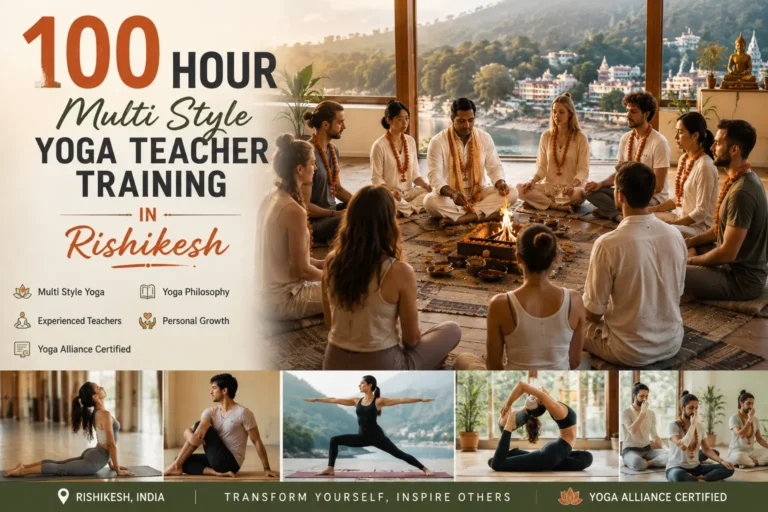
The 100-hour Multi-Style Yoga Teacher Training is a 10-day foundation course that runs from the 2nd to the 12th of the month. It introduces Hatha and Vinyasa Krama foundations together with breathing, meditation, philosophy, anatomy, and basic teaching concepts. It is useful for personal study or preparation for longer training. It should not be presented as the same professional training outcome as a complete 200-hour program. The shorter format means the main subjects are introduced rather than studied to the same depth.
The 200-hour Multi-Style Yoga Teacher Training in Rishikesh is currently a 21-day residential program. It gives more time to methodology, sequencing, anatomy, philosophy, practice teaching, observation, and assessment. Students who successfully complete an eligible 200-hour training with a Yoga Alliance Registered Yoga School may then apply separately for the relevant Yoga Alliance teacher credential, subject to Yoga Alliance requirements. The school registration and the student’s later RYT application are two different things. This distinction should remain clear on every course and informational page.
What students should be able to do with the curriculum
A curriculum is useful only when students can apply what they studied. By the end of a foundational teacher-training program, students should be better able to practise with awareness, explain basic yoga concepts accurately, plan a simple class, communicate instructions clearly, observe common movement differences, and stay within an appropriate teaching scope. They should also understand that completing a course is the beginning of teaching development rather than the end of it. Experience grows through continued practice, study, observation, and teaching. A good curriculum gives the student a structure for that continued learning.
- Practise and explain foundational asana with clearer purpose.
- Use basic pranayama and meditation methods with appropriate context.
- Understand key philosophical and ethical ideas without exaggerating them.
- Plan and teach a simple, logical class sequence.
- Observe students and offer sensible options without diagnosing medical problems.
- Receive feedback and continue improving after the course.
Frequently asked questions about YTT curriculum
Does a 200-hour yoga teacher training curriculum teach only asana?
No. Asana is important, but a complete foundational curriculum also includes breathing, meditation, anatomy, philosophy, ethics, teaching methodology, sequencing, and practicum. These subjects are not side topics. They help a trainee understand what they are teaching and how to communicate it responsibly. A course that focuses almost entirely on physical practice may leave important teaching skills underdeveloped.
Why is practicum important in yoga teacher training?
Practicum lets students test what they have learned in front of real people. Speaking clearly, watching a group, managing time, and changing a plan are skills that cannot be learned only from notes. Feedback helps the trainee see details they may miss while teaching. Repeated practice then gives them a chance to correct those details. This is why practicum should be treated as a core part of teacher preparation rather than an optional final exercise.
Do I need to memorise yoga philosophy?
No. A foundation course should help students understand key ideas and their context rather than memorise quotations without knowing what they mean. Good philosophy teaching gives enough background to discuss yoga responsibly, recognise important terms, and understand how practice relates to ethics and self-study. Students should also learn when two traditions use the same word differently. Understanding matters more than reciting text from memory.
Is yoga anatomy taught like a medical course?
No. Yoga anatomy should focus on movement knowledge that is useful within a yoga teacher’s professional scope. Students learn basic structures, breathing mechanics, joint movement, balance, and common limitations so they can observe more carefully. The training does not make a yoga teacher a doctor, physiotherapist, or rehabilitation professional. It should instead help the teacher communicate more safely and know when a concern is outside their role.
Does a 100-hour YTT have the same curriculum as a 200-hour YTT?
No. A 100-hour course can introduce many of the same broad subjects, but it has less time for depth, assessment, and supervised teaching. At FitFortunes, the 100-hour Multi-Style course is positioned as a foundation and preparation program. The 200-hour course allows more time for methodology, sequencing, practicum, and evaluation. The two programs should therefore be compared by purpose, not only by the number printed in the course title.
How should I compare two yoga teacher training curriculums?
Compare how the important subjects are actually taught rather than counting how many topics appear on the page. Look at the teachers, practice-teaching opportunities, daily schedule, assessment, teaching style, and whether the course explains what students should be able to do by the end. A long list can still be shallow if every topic receives very little time. For a broader comparison checklist, read what a good yoga teacher training syllabus should include. That article explains how to judge a syllabus, while this page focuses on what the curriculum itself contains.
Use the curriculum with the live course information
This article explains the learning areas behind a yoga teacher training curriculum, but the live course page should always be checked before booking. Dates, timetable details, subject emphasis, room choices, and other practical information can change as a program is updated. For the current residential training, use the 200-hour Multi-Style Yoga Teacher Training page. If you want to understand how those subjects fit into a normal training day, read the real YTT daily schedule guide. Together, those pages give a clearer picture of what students study and how the study fits into the residential routine.