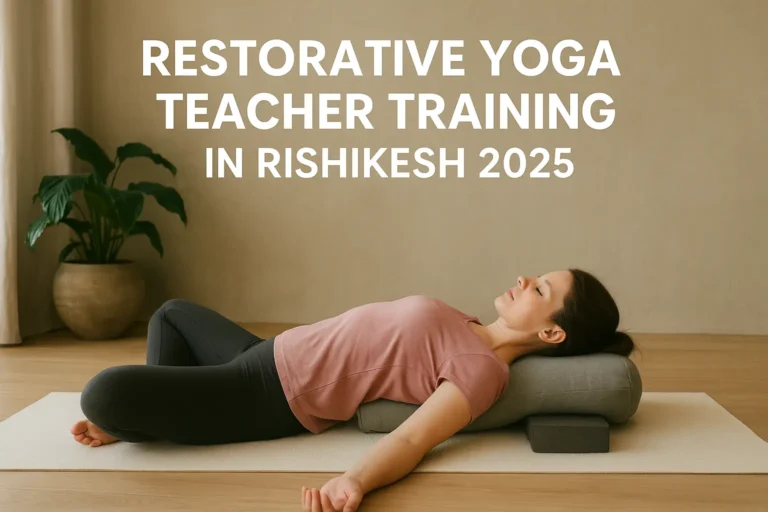
An online restorative yoga teacher training can be useful when the course gives enough time to practise, observe, teach, and receive feedback. Restorative yoga may look simple because many poses are supported and held for longer periods, but teaching it well requires more than knowing where to place a bolster. A good online course should explain positioning, prop use, breath, class planning, contraindications, scope of practice, and how to adapt the same idea for different bodies and home setups.
What is restorative yoga teacher training?
Restorative yoga teacher training focuses on supported, low-effort postures that allow students to stay comfortable for longer periods. The teaching skill is not about pushing range or building a hard sequence. It is about choosing useful shapes, setting up props carefully, observing breathing and comfort, and knowing when a position should be changed. Training should also help teachers understand that relaxation practice is not the same as medical treatment or physical therapy.
Online study can teach this material when the program is designed for the limits of remote learning. Video demonstrations, live practice, small-group teaching, recordings, written notes, and feedback can work well together. The weak version is a course made only from pre-recorded videos and a final certificate. Before enrolling, ask how much live interaction you receive and whether anyone actually watches you teach.
What should an online restorative yoga course include?
The course should explain the principles behind the practice rather than giving students a list of poses to copy. You should learn why a particular support is used, how to reduce strain, how long a position may be held, and what signs suggest that a student needs a different option. A teacher also needs to know how restorative work fits into a normal class, a private session, or the end of a more active yoga practice.
- Purpose and principles of restorative yoga.
- Use of bolsters, blankets, blocks, straps, chairs, and simple home alternatives.
- Comfortable positioning and ways to reduce unnecessary effort.
- Breath awareness without forcing deep breathing.
- Sequencing for short and longer restorative classes.
- Observation, communication, consent, and teacher boundaries.
- Contraindications and when to refer a health question to an appropriate professional.
- Practice teaching with feedback.
Why practicum matters even more online
Restorative teaching depends on details that are easy to miss when you practise alone. A student may look comfortable on camera while the neck is unsupported, the lower back is tense, or a prop is making it harder to breathe freely. Live practicum gives the trainer a chance to watch how you set up a posture, how clearly you explain options, and whether you can change the plan when the first setup does not work.
Ask how practicum is assessed before you pay. A useful online course may require you to teach a short class to classmates, submit a recorded session, receive written or live feedback, and repeat part of the lesson after correction. That is much more meaningful than watching every video and automatically receiving a certificate. Teacher education should show that you can communicate and adapt, not only that you completed the lessons.
What equipment do you need at home?
You do not need a studio full of expensive props, but you do need enough support to practise the setups you are learning. A firm bolster is useful, and folded blankets can change height or support the head and limbs. Blocks, a strap, a stable chair, and wall space are common tools. If the training encourages home substitutes such as cushions or folded towels, the teacher should also explain their limits rather than pretending every household object works exactly like a yoga prop.
- One firm bolster or a similar stable support.
- Two or more blankets.
- Two yoga blocks.
- One yoga strap.
- A stable chair without wheels.
- A yoga mat and clear wall space.
Can restorative yoga be called therapeutic?
Be careful with that word. Restorative yoga can be used in wellness settings and may help some people rest, move comfortably, or pay attention to breathing, but a yoga teacher should not diagnose or treat a medical condition unless they also hold an appropriate healthcare qualification. Training should teach clear scope of practice. Claims about curing trauma, fixing hormones, treating anxiety, or healing injuries need far stronger evidence and professional responsibility than a general yoga certificate provides.
This matters especially online because the teacher has less ability to observe a person from every angle or respond physically if something goes wrong. A responsible instructor asks useful screening questions, keeps instructions conservative, offers alternatives, and tells students when a medical issue is outside the class. The goal is not to make restorative yoga sound less valuable; it is to describe its value accurately without turning a wellness practice into a medical promise.
How is restorative yoga different from Yin Yoga?
The two styles can look similar because both may use props and slower pacing, but the intention is different. Restorative yoga normally uses enough support to reduce effort and make the position easy to maintain. Yin Yoga often uses longer holds with deliberate, mild stress on certain tissues and does not always try to remove sensation. A good teacher training should explain this difference so graduates do not use the two names as if they mean the same method.
That distinction also affects sequencing and cueing. In restorative work, adding another blanket or changing the angle may be the correct decision if the body keeps working too hard. In Yin, some controlled sensation may be part of the method, though pain should still not be treated as progress. Teachers who study both approaches need to be able to explain which method they are using and why.
Does an online certificate qualify you to teach?
A certificate shows that you completed the course described by the training provider. It does not create one worldwide licence to teach restorative yoga, and different studios, insurers, employers, and registration organisations may have their own requirements. If a course advertises outside registration, check that organisation’s current rules and confirm whether the online format and the specific training are eligible before you enrol.
If you are new to teaching altogether, a short restorative specialty course is not the same thing as a full foundational teacher training. A broader program normally gives more time to anatomy, philosophy, class management, teaching methodology, sequencing, practicum, and professional responsibilities. FitFortunes explains these foundation areas in its yoga teacher training curriculum and YTT syllabus guide.
How to compare online restorative yoga trainings
Start with the trainer rather than the sales page. Look for a clear professional background, real teaching experience, a published curriculum, live contact hours, practicum, assessment, and policies for refunds or course access. Then check the technical side: time zone, recording access, required props, class size, assignment deadlines, and whether you can ask questions outside live sessions. These details decide whether an online course is workable in your real schedule.
- Who teaches the course and what restorative training have they completed?
- How many hours are live rather than pre-recorded?
- Is practice teaching required?
- Will a trainer watch and correct your prop setups?
- What equipment is required before the course starts?
- How is the final assessment completed?
- What exactly does the certificate represent?
Online or residential training?
Online training can be easier to fit around work and family, and it lets students practise with the props and space they actually have at home. Residential training gives more direct observation, easier partner practice, and more time around teachers and classmates. Neither format is automatically stronger. The important question is whether the course uses its format well and gives you enough supervised practice to become clearer and safer as a teacher.
If you are comparing a specialty online course with a full residential foundation, make sure you are comparing the same educational goal. FitFortunes currently focuses its residential teacher-training offer on broader foundation programs in Rishikesh rather than presenting this article as a current restorative certification course. Students considering residential study can review the 200-hour teacher training in Rishikesh for current dates, subjects, room choices, and fees.
Frequently asked questions
Can beginners take restorative yoga teacher training online?
Some specialty courses accept beginners, but that does not mean the course replaces a full foundation in yoga teaching. A beginner can still learn restorative practice for personal study or as an introduction, provided the school explains the level clearly. If your goal is professional teaching, check whether the provider expects a previous 200-hour qualification or another foundation before the restorative certificate.
How long should an online restorative yoga training be?
There is no one correct number because the purpose of courses varies. A short continuing-education course may focus on a limited group of poses, while a larger specialty training may include anatomy, sequencing, practicum, assignments, and assessment. Instead of judging only by hours, check how those hours are used and how much direct feedback you receive from a qualified trainer.
Can I learn restorative yoga without expensive props?
You can learn many principles with a modest home setup, but support needs to be stable and comfortable. Blankets, cushions, and a firm chair can sometimes replace specialist props for practice, while a bolster and yoga blocks make many setups easier to repeat. A good course should teach how to judge the support rather than telling students that any soft household item is automatically safe.
Is restorative yoga the same as Yoga Nidra?
No. Restorative yoga uses supported physical positions that are held with low effort, while Yoga Nidra is a guided relaxation or meditation practice commonly done while lying down. They can appear in the same class because both may involve stillness, but their teaching structures are different. Our Yoga Nidra guide for beginners explains that practice separately.
Will an online restorative yoga certificate be accepted everywhere?
No provider can guarantee universal acceptance. A studio may care mainly about your foundation qualification and teaching ability, while an insurer or registry may have specific requirements for training hours or delivery format. Ask the organisation that matters to you before paying for the course. The useful certificate is the one that matches your actual teaching goal, not simply the one with the strongest marketing claim.
Choose a course that teaches, watches, and corrects
An online restorative yoga teacher training can be useful when it combines clear theory with real supervised practice. Look for a teacher who explains the purpose of each setup, watches your practicum, corrects mistakes, and keeps health claims within the scope of yoga education. The screen is not the main problem with online learning. The bigger problem is a course that gives information without enough observation, feedback, or responsibility.