You can improve posture habits at home, but the goal is not to hold one “perfect” position all day. A more useful approach is to change position often, build strength, move areas that feel stiff, breathe without unnecessary tension, and make your desk or daily setup easier on the body. Posture should support normal movement and breathing rather than become another position you force yourself to maintain.
If you have strong or persistent pain, numbness, weakness, symptoms after an injury, or a sudden change that concerns you, general posture advice from a blog is not enough. Seek appropriate medical or physiotherapy assessment because pain and posture can be influenced by many different factors.
Table of contents
- Five ways to improve posture habits
- How yoga may help posture
- Simple yoga movements to practise
- Desk and phone habits
- A simple daily posture plan
- Frequently asked questions
What does good posture actually mean?
Good posture does not mean keeping the spine perfectly straight. Your spine has natural curves, your body shape is individual, and your joints are designed to move. A useful posture is one you can maintain without excessive effort while still breathing and changing position easily. Even a comfortable sitting position can become irritating if you stay there for hours without moving.
This is why posture is better understood as a changing relationship between your body, task, and environment. Sitting to read, standing in a queue, lifting a bag, and walking all need different positions. The goal is not one frozen shape; it is having enough strength, mobility, and awareness to move between positions comfortably.
Five simple ways to improve posture habits at home
Small daily changes usually matter more than one dramatic correction. The most useful habits are the ones you can repeat during normal work, phone use, cooking, reading, and rest. Start with the parts of your day that last the longest instead of trying to monitor every position from morning to night.
1. Change position more often
Do not stay in one chair or one standing position for a long period when your day allows you to move. Stand up, walk for a few minutes, stretch gently, or change where and how you sit. A regular movement break gives your body variety and can be more useful than spending the whole day trying to maintain one “correct” posture.
2. Bring screens closer to a comfortable viewing height
If you bend your head toward a laptop or phone for long periods, the neck and upper back can become tired simply because the position is repeated for too long. Raise the screen when practical and keep the keyboard or mouse close enough that the shoulders do not have to reach forward constantly. The best setup is one that makes the task easier without creating a different awkward position.
3. Give your feet support when sitting
Place the feet on the floor or use a stable footrest when the chair is too high. When the legs hang without support, some people find it harder to sit comfortably for a long period. You do not need to keep both feet in exactly one position all day; the point is to have support available and enough room to change position.
4. Use your whole body when standing
Avoid locking the knees, pushing the chest forward, or pulling the shoulders back hard just to look upright. Feel both feet, let the knees stay easy, allow the ribs to settle over the pelvis, and keep the jaw and shoulders relaxed. Standing should feel organised but not rigid, and you should still be able to breathe and shift your weight naturally.
5. Build strength as well as flexibility
Stretching can feel good when an area feels stiff, but posture also depends on strength, endurance, and the ability to tolerate normal daily activity. Walking, yoga, body-weight exercise, and general strength training can all contribute. A balanced routine is usually more useful than repeatedly stretching the same area because it feels “tight.”
How yoga may help posture
Yoga gives you time to notice how you stand, sit, breathe, balance, and move through different ranges. It can help practise spinal movement, hip mobility, upper-back movement, breathing awareness, balance, and body control. Yoga is not the only way to work on posture, and it should not be sold as a guaranteed cure, but it can be one useful part of a broader movement routine.
- Spinal flexion, extension, rotation, and side bending.
- Hip mobility and leg strength.
- Upper-back and shoulder movement.
- Balance and weight shifting.
- Breathing awareness.
- Body control and movement confidence.
Simple yoga movements to practise
You do not need advanced postures for a useful posture-focused practice. Choose a few movements that let you explore standing, spinal movement, hip mobility, and upper-back extension without forcing range. The quality of the movement and how comfortably you breathe matter more than how impressive the posture looks.
Tadasana
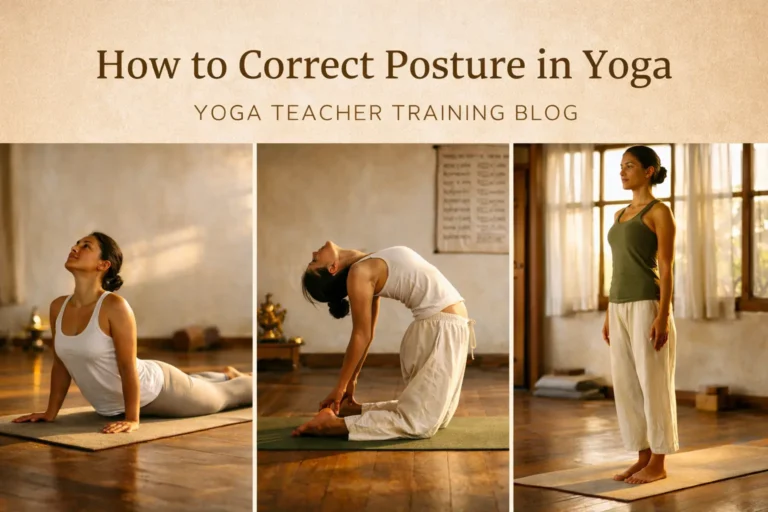
Stand comfortably and feel both feet on the floor while keeping the knees soft. Let the ribs and pelvis organise without pushing the chest forward or pulling the shoulders hard behind you. Use the pose to notice balance and breathing rather than trying to create a military-looking position.
Cat-Cow
Move the spine slowly between comfortable flexion and extension while breathing naturally. Keep the range smaller if the neck or lower back feels uncomfortable. The purpose is to explore movement and reduce stiffness, not to make the shapes as large as possible.
Low Lunge
A low lunge can help people who sit for long periods explore movement at the front of the hip. Use padding under the back knee when needed and keep the front leg in a position that feels stable. Stay within a range where you can breathe normally instead of chasing a very deep stretch.
Sphinx or gentle Cobra
Use a small backbend to practise upper-body extension without crushing the lower back. Keep the movement controlled and let the chest lift only as far as it can without strain. Several gentle repetitions may be more useful than one maximum hold when the goal is comfortable movement.
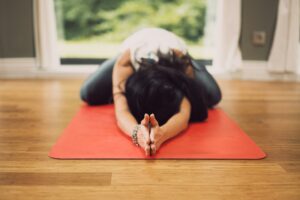
Supported Child’s Pose
Use this as a rest position when it feels comfortable for the knees, hips, and back, and place support under the body if needed. Not everyone finds Child’s Pose restful, so another comfortable resting position is completely acceptable. For a full timed sequence, use our 20–30 minute daily yoga routine for posture.
Desk and phone habits matter
One yoga session cannot cancel a full day of uncomfortable sitting if nothing else changes. Adjust the work setup so the screen is easier to see, the keyboard and mouse stay within easy reach, and the chair lets your feet rest on the floor or a stable footrest. Mayo Clinic’s office-ergonomics guidance also recommends keeping frequently used objects close, supporting the feet, and placing the monitor in front of you at a comfortable height. Phone use matters because repeatedly holding the device low or trapping it between the ear and shoulder can add strain. The most useful setup is not the one that looks perfect in a photograph; it is the one that lets you work with less reaching and gives you room to change position often.
- Use a chair that supports you comfortably.
- Keep the screen near a comfortable viewing height.
- Bring the keyboard and mouse close enough that you do not reach constantly.
- Use both hands for the phone when practical.
- Avoid holding the phone between your ear and shoulder.
- Take short movement breaks during long work periods.
Breathing and posture
Breathing should not require constant lifting of the shoulders or bracing of the abdomen. Slow, comfortable breathing can help you notice when the neck, chest, or stomach is working harder than necessary. The goal is not to force a large belly breath in every position, but to find a breathing pattern that feels calm and does not add extra tension.
Our diaphragmatic breathing guide explains a simple way to explore lower-rib and abdominal movement. Use it as a practice rather than a rule that every breath must look exactly the same.
Sleep and rest
No pillow or mattress can create perfect posture for every person. Choose a sleep position that is comfortable and lets you rest well, then look at the whole picture if you regularly wake with pain. Pillow height, mattress condition, sleep position, daytime activity, and existing health issues can all matter, so blaming one item is often too simple.
Posture mistakes to avoid
Trying too hard to look “correct” can create another kind of stiffness. Pulling the shoulders back all day, keeping the stomach tight, forcing the chin backward, or stretching aggressively may increase effort without solving the reason you feel uncomfortable. Aim for movement variety and usable strength rather than constant self-correction.
- Pulling the shoulders back all day.
- Keeping the stomach tight all day.
- Forcing the chin backward.
- Stretching aggressively because you feel tight.
- Trying to look perfectly symmetrical.
- Ignoring pain because you assume posture is the only cause.
A simple daily posture plan you can actually repeat
A practical posture routine does not need to become another long workout. Use short changes across the day instead of waiting until the evening to undo several hours in one position. In the morning, spend a few minutes moving the spine and hips; during work, change position and walk briefly; later in the day, add a little strength or yoga. The aim is to build variety into normal life so better habits do not depend on motivation. If a movement causes sharp pain, numbness, or weakness, stop and get appropriate advice rather than forcing the routine.
- Morning: 3–5 minutes of gentle spinal movement, shoulder movement, and easy standing.
- During desk work: change position regularly and take a short walking or standing break when practical.
- Midday: check screen height, foot support, and whether you are reaching unnecessarily for the keyboard or phone.
- Later: include strength, walking, or a short yoga session rather than relying only on stretching.
- Evening: notice which positions made you feel better or worse and adjust the next day instead of chasing one perfect posture.
If you want a longer practice, use the 20–30 minute yoga routine for posture. If the main problem is stiffness from sitting, start with the shorter habit changes above before adding more exercises. This keeps the advice realistic and makes it easier to stay consistent. Progress should be judged by comfort, movement options, and daily function rather than by whether your body matches one ideal posture picture.
Frequently asked questions
How long does it take to improve posture?
There is no fixed timeline because posture habits are influenced by activity, strength, mobility, pain history, work setup, stress, and how often you move. Some people notice comfort changes quickly while other changes take longer. Consistent movement and useful environmental changes matter more than chasing a promised number of days.
Can yoga fix bad posture?
Yoga can help with movement, strength, balance, breathing, and body awareness, but “bad posture” can have many causes and is not always a medical problem that needs fixing. Yoga should not be presented as a guaranteed cure. It is one useful movement approach among several that can support more comfortable daily habits.
Is a posture brace useful?
Some people may use a brace for a specific medical reason, but it should not automatically replace movement, strength, or professional assessment. If you think you need one because of pain, injury, or a diagnosed condition, ask an appropriate healthcare professional whether it is suitable for your situation and how it should be used.
Is the gym better than yoga for posture?
They can work together rather than competing. Strength training can build capacity and endurance, while yoga can add mobility, balance, movement variety, and body awareness. The better choice is the one that matches your needs, is practised consistently, and does not make pain or other symptoms worse.
Can you improve posture as an adult?
Adults can change posture habits, strength, mobility, endurance, and the way they organise common tasks, although not every structural difference needs to be “corrected.” Improvement usually means having more comfortable movement options and less unnecessary effort rather than forcing the body into one ideal shape. Work setup, activity level, pain history, and how much time you spend in one position all influence the result. If a posture change is limited by significant pain, injury, neurological symptoms, or a diagnosed condition, general exercises may not be enough. In that situation, individual assessment is more useful than chasing a generic before-and-after posture picture.
Does improving posture make you taller?
Improving posture does not lengthen adult bones or permanently increase your anatomical height. Some people may look or measure slightly taller when they stand more comfortably upright instead of collapsing or bending, but that is a change in position rather than true growth. Height also varies slightly during the day because the spine is loaded differently between morning and evening. Use posture work to improve comfort, movement, and function rather than as a height-increase method. Claims that a short posture routine will permanently add several centimetres should be treated cautiously.
The best posture is not one fixed posture
Your body is made to move, so aim for comfortable positions, useful strength, and regular movement rather than trying to hold yourself perfectly all day. A home setup that makes movement easier, plus a routine you can repeat, is usually more useful than constantly checking whether every joint is in the “right” place.