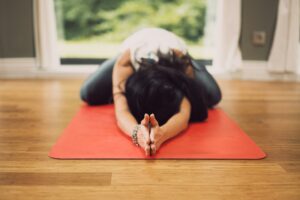
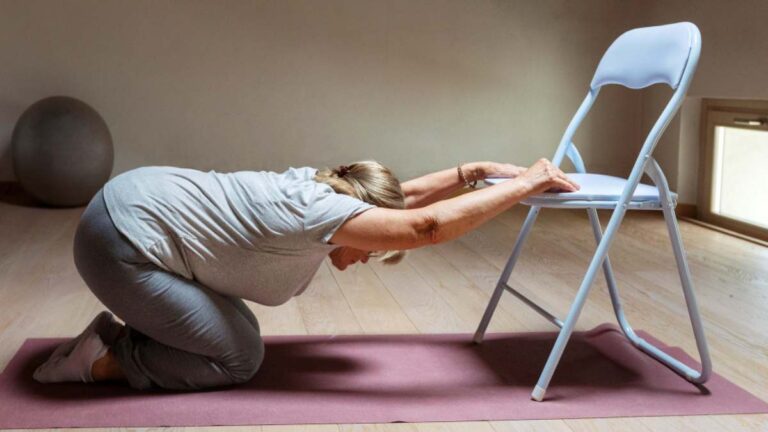
Chair yoga can make movement easier for some older adults because the chair gives support and reduces the need to get down to the floor. That can make practice more accessible for people with limited mobility, balance concerns, joint discomfort, or low confidence with floor work. But chair yoga is not automatically safe for every older adult, and it should not be presented as a cure for pain, balance problems, or age-related conditions.
Table of contents
- What research shows
- What happens in a chair-yoga class
- How to make chair yoga safer
- What a teacher should understand
- Simple chair-yoga ideas
- How to start safely
- Frequently asked questions
Is chair yoga good for seniors?
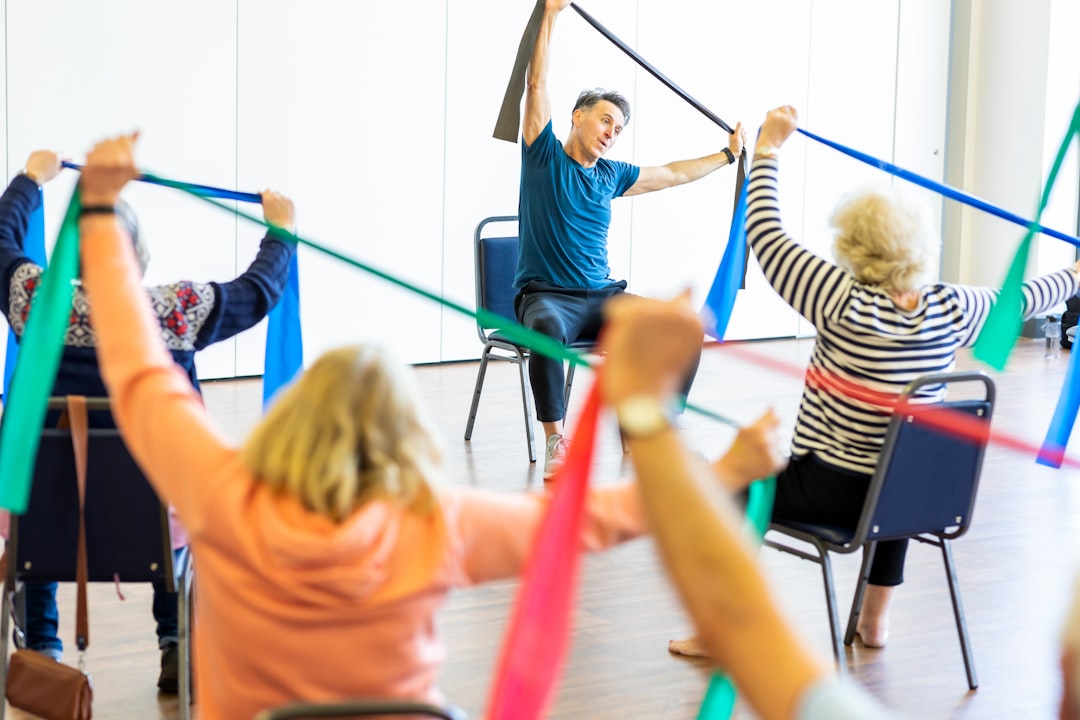
For some older adults, yes. Chair yoga can offer a supported way to practise gentle movement, breathing, and attention without requiring repeated floor transitions. Whether it is suitable depends on the person’s health, balance, mobility, medicines, and current medical conditions. A healthy 68-year-old who walks every day may need something very different from an 88-year-old recovering from surgery.
This is why a good chair-yoga class should be adaptable. The chair is a useful tool, but it is not a guarantee of safety, and it should not be used to make every student do the same movements. The teacher still needs to watch how the person moves, offer simpler options, and avoid pushing through pain or instability.
What does research actually show?
One often-cited randomized controlled trial studied 131 older adults with lower-extremity osteoarthritis. The chair-yoga group attended 45-minute sessions twice a week for eight weeks. The study reported lower pain interference and some short-term improvements during the intervention, but balance did not improve and many benefits were not sustained after the program ended.
That is an important distinction. The study supports chair yoga as an accessible movement option worth studying, but it does not prove that chair yoga treats arthritis, fixes balance, or produces the same result for every older adult. One study in one group cannot answer every question about long-term outcomes, different health conditions, or different class styles. You can read the study abstract on PubMed.
Broader research on yoga for older adults is somewhat more encouraging, but it should not be confused with chair-yoga evidence. A systematic review and meta-analysis of randomized trials in older adults reported improvements in areas such as balance, lower-body flexibility, and lower-limb strength compared with inactive controls. Those studies included different yoga styles and were not all chair-based, so they cannot be used to claim that every seated program will produce the same results. The responsible conclusion is that yoga can be adapted for older adults and may support physical function, while the exact benefit depends on the program, the person, and how consistently it is practised.
What happens in a chair-yoga class?
A chair-yoga session may include seated breathing, neck and shoulder movement, gentle spinal movement, ankle and foot work, seated twists, and supported standing exercises. The chair may be used as a seat, as a hand support during standing work, or as a reference point that makes movement and transitions more predictable. The class should be built around the people present rather than forcing every traditional floor posture into a chair.
- As a seat: useful for people who do not want or cannot comfortably sit on the floor.
- As support: a hand can rest on the chair during standing movement or small weight shifts.
- As a reference point: the chair can make transitions slower and easier to organise.
Why is chair yoga becoming more popular?
Chair yoga has become more visible because people are looking for movement that can be done at home with little equipment and less floor work. A YogaEarth analysis of Google Trends data from 2021 to 2026 reported large relative increases for searches such as “free chair yoga for seniors,” “chair yoga exercises,” and “chair yoga for seniors.” Those figures describe relative search interest, not exact monthly search volume or proof that the method works for everyone.
How to make chair yoga safer
Safety starts with the setup and the pace of the class. Use a stable chair without wheels and place it on a non-slip surface. Standing up, turning, and sitting down can be harder than the yoga movement itself for someone with poor balance, so transitions should be slow and simple. A folding chair should be used only if it locks securely and is suitable for the person’s weight and movement.
Pain should not be treated as a goal. Sharp pain, new chest pain, faintness, severe shortness of breath, sudden weakness, or other concerning symptoms need appropriate medical attention rather than a yoga modification. Someone with recent surgery, unstable heart or blood-pressure problems, severe osteoporosis, recent falls, neurological conditions, or another significant health concern should ask an appropriate healthcare professional what activity is suitable.
The NCCIH yoga overview notes that yoga is generally considered safe when practised appropriately, while injuries can occur and some people with health conditions may need modifications. Chair yoga should follow the same principle: make the practice fit the person rather than asking the person to fit the practice.
What should a chair-yoga teacher understand?
A good teacher should be able to make movement simpler without talking to older adults as if they are children. They should ask about important limitations, offer choices, watch balance carefully, and avoid turning the class into a performance. They should also understand scope of practice: a yoga teacher can guide movement and breathing within their training, but should not diagnose a condition or promise a medical outcome.
This kind of judgement is one reason teacher education matters. Anatomy, observation, communication, and teaching methodology all become important when a class includes people with very different needs. Our yoga teacher training curriculum guide explains how these areas fit into foundational teacher training.
Five simple chair-yoga ideas
These examples are educational ideas rather than a personal exercise prescription. Each movement should stay within a comfortable, controlled range, and a person should stop if they feel pain, dizziness, or instability. The right version is not the deepest movement; it is the version the person can do with control and steady breathing.
- Seated breathing: sit comfortably and notice natural breathing without forcing depth.
- Shoulder circles: move slowly through a comfortable range.
- Ankle movement: lift one foot slightly and move the ankle gently if balance and comfort allow.
- Seated side reach: keep one hand supported while the other arm reaches only as far as comfortable.
- Supported standing: hold the back of a stable chair and practise a small weight shift instead of a difficult balance pose.
How to start chair yoga safely
Start with a short session and choose movements that can be done without rushing. Use a stable chair on a non-slip surface, keep both feet supported when seated, and make standing work optional. A first session does not need to include every movement in the article. Five to ten comfortable minutes can be enough to learn how the body responds before adding more.
It is also useful to separate normal effort from warning signs. Mild muscular effort can be expected, but sharp pain, dizziness, chest pain, faintness, unusual breathlessness, or sudden weakness are reasons to stop. If an older adult has had recent surgery, repeated falls, major balance problems, unstable heart or blood-pressure conditions, or another significant medical concern, the safest starting point is individual guidance from an appropriate healthcare professional.
How to choose a chair-yoga class for an older adult
Look for a class that explains who it is for, what level of mobility is expected, and whether standing work is optional. A good teacher should ask about recent falls, major health concerns, surgery, pain, and anything that affects balance without turning the class into medical treatment. The chair should be stable, the pace should allow time for transitions, and students should be encouraged to stop rather than push through symptoms. Avoid classes that promise to cure arthritis, reverse ageing, fix balance, or guarantee weight loss. If someone is new to yoga and wants a broader starting point, our beginner yoga guide for seniors explains how to start gradually.
If the student already knows the basic movements and wants a simple home structure, use the 28-day chair-yoga practice guide as a separate practice resource. That article focuses on routine and progression, while this page remains focused on the research question: whether chair yoga can be a useful option for seniors and what the evidence actually supports. Keeping those two purposes separate helps readers and search engines understand which page answers which question.
Frequently asked questions
Is chair yoga only for seniors?
No. Chair yoga can also be useful when floor transitions are difficult, during some types of recovery when medically appropriate, at a desk, or for anyone who wants more support. The method is defined by how the chair is used, not by the age of the student. A younger person with limited mobility may find the same supported format useful.
Can chair yoga improve balance?
Do not assume that it will. The osteoarthritis trial discussed above did not find a balance improvement, and balance often needs specific standing and functional practice. A chair can make some exercises safer, but relying on it for every movement does not automatically train unsupported balance. The right approach depends on the person’s current ability and fall risk.
Is chair yoga safe for seniors?
Chair yoga can be a safer and more accessible option for some older adults, but the chair does not remove every risk. Falls can happen during standing transitions, and certain movements may be unsuitable after surgery or with unstable heart, blood-pressure, bone, neurological, or balance conditions. Use a stable chair on a non-slip surface, keep movements within a comfortable range, and allow standing work to remain optional. A teacher should adapt the class to the person rather than assume that age alone determines what is safe. Anyone with a significant medical concern should ask an appropriate healthcare professional what level of activity is suitable.
How often should seniors do chair yoga?
There is no single frequency that fits every older adult. Health status, current activity level, recovery, medicines, and class intensity all matter. A shorter comfortable practice done consistently may be more useful than suddenly doing long daily sessions. People with significant health concerns should base frequency on appropriate professional guidance.
Can chair yoga help with weight loss?
Chair yoga should not be sold as a guaranteed weight-loss method. Body weight is affected by food intake, total activity, sleep, medicines, health conditions, and many other factors. Different chair-yoga classes also have very different energy demands. It can be one form of movement, but it should not be presented as a stand-alone promise for weight change.
Is YouTube chair yoga safe?
A video cannot fully see the person practising or change the class when something looks wrong. Choose conservative instruction, use a stable setup, and avoid copying movements that do not feel appropriate. Someone with important balance, heart, neurological, bone, or recovery concerns may benefit from individual professional guidance instead of relying only on a video.
Accessible does not mean careless
Chair yoga can remove some barriers to yoga practice, and that is its main value. The method works best when movement is adapted to the person rather than when large promises are made about age, pain, or disease. A stable setup, clear teaching, sensible pacing, and respect for individual limits matter more than trying to make the class look impressive.
For a broader beginner perspective, read how yoga beginners can build a foundation.
Sources used for this guide
- Park et al., chair-yoga randomized controlled trial
- Systematic review and meta-analysis of yoga in older adults
- NCCIH yoga safety overview
- YogaEarth Google Trends analysis