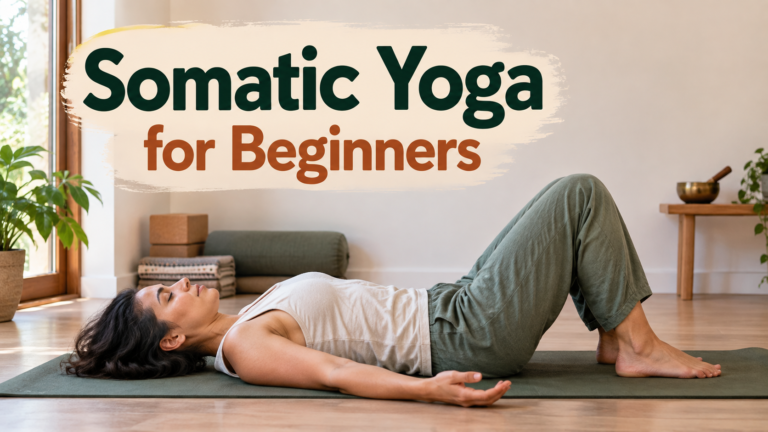
Somatic yoga is a modern term for slow, yoga-informed movement that asks you to notice how movement feels inside your body. It is usually less pose-driven than a standard group class and gives more attention to sensation, effort, breathing, and small changes in movement. The term is used in different ways, so the class description and the teacher’s method matter more than the label itself.
What is somatic yoga?
Somatic yoga is not one ancient yoga system with a fixed syllabus. Today, the term is commonly used for classes that combine yoga shapes, breath, and slow movement with close attention to internal sensation. The word somatic refers to experiencing the body from within, so a teacher may ask you to notice pressure, effort, ease, temperature, breathing, or differences between the two sides of the body.
A movement may be repeated slowly instead of being held as a perfect pose. The question changes from “Does this look correct?” to “What do I notice when I move this way?” That does not make somatic yoga a replacement for traditional Hatha Yoga. It is better understood as a modern teaching approach that can overlap with yoga, somatic education, mobility work, and relaxation practices.
Why is somatic yoga suddenly everywhere?
Search interest has grown sharply over the last several years. A YogaEarth analysis of Google Trends data for 2021 to 2026 reported strong relative growth for “somatic yoga” and “what is somatic yoga.” Those figures describe changes in relative Google Trends interest, not guaranteed monthly search volume, but they do show that more people are asking about the term.
The wider wellness market is also paying more attention to nervous-system language, gentle movement, and mind-body practices. The Global Wellness Institute’s 2026 yoga trends highlights growing interest in nervous-system regulation and related approaches. That popularity also creates a problem: the word can be used so loosely that almost any slow stretch is labelled “somatic.”
What happens in a somatic yoga class?
There is no universal class format, but a somatic-style class often uses small movements, lying or seated work, pauses between movements, gentle breath awareness, and questions about sensation rather than appearance. Repetition may be used to compare how a movement feels before and after a small change. The aim is usually to increase awareness rather than to reach the deepest version of a posture.
- Small, slow movements rather than fast flows.
- Lying or seated work with less pressure to reach a final pose.
- Pauses that give time to notice changes in effort or breathing.
- Questions about sensation rather than how the pose looks.
- Repetition used to compare how movement feels.
For example, instead of moving directly into a deep spinal twist, a teacher may guide a small rocking movement and ask you to notice where the ribs, pelvis, and breath move easily. The learning comes from attention rather than making the twist bigger. A clear teacher should be able to explain what makes the method different without relying on vague or mysterious language.
Somatic yoga vs traditional yoga styles
The main difference is usually the teaching emphasis rather than a completely different set of movements. Traditional Hatha Yoga can include asana, pranayama, concentration, philosophy, and other practices. Vinyasa normally links movement and breath in more continuous sequences, while Yin Yoga often uses longer, relatively still holds. Somatic yoga usually puts the strongest emphasis on sensing and exploring movement from within.
Traditional Hatha Yoga
Hatha teaching can include clearly named postures, pranayama, concentration, philosophy, and other established techniques. A thoughtful Hatha teacher may already ask students to notice breath, pressure, balance, and unnecessary effort, so internal awareness is not unique to a modern somatic class. FitFortunes’ Hatha yoga teacher training teaches this broader traditional framework.
Vinyasa
Vinyasa classes often connect movement with breath through a sequence. The pace can vary, but the structure normally has more continuous movement than a typical somatic class. A Vinyasa teacher can still use mindful observation, but the class usually has a clearer movement flow and a stronger sequence-based structure.
Yin Yoga
Yin Yoga often uses longer, relatively still holds, while somatic practice is usually more interested in active sensing and small exploratory movement. The two can overlap because both may be slower than a typical flow class. They are still not the same method, and a teacher should explain which approach is actually being used.
Can somatic yoga release trauma, lower cortisol, or cause weight loss?
Be careful with these claims. Slow movement and mindful attention may feel calming for some people, but feeling calmer is not the same as proving that a class treats trauma, changes hormone levels, or produces weight loss. Trauma treatment belongs within appropriate mental-health care, hormone claims require proper measurement, and body-weight changes depend on many different factors.
The U.S. National Center for Complementary and Integrative Health provides an evidence-based overview of what research says about yoga and safety. Research on yoga as a broad category should not automatically be treated as proof for every new style or branded method. A yoga teacher should describe a gentle movement class clearly without turning it into a medical promise.
Is somatic yoga good for beginners?
It can be accessible because movements are often slower and smaller, and there may be less pressure to reach a final pose. But “gentle” does not mean suitable for every person or every health condition. A beginner should look for a teacher who gives clear options, does not promise cures, and encourages students to stop when movement causes pain, dizziness, or another concerning symptom.
If your goal is broader yoga education rather than one modern movement method, it helps to understand the foundations first. Our beginner yoga teacher training guide explains what foundational study can include and how to judge whether a course is suitable for someone new to teacher training.
Can traditional yoga already be somatic?
Yes, in the ordinary sense of paying close attention to lived bodily experience. Traditional yoga teachers have long used breath, attention, balance, effort, and internal awareness as part of practice. What is newer is the current “somatic yoga” label, the influence of modern somatic education systems, and the way the term is marketed online. The useful part is the quality of attention, not simply the trend name.
Frequently asked questions
Is somatic yoga an ancient style of yoga?
No single ancient lineage called “somatic yoga” has one standard method. The current term is modern and different teachers use it in different ways. Some classes draw mainly from yoga, while others also include ideas from somatic education, mobility work, or relaxation practices. Ask the teacher what they mean by the term instead of assuming every class is the same.
Do I need to be flexible?
No. Many somatic-style practices use small ranges of movement and do not make flexibility the main goal. The emphasis is usually on noticing how the movement feels and whether effort can be reduced. A smaller controlled movement can be more useful for this kind of learning than forcing a larger range.
How often should I do somatic yoga?
There is no universal required frequency. A short, comfortable practice may be more useful than forcing a long session simply to meet a schedule. The right frequency depends on the method you are learning, your current activity level, and your health needs. Consistency matters more than trying to do as much as possible.
Is somatic yoga therapy?
A yoga class should not automatically be described as therapy. Licensed or regulated therapeutic care has different professional responsibilities depending on location. A somatic-style yoga teacher can guide movement and awareness within their training, but should not diagnose a mental-health or medical condition unless they hold the appropriate separate qualification.
Why does it feel different from a normal yoga class?
The teacher may spend more time on sensation, repetition, and small movement and less time on completing a sequence of named poses. Pauses are often part of the learning because they give you time to notice change. That slower pace can feel very different from a Vinyasa or fitness-style class even when some of the basic movements look familiar.
The useful part is attention, not the trend label
Somatic yoga can offer a slower way to explore movement, but its popularity is also a reason to ask better questions. Who trained the teacher? What method are they using? What claims are they making? Is the class education, exercise, relaxation, or therapy? Clear answers matter more than fashionable language or a new name attached to an old idea.
Sources used for this guide
- YogaEarth Google Trends analysis
- Global Wellness Institute 2026 yoga trends
- NCCIH yoga evidence and safety overview