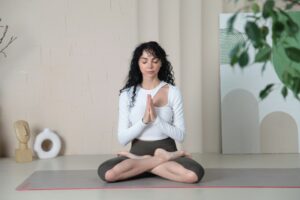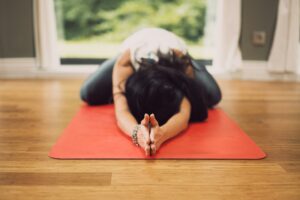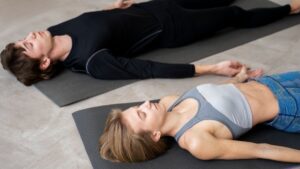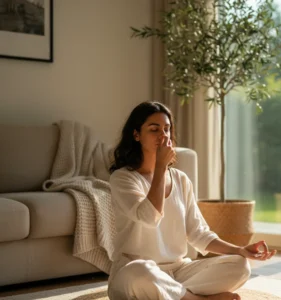
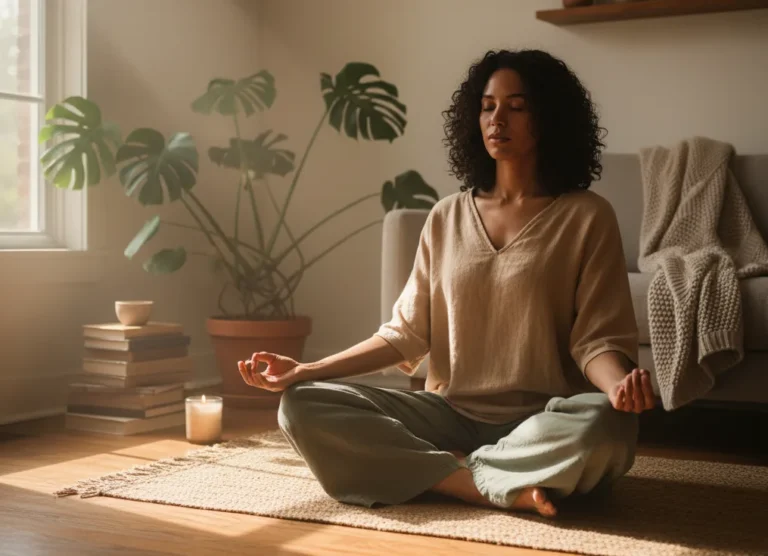
Yoga and self-knowing meet most clearly in the practice of observation. Yoga does not make you understand yourself automatically, and a difficult posture does not reveal a hidden personality trait. What practice can do is give you repeated chances to notice breath, effort, attention, habits, reactions, and choices more clearly. In classical yoga, this kind of self-study is closely connected with svadhyaya.
What does self-knowing mean in yoga?
Self-knowing in yoga is not simply analysing your personality or trying to produce constant calm. It can include noticing how the mind reacts, what habits repeat, where attention goes, and how your actions match the values you say are important. Svadhyaya is commonly translated as self-study and is one of the niyamas described in Patanjali’s Yoga Sutras, where practice includes ethical discipline as well as meditation and physical preparation.
Study can include classical texts, reflection, and observation of daily behaviour. The important point is that self-study is not limited to reading books and it is not limited to introspection either. Yoga asks whether understanding changes the way you act, speak, practise, and respond when life is not going the way you expected.
Asana can show habits, but not hidden meanings
Physical practice can reveal useful habits because you can notice whether you rush, hold the breath, compete, avoid difficulty, or push through pain. Those observations may tell you something about how you approach practice, but they do not prove that a tight hip represents a particular emotion or that one pose exposes a fixed personality trait. It is better to stay with what you can actually observe.
For example, struggling in a balance pose may simply show fatigue, unfamiliarity, vision, ankle control, or concentration on that day. The self-study comes from noticing your response: do you become frustrated, laugh, slow down, or keep forcing the pose? That kind of observation is useful because it is grounded in behaviour rather than symbolic storytelling.
Breath awareness and self-observation
Breathing is useful for self-observation because changes in effort, speed, and tension are easy to notice. During practice, you may discover that the breath becomes shallow when you hurry or that the shoulders tighten when a posture feels difficult. That does not diagnose your emotional state, but it gives you immediate information about how the body is responding to the task.
Beginners can start with simple breath awareness before using stronger pranayama techniques. Breath retention and forceful methods are not necessary for learning self-awareness and may be unsuitable for some people. Our diaphragmatic breathing guide gives a simple practice that focuses on comfortable observation rather than forcing the breath.
Meditation makes patterns easier to notice
Meditation gives you fewer external tasks, so distraction itself becomes easier to see. You may notice planning, remembering, judging, daydreaming, or repeatedly returning to the same concern. The goal is not to stop every thought immediately. A more useful first step is recognising that attention has moved and learning to return without turning the distraction into another reason for self-criticism.
Five or ten minutes can be enough for a beginner to learn this pattern. Longer sessions are not automatically deeper, and restlessness does not mean the practice has failed. Our beginner meditation guide explains how to build a simple home practice without needing a complicated ritual.
What yoga texts add to self-study
Texts such as the Yoga Sutras and Bhagavad Gita give students language for examining discipline, attachment, action, attention, and the relationship between practice and daily life. They should not be reduced to motivational quotes. A verse becomes more useful when you study its context, compare interpretations, and ask how the idea changes the way you understand your own choices.
FitFortunes includes yoga philosophy within teacher training because future teachers should understand more than posture names. The teacher training curriculum guide shows how philosophy, meditation, anatomy, teaching methodology, and practicum fit together rather than treating self-study as a separate inspirational topic.
Journaling can support reflection
Journaling is not a classical requirement for yoga, but it can be a practical modern tool for noticing patterns over time. Instead of writing pages after every class, record one or two observations that are specific enough to compare later. You might note where you rushed, what made concentration easier, how sleep affected practice, or which teaching cue finally made sense.
- What did I notice before practice?
- Where did I add unnecessary effort?
- What distracted me most?
- What changed after breathing or meditation?
- Did anything from practice affect a decision later in the day?
Self-knowing has to reach daily life
Yoga becomes more meaningful when observation leaves the mat. You may begin to notice how quickly you interrupt someone, how you react when plans change, whether you keep promises to yourself, or how often you act from habit without considering the result. These are ordinary situations, but they give self-study something concrete to work with.
The point is not to monitor every thought and become self-conscious all day. It is to create enough space to recognise a pattern before it controls the next action automatically. Sometimes that leads to a different choice; sometimes it simply shows you the same habit more clearly. Both can be part of learning.
Common mistakes in self-study
Self-study becomes less useful when it turns into constant judgement or mystical interpretation. Not every sensation needs a symbolic meaning and not every difficult day means you have discovered a deep inner problem. A grounded practice uses curiosity, context, and patience, especially when the subject is emotionally important.
- Expecting one meditation session to create permanent clarity.
- Comparing your inner experience with another student’s story.
- Assuming every body sensation represents an emotion or memory.
- Using “awareness” to ignore pain or other practical problems.
- Reading quotes without studying their context.
- Turning reflection into self-criticism.
Frequently asked questions
Is self-knowing the same as enlightenment?
No. Self-study can be part of a larger philosophical or spiritual path, but noticing habits and reactions should not be confused with claiming a final spiritual state. Classical yoga traditions use different concepts and interpretations for liberation, knowledge, and meditation, so one modern phrase should not be made to carry all of them.
Which yoga style is best for self-awareness?
No single style owns self-awareness. Hatha, meditation, pranayama, and even a vigorous asana practice can support observation when they are taught with enough attention and context. A style that keeps you engaged and gives you room to notice your reactions may be more useful than choosing one because it is marketed as more spiritual.
Can journaling replace meditation?
They do different things. Journaling turns observations into words and can help you compare patterns over time, while meditation asks you to observe experience more directly without immediately explaining it. You can use both, one, or neither depending on your practice, but they should not be treated as identical methods.
Can yoga help me manage emotions better?
Yoga may help some people notice tension, breathing, and reactions earlier, which can create a pause before responding. That is different from treating an emotional or mental-health condition. When distress is persistent, severe, or difficult to manage, appropriate professional support is more important than expecting yoga alone to solve it.
Self-knowing is a practice of attention
Yoga does not hand you a finished answer about who you are. It gives you repeated situations in which you can observe attention, effort, habit, reaction, and choice. With time, those observations can become clearer and more useful, especially when practice is supported by study and honest reflection rather than dramatic interpretations of every pose or feeling.