Category: Health

  • 7 Exercise Substitutions for Faster Fat Loss Without Gym

    To to start with everyone moving towards better health and Beach Body. And, in this self-care people first choice is joining a gym for exercise. Those highly equipped gyms with fantasy new school machines will easily make your body drooling until you start using them. And yes, they all offering you a good package and transformation dreams.
    But, Transformation doesn’t come from machines, packages or from dreams. Transformation comes with a dedication to yourself.

    Many people think joining a good gym is the first need to start their journey.  Nevertheless its a good choice for self-care. But what to do when you are not around to your favourite machines.

    In fact, I Body weight exercises getting more popular nowadays instead of using exercise machines and one of the big reason is, It’s a functional movement and our daily life depends on our movements and mobility.

    Function Movement

    Now, the term “Functional movement” gets thrown around a lot in the fitness industry. However, it simply reflects activities and movement patterns in your daily life. Every such movement requires the use of your full body, right? So why eliminate it and train in a fixed range of motion with machines?

    You see, the shiny, expensive machines at the gym may seem like the right idea, but it’s not necessary to get a time efficient, fat burning workout.

    Want to be able to keep up with your kids for hours? Plus lose a ton of fat, build a better body, and not to mention, feel totally awesome?

    Try these 7 simple exercises will help improve your coordination and core strength so you burn more calories and feel a million bucks. Moreover, you could do all of these at home or even when you are travelling around for some days.

    1. Hip Machines – Lateral Lunges

    Why? The fixed range of motion on the inner/outer thigh (aka adductors/abductors) machine targets one area on your hip. But there’s nothing remotely like these movements in real life! These muscles are designed for stabilizing – so that’s how you should train them.

    Try lateral lunges instead. This exercise targets your glutes, inner thigh, hamstrings and quads – plus requires core engagement and integration. You will improve your hip mobility, lower body stability and burn more calories in the process.

    Lateral Lunge
    Lateral Lunge

    2. Chest Press Machines – Push Ups

    Why? Go for push-ups. This move is simply a moving plank (one of my favourite core exercises).

    If you can’t do a full push up yet, make that your first goal. Start with an incline (raise your hands, rather than drop your knees to the ground). No girly push-ups, ok? Knees to the floor and you lose core involvement, which is a major component of a full push up.

    Push Up
    Push up

    No problem busting out a ton of push-ups? Challenge yourself – try decline push-ups, Spiderman pushups or suspend your feet from a TRX and do Atomic Push Ups. Oohh my abs hurt just thinking about it. 😉

    3. Incline Leg Press – Squats

    Why? The leg press machine puts a ridiculous amount of force on the discs in your lower back. The expert research on this topic speaks for itself.

    Dr. Stuart McGill has dedicated his whole life to researching lower back disorders and is a professor of spinal mechanics at the University of Waterloo. His book “Low Back Disorders” has quality research that suggests the 45-degree leg press machine could seriously damage your lower back.

    Trx Squats
    Trx Squats

    Learn to love squats. Your bodyweight is the perfect resistance to start with. Work to improve your mobility, and core integration before you add weight to mix.

    4. Glute machine – Step Ups

    Why? Get a sexy butt without spending an hour at Barre class. Switch to step ups – there are plenty of variations to sculpt a lean, defined butt without stepping anywhere near a machine.

    As a bonus, you engage your core at the same time and this movement transfers to your daily life. Climbing the stairs? It will be a breeze.

    5. Leg Extension Machine – Lunges

    Why? Target your quads, hamstrings and glutes all in one move. Isolating and training only your quads on the leg extension machine not only sets you up for muscle imbalances, but it causes excessive strain on your knee.

    Once you have the basic lunge down, progress to reverse lunges and the Bulgarian split squat. Oohh good times. Expect burning quads. Sexy burning quads.

    pexels photo 999257
    Lunges

    6. Bicep Curls Machine – Chin-ups

    Why? The bicep curl is an isolated exercise, hitting one muscle group. Maximize your time and hit the whole upper body instead – yes, chin-ups are a tough exercise that requires multiple, large muscle group recruitment.

    Pull ups
    Pull ups

    Struggling to pull your bodyweight? You can use a resistance band for assistance or do negative chin-ups. You will get stronger, burn more calories in less time and your biceps will look lean and sexy.

    7. Elliptical/Treadmill Intervals – Bodyweight Cardio Intervals

    Why? Getting tired of the same old interval workout? Yeah, I know intervals of “30s on, 30s off” gets awfully boring after a while…

    Try doing these Bodyweight Cardio Accelerator Intervals instead. Why? Well, it’s WAY more fun. Plus, this style of workout combines big movements that hit multiple muscle groups at the same time so you boost your metabolism and burn a ton of calories.

    You will also notice a dramatic difference in your metabolism after just ONE workout, and your body will start changing in days.

    Get Bodyweight Cardio 500 here

    If you’ve ever invested in a program, thinking you were getting “no equipment” workouts, only to find out later on that you actually needed a pull-up bar and a stability ball. You’ll be happy to know that with Bodyweight Cardio 500 you literally need ZERO equipment to rapidly lose fat.

    The workouts not only allow you to sculpt your abs, but they will burn away your ugly belly fat as well.[/et_pb_text][/et_pb_column]

  • PanchaKarma The Ayurvedic Detoxification Treatments

    PanchaKarma
    PanchaKarma The Ayurvedic Detoxification Treatments
    Not to mention Ayurveda has given the world innumerable things. These things have helped to transform a world full of ailments to one which is fit and healthy. The endless significance of Ayurveda providing you with an alternative way of medication. Being the most prestigious branches of Ayurveda. Also, acts as a pillar for most of the healing technique of Ayurveda.
     
     
      Panchakarma is much needed for everyone after a certain time. Not just, it eliminates toxins from the system. As well as, Rebalances the Doshas and heals countless ailments. At the same time, renews a sense of clarity and inner peace.

    Oleation –  Ayurveda includes the usage of various oils. Which are homegrown with various mineral ingredients. In addition to, These oils differ from the oils or ghee that used for internal applications. These mineral richen oils find profound tissues to carry the medicinal ingredients. And, suck out the toxin from other cells.
     
    Fomentation – The process of sweat production called fomentation. The targeted tissues of oleation made more flexible and delicate by fomentation treatments. So, The toxin released gets melted and flushed out of the body.


    Herb
    Herb
    Its a five-step, total mind-body rejuvenation experience. That comprises of herbal oil massages, steam baths, cleansing enemas. And, other purifying practices. Following are the 5 therapies of “Panchakarma”:
     

    Vaman

     
    In these treatments, the patients provided with oleation and fomentation treatments. In fact, for A couple of days which includes various sessions of therapies and medicines. Once the targeted cells release their toxins. They get accumulated on the upper cavities. And, then the patients treated with decoction and emetic medicines. These medicines aids in disposing of the poisons out from the body through vomiting. This treatment suggested for those who have kapha-dominated conditions. As well as undergo weight gain, hyperacidity, and asthma.

    Virechan

    In this, the patients provided with outside and inside oleation and fomentation treatments. But, the disposal of toxins is not through vomiting but through the clearing of bowels. The patients treated with natural purgative. Which aids in the clearing of bowels purifying the body toxins. The targeted patients are those who are suffering under Pitta- dominated diseases. Including jaundice, celiac infections etc.

    Basti

    Basti treatment said to have incredible many positive effects. This process includes the regulation of medicated substances through an enema. Therefore, considered as an exceptional contribution to the therapeutic world. After understanding your nature of disease homegrown decoction, ghee and oils managed into the rectum. This treatment is useful for patients suffering against vata dominated conditions. And also against chronic diseases.

    Nasya

    This therapy has an effective cleaning effect in the head area. This treatment starts with a head and shoulder massage followed by fomentation. After that, they apply nasal drops administered in both the nostrils. This follows the complete cleaning of the area giving you freedom. From any sort of cerebral pain, hair issues, sleep disorders, sinusitis. And also, respiratory ailments.

    Raktamokshan

    This treatment used to fight against various skin ailments. And also, help in cleansing the impure blood. You can target a particular body part or cover up the whole body. Also, practices fighting against skin infections, eczema and in local lesions.

    Precautions of Panchakarma.

    However, panchakarma dont have any side effect. Still, These treatments should be avoided during pregnancy and disease. Before taking up such treatment do get a consultation from a trained and qualified physician. Who will help you to plan for therapy according to your state of health.

    Experience the serenity of Rishikesh and elevate your yoga practice with our 200 Hour Yoga Teacher Training. Don’t miss this opportunity to train in the yoga capital of the world. Enroll today!

  • Pancha Mahabhutas and Their Importance

    Pancha Mahabhutas and Their Importance

    Pancha Mahabhutas and Their Importance

    Panchamahabhutas
    Panchamahabhutas

    Panchamahabhuta , Our lives are governed by different elements and sensations. How we think, consume and reciprocate to the universe around us depends upon the essence of the world.
    These essences perceived by us as 5 elements. Known Panchamahabhutas.
    According to Ayurveda, all objects in the universe including human body are composed of these 5 basic elements.
    They govern our sensory nerves and help us achieve an understanding of our actions.
    But, each of the Tanmantras connects to elements of nature. Akash(sky), Vayu(air), Aag(fire), Jal (water), Dharti(earth). They blend while giving us a simpler understanding of how each function works.

    1.Ether (Akash)

    Ether or Akash means infinite freedom. It is a limitless space with the power to create movement between objects and have them correspond, creating Shabda (sound), the ether Tanmantra.
    When two atoms or objects physically touch, the small sound of thud or a tap is resonated throughout the space. It forms a frequency of soundwave which we feel through auditory senses.

    Sky
    Aakash


    2. Air (Vayu)

    The function of air is to help elements relocate and travel. It is in constant movement, helping different molecules to come across each other creating a small touch. The Tanmantra for such a sensation is called Sparsha (Touch). The skin is sensitive and can perceive any small change over the surface. If there is an amount of pressure, drop of water or a fallen leaf the skin will sense it immediately and detect the different feel of different elements.

    Vayu
    Vayu


    3. Fire (Tej)

    Fire, Created through aggressive friction of two elements. When two elements touch during movement through Vayu, they might spark a heat and thus the birth of tej. This bright fire is blazing and a bright source of light. This light can be visualized in front of us with the help of Vision (Rupa). Rupa means the physical manifestation of an element which is perceived steadily.

    candles 1645551 340
    Aag


    4. Water (Jala)

    Water brings about fluidity. it helps in connecting two molecules together which help both in a proper formation. The function of water, To glue two different objects to form one.
    In the same way, the use of our mouth is to chew and identify what we have eaten. The Tanmantra, Taste (Rasa) helps in forming a taste once food reaches your mouth. It binds a dry element with water, making it easier to shape.
    Jala helps a being taste food, understand the quality and appearance of the food inside your mouth and experience a sense of fulfilment. The saliva in our mouth acts as Jala in such a scenario.

    Jala
    Jal


    5. Earth (Prithvi)

    Earth, a solid mass. Hard on the outside, changes temperature along with seasons and has a solid foundation. So, A dense and hard structure to form on the surface of the earth. Parts of our bodies constitute of Prithvi. Our bones, muscles and physical strength are objects formed through the earth we live in.
    How we perceive the earth is through our nose. Yes, our sense of smell (Gandha) helps in identifying objects around us with the sense of smell. Gandha helps in understanding the quality and quantity of objects around us through our nasal sensory.

    Dharti
    Dharti


    Pancha Mahabhutas: five elements in one table

    ElementSanskritTraditional association
    SpaceAkashaOpenness and sound
    AirVayuMovement and touch
    FireAgni/TejasHeat and transformation
    WaterJalaFluidity and taste
    EarthPrithviStability and smell

    This is a traditional Indian philosophical and Ayurvedic framework. It should not be confused with the modern scientific periodic table or literal chemical elements.

    Frequently asked questions

    Are the Pancha Mahabhutas scientific elements?

    No. They are part of traditional Indian philosophical and medical models, not modern chemistry.

    How are they related to yoga philosophy?

    They appear in wider Indian thought about body, perception and nature. For related reading, see our three Gunas guide and Karma article.

  • Top Yoga Poses to cure depression and anxiety

    Top Yoga Poses to cure depression and anxiety

    Yoga Poses That May Support Depression and Anxiety Care


    Have you ever felt too tired to get out of bed, even after a whole night of sleep? Or cancelled on meeting a friend as it got too overwhelming suddenly.
    These are not signs of laziness. Yes, many people feel we are too lazy to perform day-to-day activities and want the easy way out. But in reality, there is just a huge amount of sudden emptiness we can’t seem to shrug off.
    Depression is a serious medical condition which requires urgent help from psychiatrists. Ignoring it might lead to suicidal thoughts a worst.

    Before going into deep meditation stage you need to follow the simple niyam/Rules of Yoga. In addition, medications for depression or stress need a lot of time to reach that level. Cause, we can not get into that stage of self-awareness very quickly. But, with the help of some yoga asanas, everything is possible. Yoga helps improving blood circulation to our brains. It also increases the production of mood-enhancing hormones to help us feel relaxed.

    1. Bridge Pose (Sethu Bandhasana)

    Lie down on your back on a flat surface. Use your yoga mat. Now, place your arms parallel to the body, palms on the mat. Bend your knees and drag your feet towards your hips. Also, make sure your feet on the floor are slightly apart. Now, start lifting your hips up. Raise your lower back off the floor too. Then your upper back. During this, Your torso should touch the chin.

    https://www.youtube.com/watch?v=M2GMl7usr8U

    in Addition, squeeze your hips together and push them upwards. So, mainly both the sole of your feet, your shoulders and back of the head is grounded, Rest of the body in the air making like a bridge.
    Hold the stance for 3-5 seconds and relax back. Repeat it a few more times. Keep your Face relaxed.

    2. Standing Forward Bend (Uttanasana)

    Stand straight and let your feet be close to each other. Put the hands on your hips and Roll back your shoulders. so that your chest will pump up. Now, Bending from the hips Lean your upper body forward and bring it down. Keeping your spine straight Balance the stance by letting the arms extend down to hold the floor. Your arms should be right below the shoulder line. Take a deep inhale and as you exhale Lower your torso towards the legs and wrap the arms around your ankles. you could slightly bend your knees. but not too much. Hold it for few breaths and comes up slowly.

    This video showing 2 asanas including the Forward Bend.

    https://www.youtube.com/watch?v=cYDNbeoUjqk

    3. Upward Facing Dog (Urdhva Mukha Svanasana)

    Lie down on your abdomen and keep your feet apart by a few inches. Your toes should be facing out. Now,  Bring the hands on either side of your chest and place the palms on the floor. Roll out your shoulders. With the help of your palms, lift your upper body from the ground. Arch up your back and look forward. Your arms should be right below the shoulders. There should not be any stress in the lower back. squeezing your hips will take away the extra pressure from the lower back. Breathe out slowly and relax your body down.

    4. Child Pose (Balasana)

    Sit down on your thighs and place your palms on the knees. Your feet at the back should be touching inwards. Bend your upper body forwards and simultaneously, straighten out your arms towards the front. Your torso should touch the upper thighs and the face should be right above the floor. Keep your arms straightened out forward on either side of your head. Thus the final position is like a child sleep sometimes. The spine should not be curved.

    https://www.youtube.com/watch?v=M2GMl7usr8U

    5. Corpse Pose (Savasana)

    Perform this yoga-asana at the end to relax your entire body.
    Lie down on your back and extend the arms out on either side, palms facing up. Let your legs extend sideways and relax them. Close your eyes, breathe in and breathe out slowly, calming down your body and soul. No Muscular movement, every muscle, every joint should be relaxed. Don’t try to control anything. Concentrate on your Breathing keeping your face soft and tension free.

    Yoga Poses That May Support Depression and Anxiety Care
    Yoga Poses That May Support Depression and Anxiety Care

    Yoga may support wellbeing for some people, but depression and anxiety can require professional assessment and treatment. Remember, Use yoga as supportive self-care, not as a replacement for medical or mental-health treatment.

    Unlock your potential as a yoga teacher with our comprehensive 200 Hour Yoga Teacher Training in Rishikesh. Sign up today and start your journey towards a fulfilling career.

    How to use yoga safely alongside mental-health care

    • Choose gentle poses and comfortable breathing.
    • Keep sessions short on difficult days.
    • Do not force strong breath retention or exhausting practice.
    • Use professional support when symptoms are persistent, severe or getting worse.

    Frequently asked questions

    Can yoga cure depression or anxiety?

    No. Yoga should not be presented as a cure. It may support movement, relaxation and routine for some people alongside appropriate care.

    Which poses are usually easier on low-energy days?

    Child’s Pose, a supported forward fold, gentle Bridge and Savasana can be easier than a demanding flow, depending on the person.

    For a simple starting point, see our beginner yoga poses and weekly practice guide.

  • Yoga for a 9–5 Job: Desk Stretches, Breaks & Routine

    Yoga for a 9–5 Job: Desk Stretches, Breaks & Routine

    Yoga for a 9–5 job works best when it is broken into small pieces across the day. You do not need a one-hour class at your desk. A few minutes of movement, breathing and posture changes can help you feel less stiff, reset your attention and make an evening practice easier to maintain.

    The goal is not to “fix” sitting with one perfect pose. Office work usually means long periods in the same position. The practical answer is to change position more often, move the shoulders and spine, stand when you can, and use short yoga breaks without turning the workday into another fitness target.

    Yoga for a 9–5 job: a simple daily plan

    TimeWhat to doHow long
    Before workGentle spinal movement, shoulder circles, easy standing stretch5 minutes
    Mid-morningStand, walk, chest opening, neck movement2–3 minutes
    LunchShort walk or simple standing yoga5–10 minutes
    Mid-afternoonQuiet breathing and shoulder reset2 minutes
    After workHips, upper back, hamstrings and rest10–20 minutes

    Before work: start with five minutes

    You do not need a hard morning session. Start with Cat-Cow, shoulder circles, a gentle standing side bend and a relaxed forward fold with bent knees. Move slowly and notice how the body feels after sleep.

    If you prefer a ready-made short session, use our 10-minute yoga routine for beginners. A short practice that you repeat is usually more useful than a long routine you avoid.

    Desk yoga during work: change position often

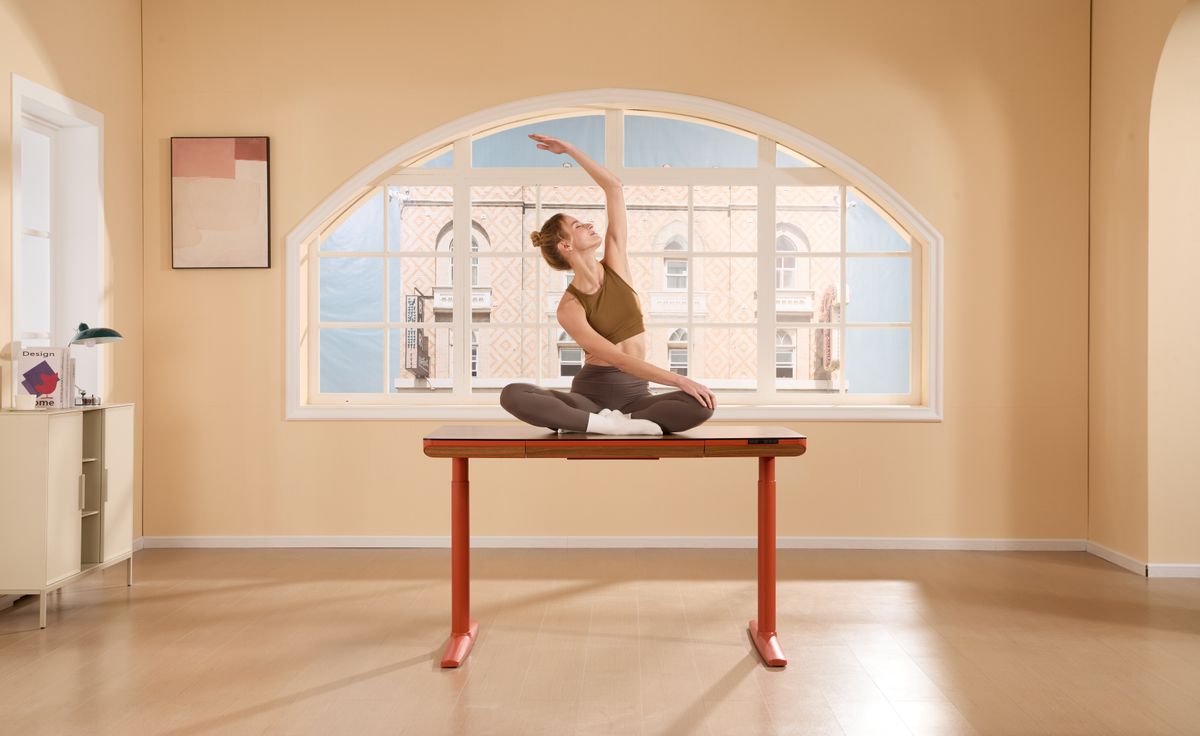
    Desk yoga should be simple enough that you can do it in normal clothes. Sit tall for a few breaths, then let the body relax again. Roll the shoulders backward. Turn the chest gently to one side and then the other. Stand up and reach the arms overhead if there is room.

    You can also place the hands on the desk, step back and let the spine lengthen while keeping the knees soft. This gives the upper back and shoulders a different position after typing. Nothing needs to be forced.

    • Neck: turn left and right slowly instead of making large circles.
    • Shoulders: lift, roll back and release.
    • Wrists: open and close the hands, then move the wrists gently.
    • Spine: alternate between a comfortable upright seat and a gentle seated twist.
    • Hips: stand and walk for a few minutes whenever work allows.

    A two-minute breathing reset

    When work becomes busy, use a very simple breathing break. Sit comfortably and let the shoulders drop. Breathe through the nose if that feels natural. Make the exhale unhurried without trying to hold the breath for a long time.

    This is not a performance test. Two calm minutes can be enough to separate one task from the next. If strong breathing techniques make you light-headed or uncomfortable, return to normal breathing.

    Lunch break: move before you sit again

    A short walk after eating may be easier to maintain than a full yoga sequence in the office. If you have space, add Tadasana, a gentle standing side stretch and a supported lunge. Keep the movements comfortable rather than trying to stretch deeply during a short work break.

    People who sit for many hours often focus only on the lower back. The hips, upper back, shoulders and ankles also benefit from changing position. Think about the whole body rather than searching for one “office posture” exercise.

    After work: 10–20 minutes of yoga

    After a long day, start with movement before longer holds. Try Cat-Cow, Low Lunge, a gentle hamstring fold, Sphinx or a mild Cobra, and a comfortable twist. Finish with a few minutes of quiet rest.

    If posture is your main concern, our 20–30 minute daily yoga routine for posture gives a longer sequence. It focuses on movement habits rather than forcing the body into one “perfect” shape.

    Can yoga improve office posture?

    Yoga can help you practise body awareness, movement, breathing and positions that feel easier to maintain. It does not make anyone sit perfectly for eight hours, and that should not be the goal. Even a good sitting position becomes tiring if you stay there too long.

    Use posture as a moving target. Sit differently, stand sometimes, walk when possible and adjust your screen or chair if the setup makes you constantly reach or twist. Yoga supports the habit of noticing these patterns.

    How often should office workers do yoga?

    For many people, two or three longer sessions each week plus short daily movement breaks is realistic. Others prefer ten minutes every day. Your schedule, recovery and other exercise matter more than copying someone else’s routine.

    Our guide on how many times a week to do yoga compares weekly practice for beginners, strength, flexibility and stress relief.

    What to avoid

    • Do not force deep stretches because you feel stiff after sitting.
    • Do not hold your breath to make a pose feel more advanced.
    • Do not use yoga to ignore persistent pain, numbness or weakness.
    • Do not expect one evening class to cancel a full week of no movement.
    • Do not turn every short break into another productivity challenge.

    Frequently asked questions

    Can I do yoga at my desk?

    Yes. Simple shoulder, wrist, neck and seated-spine movements can be done beside or at a desk. Keep the range comfortable and avoid anything that needs unsafe furniture support.

    Is 10 minutes of yoga after work enough?

    Ten minutes can be useful when it helps you practise consistently. A short routine can include spinal movement, hips, breathing and rest without needing a full class.

    Should I do yoga before work or after work?

    Either can work. Morning practice can help you start moving before sitting. Evening practice can help you change position after work. Many people do best with a short morning session and a slightly longer evening one.

    What if sitting causes pain?

    General yoga advice cannot diagnose pain. Persistent pain, numbness, weakness or symptoms that keep worsening should be assessed by a qualified health professional.

    A workday yoga routine should be easy to repeat

    The best yoga routine for a 9–5 job is not the most impressive one. It is the routine that fits around real work. Move for a few minutes, breathe without strain, change position often and keep a short after-work practice available for days when your body feels stiff.

    If you later want to study yoga in more depth, our 200-hour multi-style yoga teacher training in Rishikesh is a 21-day residential course. For everyday office practice, however, consistency matters more than advanced poses.