
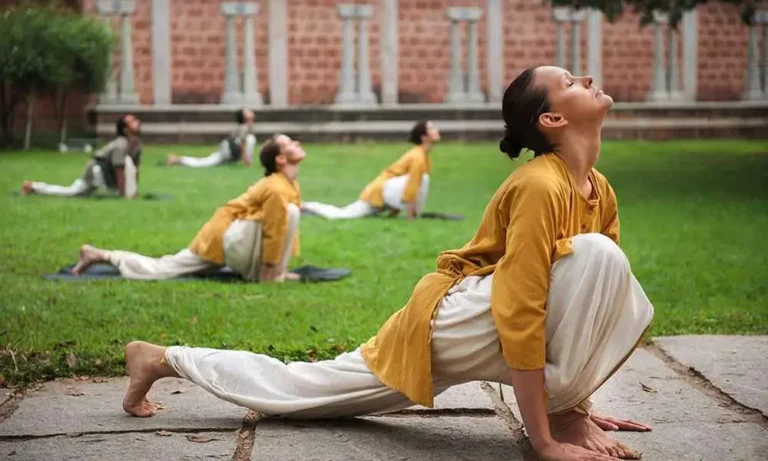
Traditional Hatha Yoga teacher training should be easy to explain in practical terms. A school should be able to show what students actually practise, how the subjects connect, who teaches them, and how teaching skills are assessed. The word ‘traditional’ is useful only when the course has a clear method behind it.
There is no single worldwide Hatha syllabus followed by every school. Different lineages organise the material differently. What matters is whether Hatha is taught as a complete practice rather than reduced to a slow asana class. A serious course should give clear time to asana, pranayama, meditation, philosophy, teaching practice, and the Hatha methods it claims to teach.
Table of contents
- Hatha is more than posture
- Asana as disciplined practice
- Pranayama and breath training
- Mudra and bandha
- Nadanusandhana and sound awareness
- Philosophy, ethics and lifestyle
- Traditional practice and modern anatomy
- How to test a school’s traditional claim
- How FitFortunes structures Hatha training
- Frequently asked questions
Hatha is more than posture
Modern yoga classes often use ‘Hatha’ to mean a slower physical class. Traditional Hatha practice is broader. Depending on the lineage, it can include asana, pranayama, cleansing methods, mudra, bandha, concentration, meditation, and methods that work with breath and attention.
A teacher-training course does not need to teach every historical Hatha technique. It should explain why its chosen practices are included and how they relate to one another. Students should not leave thinking Hatha simply means holding poses longer than Vinyasa.
Asana as a disciplined practice
Asana training should cover more than copying shapes. Students need time to understand setup, stability, breathing, common errors, sensible variation, observation, and how a posture changes across different bodies. Repetition is useful because it gives trainees time to notice details that disappear when the sequence changes constantly.
At FitFortunes, Hatha asana is taught with attention to movement understanding and practical observation. Lead teacher Pravesh Narwal is an E-RYT 500 and Ministry of AYUSH Level-3 Health & Wellness Teacher, with long professional experience in orthopedic rehabilitation support. The teaching emphasis is on seeing the student in front of you rather than forcing every body into one ideal shape.
Pranayama and breath training
Pranayama should be taught progressively. Students first need posture, breath awareness, and basic breathing control before moving toward more demanding techniques. A teacher should explain the purpose, preparation, limitations, and appropriate practice of each method rather than giving a list of breathing exercises to memorise.
Breath training also changes how students understand asana. A posture can look correct while the breath is tense or rushed. Hatha training should teach students to observe both the visible position and the quality of breathing.
Mudra and bandha
Mudra and bandha are often mentioned in course brochures but receive very little teaching time. A traditional program should at least explain their role, basic technique, preparation, and relationship with pranayama and concentration. These practices should not be treated as decorative advanced topics.
They also require responsible teaching. Strong bandha work and breath retention are not suitable as casual group exercises for every student. Teacher training should cover when to practise, when to reduce intensity, and when a technique should not be taught.
Nadanusandhana and sound awareness
Nadanusandhana is the practice of placing attention on sound. In Hatha traditions, sound can be used as a concentration method rather than as entertainment. A course may approach this through internal listening, mantra, simple sound awareness, or other lineage-based methods.
At FitFortunes, the traditional Hatha framework is organised around four practical pillars: Asana, Pranayama, Mudra & Bandha, and Nadanusandhana/Nada Yoga. These sit alongside philosophy, meditation, anatomy, teaching methodology, and supervised practice teaching. The structure gives the Hatha course a clear identity rather than turning it into a general multi-style program.
Philosophy, ethics and lifestyle
Traditional does not mean rejecting modern teaching standards. Philosophy should help students understand why yoga is practised, not only help them remember Sanskrit terms for an exam. Ethics should cover teacher-student relationships, boundaries, consent, professional conduct, and the limits of a yoga teacher’s role.
Classical texts can provide context for Hatha methods, but a teacher-training course also needs modern educational skills. Students must learn how to explain, observe, sequence, adapt, give feedback, and practise teaching under supervision. Tradition and professional responsibility can sit together when the school is clear about what comes from classical sources and what comes from modern teacher education.
Traditional Hatha practice and modern anatomy can work together
Modern anatomy does not make a Hatha course less traditional. It helps trainees understand joint movement, breathing mechanics, load, stability, variation, and professional scope. Classical texts were not written as modern anatomy manuals, so a responsible school should not pretend they answer every contemporary teaching question.
The practical aim is better teaching. Trainees should learn to see differences between bodies, offer reasonable options, respect pain reports, and know when a concern belongs with a qualified healthcare professional. The detailed Hatha Yoga anatomy and alignment guide explains this part of training in more depth.
How to test a school’s ‘traditional’ claim
Ask for the timetable. Ask which texts or teaching traditions influence the course. Ask how much time is given to pranayama, mudra, bandha, meditation, philosophy, anatomy, and practicum. Ask who teaches these subjects and what experience they have.
Then compare those answers with the course page. If ‘traditional Hatha’ appears in the headline but most practical classes are unrelated flow sessions, fitness classes, excursions, and wellness add-ons, the label may not describe the real training. A useful comparison is to read the school’s Hatha vs Multi-Style Yoga Teacher Training guide and see whether the course structure matches the name.
How FitFortunes structures Hatha teacher training
The current FitFortunes 200-hour Hatha Yoga Teacher Training in Rishikesh is a 21-day residential program. Hatha is the main practical identity. The four practical pillars are supported by philosophy, meditation, anatomy, teaching methodology, and supervised practicum.
Students comparing locations can first read where to learn Hatha Yoga in India. Those preparing to join can use the 30-day Hatha YTT preparation checklist. These supporting articles answer different questions so the main course page can stay focused on the actual training.
What Does a Good Hatha Yoga Teacher Training Include?
| Area | What students may study |
|---|---|
| Asana | Foundational postures, alignment and modifications |
| Pranayama | Basic breathing practices and safety |
| Mudra and Bandha | Traditional techniques with context |
| Philosophy | Yoga texts, ethics and lifestyle |
| Anatomy | Basic movement and injury awareness |
| Practicum | Teaching practice and feedback |
Related guides: YTT syllabus, traditional Hatha Yoga, and 200-hour Hatha YTT.
Frequently asked questions
Is traditional Hatha Yoga the same as slow yoga?
No. A slower asana pace may be part of Hatha practice, but traditional Hatha includes more than posture speed. Pranayama, mudra, bandha, concentration, meditation and other methods may also be included.
Does a Hatha teacher training need to teach every Hatha technique?
No. Different lineages choose different practices. The important point is that the course explains its framework clearly and gives enough time to the practices it claims to teach.
Are mudra and bandha necessary in Hatha Yoga training?
They are important topics in many Hatha traditions. Their depth depends on the course, but students should receive clear, responsible instruction rather than only seeing the terms in a brochure.
Can traditional Hatha training include modern anatomy?
Yes. Traditional practice and modern functional anatomy can support each other when both are taught accurately. Modern anatomy does not make a course less traditional.
How can I tell whether Hatha is really the main style?
Check the daily timetable and practical hours. Ask which asana style is taught most often, who teaches it, and how pranayama, mudra, bandha, philosophy and practicum fit around it.
Can a beginner join traditional Hatha teacher training?
Many foundation programs accept beginners who are ready for regular practice and study. Check the school’s entry requirements, daily workload, and teaching expectations before booking.