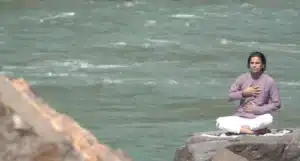
Chakras in yoga are part of a traditional map of the subtle body. They are used in particular yogic and Tantric practices to contemplate breath, awareness, mantra and spiritual development. They are not seven anatomical organs that a doctor can identify along the spine.
That distinction matters. Modern posters often make chakras look like a fixed scientific system with seven rainbow colours, each responsible for a separate emotion or gland. The historical traditions are more varied. A careful introduction should show what the symbols mean, where the familiar map comes from and how to approach practice without exaggerated health promises.
What does chakra mean in yoga?
Chakra is a Sanskrit word commonly translated as “wheel” or “disc.” In several Tantric and yogic systems, a chakra is a focus within the subtle body—a contemplative body described through symbolic channels, lotuses, sounds and centres of awareness. The idea belongs to a spiritual practice and its texts, rather than to modern medical anatomy.
When teachers talk about a root chakra or heart chakra, they usually mean a location and set of associations within such a practice. This is different from claiming that the spinal cord or endocrine system contains a hidden physical organ that science has overlooked.
Traditional explanations can be rich without turning them into medical claims. A lotus, a geometric symbol, a syllable or a visualised centre may give a practitioner something steady to work with during meditation. Its value has to be understood in that context.

Did classical yoga always teach exactly seven chakras?
No single chakra map belongs to every school of yoga. Indian Tantric traditions developed different systems, and the number, placement and symbolism of centres vary between texts and lineages. The seven-centre arrangement most people recognise today is one influential presentation—not the only historical one.
Scholarly study of Tantra pays attention to the textual and ritual settings of subtle-body systems. Readers interested in the historical background can explore the Oxford Centre for Hindu Studies’ introduction to Tantra and the academic discussions collected in The Oxford Handbook of Tantric Studies.
In some commonly taught systems, six centres are described along the central channel while Sahasrara, the thousand-petalled lotus at the crown, is treated somewhat differently. Modern teaching usually groups these into a convenient list of seven. That list can be useful for introduction, as long as it is not presented as the one universal ancient model.
What are the seven commonly named chakras?
In the best-known modern sequence, the centres are named from the base of the trunk towards the crown of the head. The locations below are traditional points of visualisation, not anatomical discoveries.
| Common name | Sanskrit name | Usual focus in introductory teaching |
|---|---|---|
| Root | Muladhara | Grounding and stability |
| Sacral | Svadhisthana | Feeling and fluidity |
| Solar plexus | Manipura | Will and transformation |
| Heart | Anahata | Compassion and connection |
| Throat | Vishuddha | Expression and discernment |
| Brow or third eye | Ajna | Attention and insight |
| Crown | Sahasrara | Spiritual transcendence |
These short associations are a contemporary teaching summary. The symbols and correspondences in specific Sanskrit sources can be much more detailed. For a more practical, centre-by-centre overview, see our separate article on the seven chakras and their traditional associations.
Do chakra colours come from one ancient text?
Many yoga studios use an easy-to-remember progression from red at the base to violet at the crown. It is visually clear, but the familiar rainbow chart is not a universal chart from all ancient texts. Traditional descriptions may include different colours for lotus petals, elements, deities, syllables or internal forms.
That does not make a modern colour chart useless. Teachers can use one as an introductory memory aid. The important thing is to say what it is: a teaching device that simplifies a far more varied history.
How are nadis and kundalini related to the chakra model?
In some subtle-body teachings, nadis are pathways through which life force (prana) is understood to move. The central channel is often called Sushumna; Ida and Pingala are also significant in many accounts. These are terms from a yogic framework and should not be described as equivalent to nerves or blood vessels.
Kundalini refers in various traditions to a latent spiritual power. Practices involving Kundalini may include mantra, breath, visualisation, ritual and disciplined instruction. Claims about guaranteed “awakening” or dramatic results after a single class should be treated with caution. Different schools approach the subject in different ways.

How can a yoga student work with chakra symbolism responsibly?
Begin by separating reflection from treatment. A student can use the heart centre as a focus for compassion or the brow centre as a reminder to bring attention to the present. That is a form of contemplative practice, not proof that a blocked chakra caused a physical condition.
Start with quiet observation
Find a comfortable seated position, with the back supported if needed. Notice breathing without forcing its pace. If a teacher uses a symbolic point of awareness, keep your attention gentle. There is no requirement to imagine something extraordinary happening.
Keep the practice proportionate
Five minutes of simple observation can be enough for a beginner. More intense breath retention, rapid breathing or practices designed around dramatic sensations are not necessary for learning the basic concepts. Students should be able to stop, rest and ask questions freely.
Learn the lineage and its language
If a class teaches chakra meditation, ask which tradition it draws from. Does the teacher distinguish historical material from a modern interpretation? Can they explain why a particular mantra or visualisation is used? Careful answers matter more than promises to “activate” all seven centres.
Use yoga poses for their direct, observable value
Yoga postures may develop strength, mobility, coordination and body awareness. You can practise them alongside a contemplative theme, but there is no reliable basis for saying a particular stretch mechanically opens a chakra or cures an illness.
Can a chakra become medically blocked?
There is no established medical test that detects a “blocked” chakra, and chakra balancing should not be presented as a treatment for depression, hormonal problems, digestive disease or another diagnosed condition. The spiritual vocabulary and the language of clinical medicine answer different kinds of questions.
Someone may feel calmer after yoga or meditation. That experience is meaningful, but it does not prove that an invisible centre has changed or that medical treatment is unnecessary. Persistent pain or symptoms deserve assessment from a qualified health professional.
What should yoga teachers avoid saying about chakras?
- Do not say every disease is caused by a blocked chakra.
- Do not describe the seven-colour map as the only ancient yoga teaching.
- Do not claim a pose repairs an organ by opening its related chakra.
- Do not make students feel spiritually inadequate if they do not experience energy sensations.
- Do distinguish a traditional belief, a teacher’s interpretation and evidence from health research.
Good yoga education can respect traditional knowledge while being precise about the limits of what it establishes.
Frequently asked questions
Are chakras real parts of the human body?
Chakras belong to traditional subtle-body models. They are not established anatomical organs like the heart, lungs or kidneys.
Why do teachers often mention seven chakras?
The seven-centre presentation is widespread in modern yoga education and is easy to remember, although historical sources describe other systems too.
Is chakra meditation the same as mindfulness?
Not exactly. Chakra practice can involve particular symbols, sounds and theological ideas. Modern mindfulness classes may use attention training without those elements.
Do chakra colours have to be memorised?
No. If you encounter a colour chart, use it as a learning aid and ask which tradition it represents.
Can beginners study chakras safely?
Beginners can study the ideas and practise ordinary comfortable attention exercises. More demanding methods should be approached with a knowledgeable teacher and without pressure to seek dramatic experiences.
Next reading: Our practical guide to the seven commonly taught chakras explores individual names and meanings. This article concentrates on how to interpret chakra ideas accurately.