

Day: October 3, 2026

  • Where to Learn Hatha Yoga in India: Rishikesh, Goa or Mysore?

    Where to Learn Hatha Yoga in India: Rishikesh, Goa or Mysore?

    If you want to learn Hatha Yoga in India, choose the school before you choose the city. Rishikesh, Goa, Mysore and quieter Himalayan settings can all support serious study, but they do not offer the same daily experience. The useful question is not which destination looks most impressive online. It is which place gives you the teachers, course structure, practice style and routine that fit your reason for training.

    For teacher training, the word “Hatha” in a title is not enough. Read the timetable and ask what is taught every day. A serious program should explain its approach to asana, pranayama, meditation, philosophy, anatomy, teaching methodology and practicum. If it also uses terms such as mudra, bandha or nada, those subjects should have a clear place in the course rather than appearing only in a long marketing list.

    Table of contents

    Quick comparison: Rishikesh, Goa, Mysore and Himalayan settings

    Each location has strengths and trade-offs. Rishikesh offers a large yoga community and many residential schools. Goa gives students a coastal setting and often mixes Hatha with modern flow styles. Mysore has a strong modern asana culture, while smaller Himalayan or rural centres can offer fewer distractions but may have simpler facilities and more travel planning.

    LocationCommon reason students choose itWhat to check carefully
    RishikeshResidential yoga study, pranayama, philosophy and a strong yoga-school ecosystemWhether Hatha is truly the main practical method and how much practicum is included
    GoaCoastal setting and programs that may combine Hatha with Vinyasa or other stylesSeason, exact style mix, daily schedule and whether the course is more retreat-like or teacher-training focused
    MysoreEstablished modern asana culture and disciplined practice environmentsWhether the program you are considering is actually Hatha-focused rather than mainly Ashtanga Vinyasa
    Himalayan or rural campusQuiet study, smaller communities and fewer outside distractionsTransport, medical access, internet, weather, room comfort and teacher credentials

    Rishikesh for traditional residential Hatha study

    Rishikesh is one of India’s best-known centres for residential yoga study. Students can find Hatha Yoga, pranayama, meditation, philosophy and teacher training in the same area, often within walking distance of the Ganga. The daily rhythm can suit people who want yoga to shape the whole study day rather than sit beside a normal holiday schedule. Early mornings, simple meals, theory classes and regular practice are common parts of residential training.

    The large number of schools is both an advantage and a risk. You have more choice, but the word “Hatha” can mean different things from one school to another. Ask whether the main asana class is Hatha, whether the course also teaches other styles, and how much time is given to teaching practice. A famous location should never replace checking the teacher, curriculum and timetable.

    If your goal is a focused Hatha teacher training, start with the school’s actual course page. FitFortunes keeps a separate 200-hour Hatha Yoga Teacher Training in Rishikesh as the commercial owner for that program. This article has a different job: it helps you compare locations before you decide where to study.

    Goa for a coastal training environment

    Goa appeals to students who want teacher training near the coast. Many programs there combine Hatha with Vinyasa, Yin, Ashtanga Vinyasa or other modern class formats. That can work well when you want variety and the school explains how the methods fit together. It is less useful when a program lists many styles but gives only a small amount of time to each one.

    Season also matters. Some coastal schools are strongly seasonal, and heat, humidity or monsoon conditions can change the day-to-day experience. Check whether the yoga hall is comfortable, what accommodation is included and whether the timetable leaves enough recovery time between practical classes. If you are unsure whether a mixed program suits you, read the comparison of Hatha vs Multi-Style Yoga Teacher Training before you book.

    Aerial view of the Goa coastline in India
    Goa offers a very different study setting from inland or Himalayan yoga centres. Photo by Kiran Patel on Pexels; used under the Pexels free-use licence.

    Mysore for a strong asana culture

    Mysore has an established international reputation for modern Ashtanga Vinyasa practice. Hatha courses are also available, but students should read the syllabus carefully instead of assuming every yoga program in the city has the same focus. A school may use Hatha as one part of a broader physical curriculum. If your main reason for travelling is classical Hatha study, make sure the timetable gives it enough time.

    Mysore can suit students who enjoy disciplined practice and want to live in a city with a strong yoga culture. It may be especially attractive to people who already know they want a physically structured daily routine. The key is intent. Choose Mysore because the specific teacher and course fit you, not because the city name alone sounds authoritative.

    Mysore Palace in Mysuru, Karnataka, India
    Mysuru has a long-established international yoga culture, but students should still verify the exact style and syllabus of any Hatha course. Photo by Sumit Kumar on Pexels; used under the Pexels free-use licence.

    Himalayan and rural training settings

    Smaller mountain or rural campuses can give students more quiet and fewer distractions. This can help when the course includes early practice, study, meditation and self-study. Small communities may also make it easier to know the teachers and other students. The trade-off is that remote schools can require more planning than a school inside a major yoga town.

    Check transport before arrival, especially during monsoon or winter. Ask about internet access, room heating or cooling, drinking water, nearby medical care and how students reach the property. A peaceful setting is useful only when basic arrangements are clear. Do not treat remoteness as proof that a school is more traditional or more authentic.

    What should a serious Hatha curriculum contain?

    Classical Hatha sources make one point very clear: Hatha is broader than a slow posture class. The Hatha Yoga Pradipika, attributed to Svātmārāma, is organised across four chapters that move through asana, pranayama and purification, mudra and bandha, and later meditation, samadhi and nada. The Gheranda Samhita is another important Hatha text and presents its own multi-part system of cleansing, posture, mudra, breath, meditation and related practices. Modern schools do not all follow one fixed historical syllabus, but they should be able to explain what they mean when they use the word “traditional.”

    For a teacher-training student, the practical curriculum also needs modern educational areas. Anatomy, movement observation, teaching methodology, ethics, sequencing, supervised practicum and assessment matter because the student is learning to teach other people. A course can respect classical Hatha sources while also using current anatomy and clear professional boundaries. Our detailed Yoga Teacher Training Curriculum guide explains how those areas can fit together.

    • Hatha asana with clear purpose, progression and appropriate variations.
    • Pranayama taught progressively rather than as a list of advanced techniques.
    • Meditation and concentration practice with enough context to understand why they are used.
    • Mudra and bandha where they belong to the course tradition and are taught responsibly.
    • Yoga philosophy and named source texts rather than vague claims about “ancient wisdom.”
    • Functional anatomy, movement observation and basic safety.
    • Teaching methodology, sequencing, practicum and specific feedback.
    • Clear assessment and completion requirements.

    How to compare Hatha schools before you book

    Start with facts that are difficult to fake. Read the timetable. Check the names and qualifications of the teachers who actually teach the course. Look at how much supervised practice teaching is included and how students are assessed. Then compare room type, meals, class size, attendance rules, deposit terms and the total residential cost.

    A five-minute check before you shortlist a school

    1. Open the timetable and identify the main daily asana style.
    2. Open the teacher pages and check who teaches the core subjects.
    3. Find the practicum and assessment details, not only the curriculum list.
    4. Check the full residential cost, room type, meals and cancellation terms.
    5. Save only the schools that answer all four points clearly, then compare location and travel convenience.

    Next, check whether the school’s language matches the real program. If the page says “traditional Hatha” but most practical classes are Vinyasa, fitness sessions or unrelated wellness activities, ask for clarification. If the school claims international recognition, find out what organisation it means and what that recognition actually allows a graduate to apply for. The wider guide on how to choose a yoga teacher training in India gives a full comparison checklist.

    Seven questions worth sending a school before payment

    1. Which practical yoga style is taught every day?
    2. Who teaches Hatha asana, pranayama, anatomy, philosophy and methodology?
    3. How many students are normally in one batch?
    4. How much supervised practice teaching is included?
    5. What assessment must I complete?
    6. Exactly what is included in the residential fee?
    7. What credential can I apply for after successful completion?

    How FitFortunes approaches Hatha training in Rishikesh

    FitFortunes separates its Hatha training from its Multi-Style program so students can understand the difference before booking. The current Hatha course is a 21-day residential 200-hour program in Rishikesh, with regular arrivals on the 2nd of each month. Hatha is the main practical identity rather than one style hidden inside a long list. Current dates, accommodation and other booking details should always be checked on the live course page before travel.

    Lead teacher Pravesh Narwal is an E-RYT 500 and Ministry of AYUSH Level-3 Health & Wellness Teacher. His long background in orthopedic rehabilitation support also shapes the school’s emphasis on alignment, movement observation and sensible variation. FitFortunes describes its traditional Hatha framework through four practical areas: Asana, Pranayama, Mudra & Bandha, and Nadanusandhana/Nada Yoga, supported by philosophy, anatomy, teaching methodology and supervised teaching practice. Students comparing all current programs can also use the FitFortunes Yoga Courses hub.

    Book and standards references used in this guide

    The historical Hatha references behind this article are the Hatha Yoga Pradipika of Svātmārāma and the Gheranda Samhita. They are useful for understanding why Hatha cannot be reduced to posture alone, but they are not identical manuals and modern teacher-training schools interpret their material differently. For modern professional training, Yoga Alliance publishes its current Registered Yoga School standards separately. Students who care about RYS or RYT pathways should verify the current rules directly on the official Yoga Alliance standards page.

    Frequently asked questions

    Where is the best place to learn Hatha Yoga in India?

    There is no single best place for everyone. Rishikesh suits many students who want residential Hatha study with pranayama, philosophy and a large yoga community. Goa can suit students who like a coastal setting and are comfortable with Hatha mixed with other styles. Mysore has a strong modern asana culture, while quieter Himalayan campuses can suit people who want fewer distractions.

    Is Rishikesh good for Hatha Yoga teacher training?

    Yes, Rishikesh has many residential yoga schools and a long association with yoga study. Quality still varies widely. Check the exact practical style, teachers, practicum, class size, room arrangements and assessment before choosing a school.

    Can a beginner learn Hatha Yoga in India?

    Many programs accept beginners, but beginner-friendly does not mean effortless. Regular basic practice, willingness to study, early mornings and a realistic attitude toward feedback make residential training easier. Always check the school’s stated prerequisites before booking.

    Is traditional Hatha Yoga the same as a slow yoga class?

    No. A slower asana pace may be used, but historical Hatha traditions include much more than posture speed. Pranayama, mudra, bandha, purification, concentration, meditation and nada can all appear in Hatha sources and lineages.

    Does Yoga Alliance decide which Hatha style a school must teach?

    No single Hatha asana style is imposed on every registered school. Yoga Alliance uses educational standards for Registered Yoga Schools, while schools still teach according to their approved tradition and program structure. Students should therefore compare the actual curriculum as well as registration status.

    The practical way to choose

    Choose the training environment that helps you study well, but let the teacher and curriculum make the final decision. A beach, famous yoga town or remote mountain campus cannot compensate for weak instruction or almost no practicum. Compare the real timetable, teaching team, learning outcomes and residential details before you pay. Once those facts are clear, the location becomes a useful part of the decision instead of the whole decision.
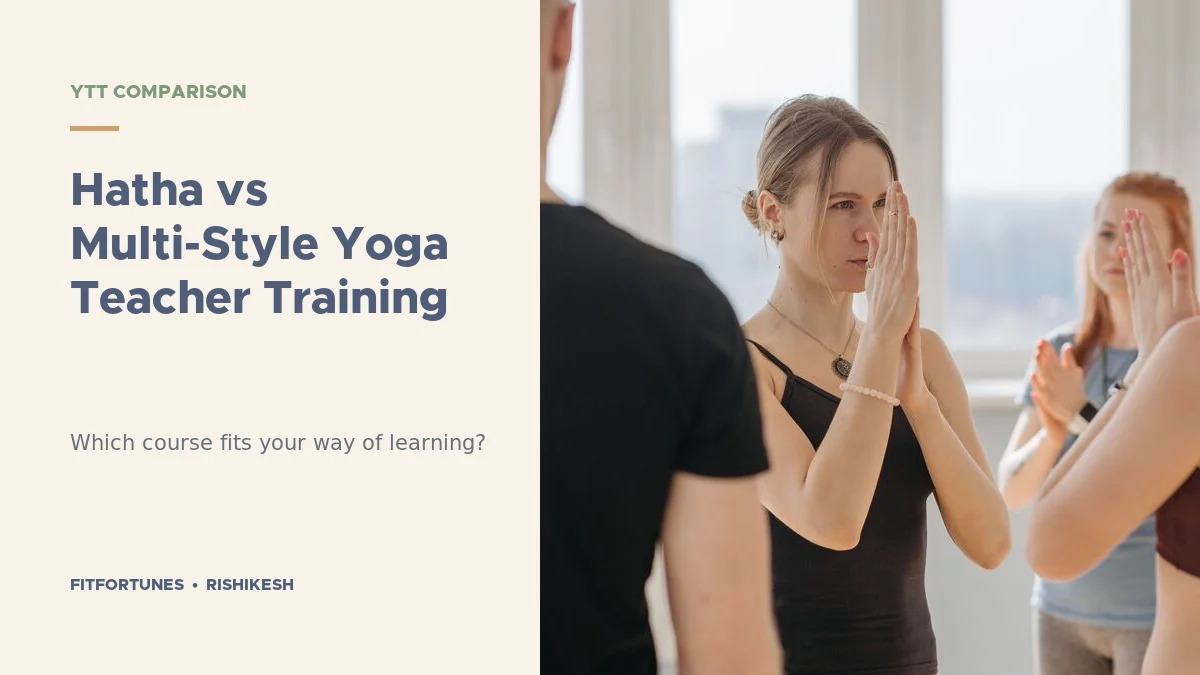

  • Hatha vs Multi-Style Yoga Teacher Training in India: Which Course Fits You?

    Hatha vs Multi-Style Yoga Teacher Training in India: Which Course Fits You?

    Hatha and Multi-Style yoga teacher training are different learning paths. A Hatha-focused training gives more time to one main practice framework. A Multi-Style course combines more than one approach so students can compare pacing, sequencing, alignment, and class structure. Neither option is automatically better. The right course depends on how you want to practise, what you want to teach, and how much variety you want during training.

    For students comparing yoga teacher training in India, the course title alone is not enough. Two schools may both use the words “Hatha” or “Multi-Style” while teaching very different schedules. The useful comparison is the real curriculum, daily practice, teacher experience, practice-teaching hours, assessment, and how clearly the school explains what is included. This guide compares the two paths without treating one as a winner.

    Table of contents

    Hatha vs Multi-Style Yoga Teacher Training: quick comparison

    PointHatha-focused YTTMulti-Style YTT
    Main purposeStudy one main practice framework in greater depthLearn more than one approach and understand how they differ
    Asana emphasisClassical Hatha practice, steadier pace, posture study and alignmentDepends on the school; at FitFortunes the practical focus is Hatha Yoga and Vinyasa Krama
    SequencingUsually built around Hatha principles and progressionStudents compare different sequencing methods and pacing
    Best suited toStudents who want a clear traditional base and less style-switchingStudents who want a broader teaching vocabulary and more than one practical method
    Teaching preparationShould still include methodology, practicum, anatomy and professional topicsShould still include the same core teacher-training areas, not only extra asana styles

    The most important point is that “Multi-Style” is not a universal syllabus. One school may combine Hatha and Vinyasa. Another may add several unrelated styles and spend very little time on each. Ask the school to name the exact practical styles and show how many hours are given to each. A clear answer is more useful than a long list of yoga names on a sales page.

    What Hatha yoga teacher training usually focuses on

    A Hatha-focused teacher training normally gives more attention to steady asana practice, alignment, breathing, classical techniques, and the relationship between posture and breath. The pace is often slower than a continuous flow class, but slower does not mean easy. Holding a posture, refining position, and learning how to teach it clearly can be demanding. Students usually repeat key movements often enough to notice details that are easy to miss when the sequence changes every day.

    A strong Hatha course should also go beyond physical postures. Pranayama, meditation, mudra, bandha, philosophy, anatomy, teaching skills, observation, and practice teaching may all be part of the program. The exact balance depends on the school and its teaching tradition. If a course uses “traditional Hatha” in its title, ask what that means in its real timetable rather than assuming the phrase has one fixed definition.

    Small group practicing yoga together in a bright indoor studio
    A small-group yoga practice illustrating the steady, attentive class setting discussed in Hatha-focused training. Photo by Pavel Danilyuk on Pexels; used under the Pexels free-use license.

    What Multi-Style yoga teacher training usually means

    Multi-Style training is useful when the styles are chosen for a clear reason. The aim should not be to collect as many yoga labels as possible. A well-planned program uses each method to teach something distinct, such as pacing, sequencing, transitions, alignment, class structure, or adaptation. Students should finish knowing why a method is used and when it may or may not suit a class.

    At FitFortunes, the current 200-hour Multi-Style Yoga Teacher Training in Rishikesh uses Hatha Yoga and Vinyasa Krama as its practical style focus. Vinyasa Krama is taught as progressive sequencing rather than as a race through poses. Hatha provides the steadier base. This keeps the combination limited enough for students to understand the differences instead of moving through many styles superficially.

    Yoga teacher guiding a student with alignment during an indoor practice
    Teacher guidance during a yoga practice, used here to show why alignment, observation and feedback matter in both Hatha and Multi-Style training. Photo by Yan Krukau on Pexels; used under the Pexels free-use license.

    Who may prefer a Hatha-focused teacher training?

    Hatha training may suit you if you want to spend more time with one main practice method and build confidence through repetition. It can be a good fit for students who value alignment, breath awareness, classical techniques, and a steadier learning pace. It may also suit people who do not want their first teacher training divided between several asana systems. The benefit comes from depth, not from the word “Hatha” itself.

    • You prefer a steadier practice pace.
    • You want more repetition before teaching a posture or sequence.
    • You want one main asana framework rather than several.
    • You are interested in pranayama, meditation and traditional Hatha practices alongside asana.
    • You want a clear base before adding faster or more varied sequencing later.

    Who may prefer a Multi-Style teacher training?

    Multi-Style training may suit students who want to understand how more than one method changes the way a class is built. It can be useful when you enjoy both steady posture work and progressive movement. The value is strongest when the program connects the styles instead of teaching them as separate random classes. Students should be able to explain how pacing, transitions, breath, and sequencing change from one approach to another.

    • You enjoy both Hatha practice and structured movement sequences.
    • You want to compare different ways of building a class.
    • You want a broader base before deciding what you prefer to teach most.
    • You are comfortable learning two practical systems during the same course.
    • You want sequencing practice to be a visible part of the training.

    What a good 200-hour curriculum should still include

    The style name should not replace the teacher-training curriculum. Yoga Alliance’s RYS 200 standards organise the core curriculum into four broad educational areas: Techniques, Training and Practice; Anatomy and Physiology; Yoga Humanities; and Professional Essentials. The standards allow schools flexibility to teach according to their tradition while keeping a common educational framework. You can read the current Yoga Alliance RYS standards directly.

    In practical terms, a 200-hour course should not be judged only by how many asana styles appear in the brochure. Look for anatomy, safety, teaching methodology, ethics, philosophy, sequencing, observation, practicum, feedback, and enough guided practice to use the material responsibly. A course with two well-taught practical styles can be more useful than a course listing six styles with very little time for each. The schedule should show how the hours support actual learning.

    How to compare yoga schools without getting distracted by style labels

    Start with the timetable and curriculum, not the headline. Check how many hours are spent on asana, pranayama, meditation, anatomy, philosophy, methodology, practicum, and assessment. Then look at who actually teaches those subjects. A detailed teacher bio is more useful than a page full of broad claims about “master teachers” or “ancient wisdom.”

    Next, check the practical details that affect the whole residential experience. Confirm course length, arrival date, room type, meals, class days, attendance rules, exam or teaching-demo requirements, and what is not included. Read the cancellation and deposit terms before paying. If the school cannot answer simple factual questions clearly before booking, a polished website should not be enough to make the decision.

    Questions worth asking before you book

    • Which yoga styles are actually taught in daily practical classes?
    • How many practice-teaching hours are included?
    • Who teaches anatomy, philosophy and teaching methodology?
    • What assessment must students complete?
    • Are accommodation and meals included in the listed price?
    • What happens if I miss classes because of illness?
    • What does the certificate allow me to apply for after completion?

    How the two FitFortunes 200-hour options differ

    FitFortunes currently offers separate 200-hour Hatha and Multi-Style training paths in Rishikesh. Both are residential teacher-training options, but the practical emphasis is different. The 200-hour Hatha Yoga Teacher Training keeps Traditional Hatha Yoga as the main style. The 200-hour Multi-Style course combines Hatha Yoga with Vinyasa Krama.

    The current 200-hour Multi-Style course runs for 21 days, with regular arrivals on the 2nd of each month. The residential fee is USD 1,199 for a shared room or USD 1,499 for a private room, including accommodation and vegetarian meals. Students who complete the applicable registered training requirements can use their school certificate when applying for the relevant Yoga Alliance registration; Yoga Alliance registration itself is a separate process and should not be described as a teaching licence.

    If you are not ready for a complete 200-hour program, the 100-hour Multi-Style foundation course is a shorter preparation option. It is designed for fundamentals and training preparation rather than as a promise that a student can teach after ten days. Choosing the shorter course can make sense when your first goal is personal study or testing whether residential training suits you.

    A simple decision checklist

    Choose based on the way you want to learn, not on which label sounds more advanced. If you want repetition, a steadier method, and one main practical framework, Hatha-focused training may fit better. If you want to compare steady Hatha practice with progressive sequencing and learn how class pace can change, a limited Multi-Style program may fit better. In both cases, the quality of teaching and practicum matters more than the number of styles printed on the certificate.

    Use this five-step check before paying a deposit

    1. Write down whether your priority is depth in one method or experience with two compatible methods.
    2. Open the real timetable and count the hours for practical classes, methodology, anatomy, philosophy and practicum.
    3. Read the lead teachers’ qualifications and check who teaches each major subject.
    4. Compare the total residential cost, room type, meals, attendance rules and assessment requirements.
    5. Only then choose the course whose daily training structure matches the way you actually want to learn.

    For a broader comparison of current programs, see the FitFortunes yoga teacher training course hub. If you are still comparing schools rather than course styles, the guide on how to choose a yoga teacher training in India covers teacher credentials, curriculum, accommodation, costs, and warning signs in more detail.

    Frequently asked questions

    Is Hatha yoga teacher training easier than Multi-Style training?

    Not necessarily. Hatha may move at a steadier pace, but detailed alignment work, longer holds, pranayama, philosophy, and repeated teaching practice can still be demanding. Multi-Style training adds the challenge of understanding more than one sequencing method. Difficulty depends more on the timetable, teaching hours, physical load, assignments, and assessment than on the course label.

    Can a beginner choose either Hatha or Multi-Style YTT?

    Yes, some 200-hour programs accept beginners, but “beginner-friendly” should not mean no preparation is needed. A student should be ready for regular practice, study, early mornings, feedback, and teaching exercises. Ask the school what baseline practice it expects and whether injuries or mobility limits can be accommodated safely.

    Is Multi-Style yoga teacher training less traditional?

    Not by definition. A Multi-Style course can still include yoga philosophy, pranayama, meditation, ethics, and traditional Hatha practices. The important question is whether the styles are taught with a clear framework or simply added as marketing labels. Read the real curriculum and daily schedule before deciding.

    Does Yoga Alliance require a specific yoga style in a 200-hour course?

    Yoga Alliance structures RYS 200 education around core educational categories rather than requiring every school to teach the same named asana style. Schools have room to honour their own lineage or teaching approach while meeting the applicable standards. That is why two registered 200-hour programs can have different practical emphasis.

    Which course is better if I want to teach after graduation?

    Choose the course that gives you stronger practice teaching, feedback, sequencing skill, safety knowledge, and a method you understand well enough to teach within your competence. A larger number of styles does not automatically make someone more employable. Employers and countries can also have their own requirements beyond one 200-hour certificate.

    How can I tell if a Multi-Style course is trying to teach too much?

    Look at the timetable. If many styles are advertised but the school cannot show meaningful hours for each one, the list may be mainly promotional. A focused combination of two compatible methods is easier to study properly than several styles squeezed into short sessions. Also check whether methodology and practicum have enough time after the asana classes are counted.

    The practical answer

    Hatha training is usually the clearer choice when you want depth in one main physical practice. Multi-Style training is useful when you want to understand more than one way of sequencing and teaching, provided the course keeps the combination focused. Before paying a deposit, compare the real timetable, teachers, practicum, assessment, accommodation, meals, and course policies. The style name should help you understand the training, not replace the details. If you are also deciding between Indian locations, compare where to learn Hatha Yoga in India before choosing the city first.